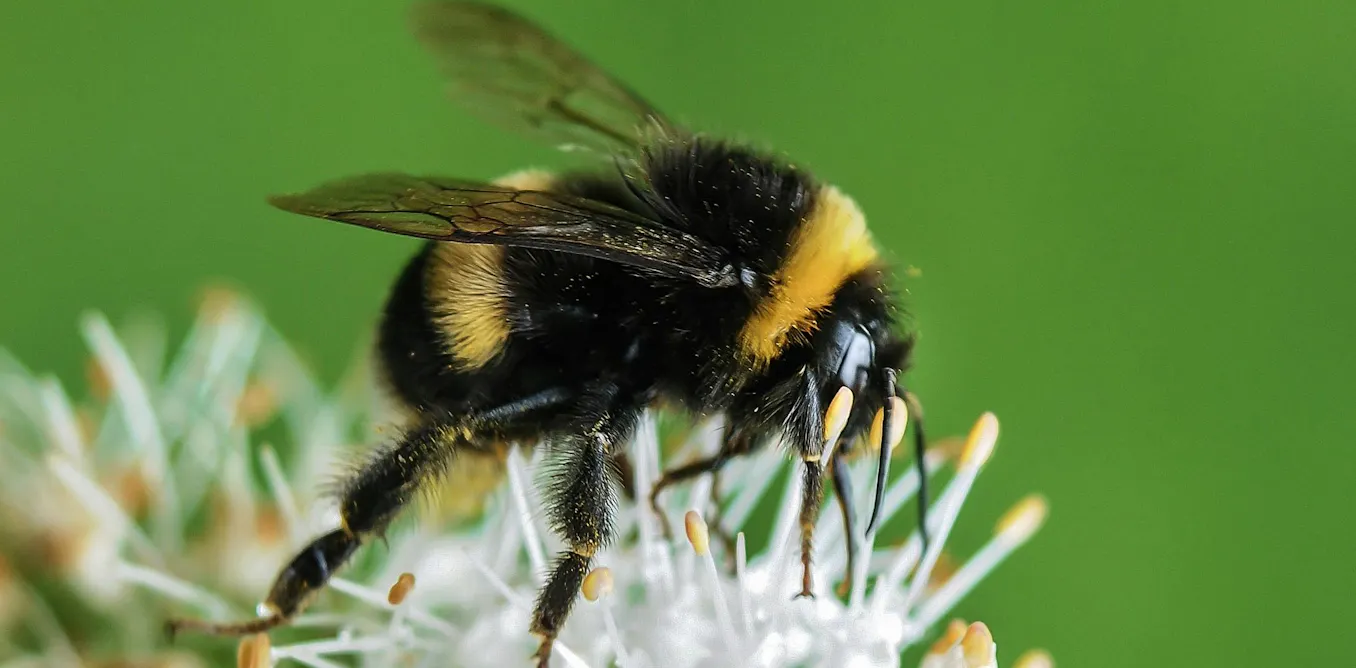
In a surprising discovery that challenges long-held assumptions about animal cognition, researchers have found that bumblebees can learn and recognize abstract rhythms, even with brains the size of a sesame seed. The study, published today in the journal Science, reveals that these pollinators are capable of distinguishing rhythmic patterns in flashing lights and vibrations, adapting to changes in tempo and sensory modality. This finding, led by a team from Southern Medical University in China and Macquarie University in Australia, suggests that the ability to perceive rhythm may not require the complex neural architecture previously thought necessary.
Humans have long been celebrated for their rhythmic prowess, from ancient drumming rituals to modern symphonies. We can identify a melody by its beat alone, whether accelerated or decelerated. "Humans are creatures of rhythms," the researchers noted in their article on The Conversation. "As far as we know, humans have always sung and always danced. We can recognise a song by its rhythm alone, regardless of whether it is played fast or slow." Yet, until now, this skill was believed to be exclusive to species with large brains, like certain birds and mammals.
The natural world, however, is replete with rhythmic phenomena. Birds chirp in patterned songs, frogs croak in syncopated calls, and bats emit ultrasonic pulses during hunts. Visual displays abound too: fireflies synchronize their flashes, peacocks shake their tails rhythmically, honeybees perform waggle dances to communicate food sources, and fruit flies engage in courtship dances. Traditionally, scientists viewed these as innate behaviors, hardwired by evolution rather than learned skills. "But, up to now, we have assumed these were innate rhythmic patterns: the animals are not learning a rhythm; they are simply rolling out an evolved behavioural program," the study authors explained.
Prior research had demonstrated rhythm learning in only a handful of species beyond humans, primarily songbirds like zebra finches and mammals such as elephants and primates. These animals possess relatively large brains, reinforcing the idea that cognitive complexity was a prerequisite. Bumblebees, with their minuscule neural structures—about one million neurons compared to the human brain's 86 billion—seemed unlikely candidates. Yet, as the researchers point out, most animals thrive with tiny brains. "Big-brained animals are the exception in the animal kingdom. Most animals have evolved tiny brains (by our standards) and they can still solve all the problems they need to solve to survive and thrive."
To test whether bumblebees could indeed grasp rhythms, the international team designed ingenious experiments using the insects' natural foraging instincts. Bumblebees, known for their social colonies and eagerness to collect nectar, proved ideal subjects. The researchers worked with individually labeled bees from colonies maintained in controlled lab settings at Macquarie University, though specific dates for the experiments were not disclosed in the publication.
In the first phase, bees were trained on artificial flowers equipped with controllable LED lights. One rhythmic flashing pattern—such as a repeating dot-dash-dot-dash—signaled a sugary reward, while another, like dot-dot-dash-dash, offered none. After an afternoon of training, the bees reliably preferred the rewarded rhythm. When tested on neutral flowers without sugar, "bees preferred to visit the flower flashing the rhythm that had been rewarded with sugar in training," the authors reported. This demonstrated that the bees had learned to associate the abstract rhythm with a positive outcome.
Crucially, the bees generalized their learning across tempos. Without additional training, they recognized the rewarded rhythm even when it was sped up or slowed down. "This shows bees had learned a rhythm regardless of tempo – the first evidence that bees had learned a flexible rhythm," according to the study. This flexibility mirrors human abilities, where rhythm perception transcends speed variations, as in recognizing a song's beat whether played as a waltz or a march.
To probe deeper, the team explored whether bumblebees could transfer rhythmic understanding between senses. Bees cannot hear audible sounds but are highly sensitive to vibrations, which they detect through their bodies. In a maze setup, the floor at a junction pulsed with specific rhythms: one pattern, say dot-dot-dash-dash, indicated sugar in the left arm, while dot-dash-dot-dash pointed to the right. After training, bees navigated the maze successfully, with performance improving over sessions.
Then, in a transfer test, the researchers removed the vibrating floor and installed a flashing LED at the junction. Remarkably, the vibration-trained bees used the light pulses to choose the correct path. "The bees trained with vibration were able to use the rhythmic pulses of light to work out which arm of the maze to pick to find the sugar," the authors stated. "This showed bees could recognise a rhythm regardless of how it was played out. In other words, the bees had a sense of abstract rhythm." Such cross-modal recognition had only been documented in humans before this experiment.
The implications of these findings ripple through biology and neuroscience. Rhythm perception in humans and other mammals involves intricate networks across the brain's auditory, motor, and prefrontal regions. Yet bumblebees achieve similar feats with far less neural real estate. "That the bumblebees did so well in these tests of rhythm learning changes how we think about what is needed to perceive and learn rhythm," the researchers wrote. They speculate that the inherent rhythms in neural firing—synchronous and asynchronous impulses—might underpin this sensitivity, allowing even small brains to detect temporal patterns in the environment.
This discovery builds on prior bee research, such as studies showing bumblebees can learn color associations, solve puzzles, and even teach each other skills. For instance, a 2016 Macquarie University study demonstrated bumblebees rolling balls to access food, hinting at problem-solving beyond instinct. The current work extends this, suggesting rhythm as another layer of cognitive sophistication in insects.
Broader applications could emerge in technology and medicine. By mimicking how tiny brains process rhythms, engineers might develop compact sensors for detecting patterns in speech, music, or physiological signals. "If we can capture that insight, and give miniature sensors a capacity to detect rhythmic temporal structure, there could be all sorts of applications: from lightweight solutions to speech and music recognition to diagnosis of heart irregularities, or pre-epileptic brain waves," the authors proposed. Such innovations could lead to more efficient AI systems or portable health monitors.
While the study focused on bumblebees from lab colonies, likely sourced from local Australian or Chinese apiaries, the researchers emphasized the bees' motivation: their drive to gather nectar for their nests. No adverse effects on the insects were reported, aligning with ethical standards in animal behavioral research. The publication in Science, a premier journal, underwent rigorous peer review, lending credibility to the results.
Experts not involved in the study have praised the work's ingenuity. Dr. Lars Chittka, a bee cognition specialist at Queen Mary University of London, who was not a co-author, described it in a separate commentary as "a game-changer for understanding minimal cognition." He noted that it blurs the line between instinct and learning in invertebrates. However, some biologists caution that while impressive, the bees' rhythm sense might still stem from simpler mechanisms than in vertebrates.
Looking ahead, the team plans to investigate whether other insects share this trait and how it aids survival—perhaps in synchronizing foraging or evading predators. As climate change threatens pollinators like bumblebees, understanding their cognitive abilities could inform conservation efforts. For now, this sesame-seed-sized breakthrough reminds us that intelligence manifests in unexpected ways across the animal kingdom, reshaping our view of the rhythmic world we all inhabit.