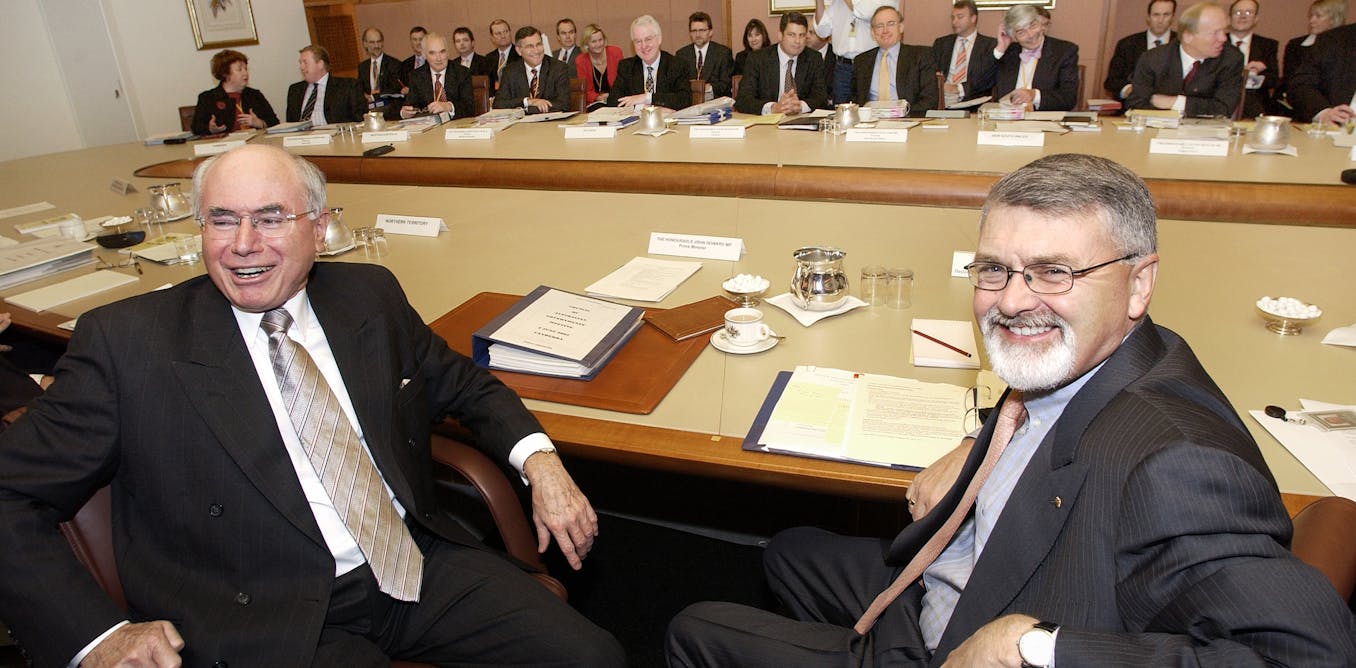
APPLETON, Wis. — The National Archives of Australia has unveiled a trove of 2005 cabinet documents, shedding new light on the Howard government's pivotal decisions during a year marked by bold industrial reforms, deepening military commitments abroad, and early warnings on climate change. Released this week, the papers reveal how Prime Minister John Howard's administration, fresh from securing a Senate majority in July 2005, pushed forward with sweeping changes that would ultimately contribute to its electoral downfall two years later.
The most contentious initiative detailed in the records is WorkChoices, the industrial relations overhaul approved by cabinet in March 2005. According to the documents, the reforms aimed to foster a "more direct relationship between employers and employees" by unifying state and federal systems into a single national framework. Set to take effect on March 27, 2006, the legislation eliminated unfair dismissal protections for smaller companies, scrapped the "no disadvantage test" that ensured workers weren't worse off under new agreements, and introduced a limited safety net of five bargainable conditions. It also curtailed union influence by restricting strikes and allowing individual bargaining over collective representation.
The Australian Council of Trade Unions (ACTU) mounted a fierce opposition through its "Your Rights at Work" campaign, which the archives describe as playing a "significant role" in Howard's 2007 defeat. The papers underscore how the government's Senate control, achieved after the October 2004 election, freed it from crossbench negotiations, emboldening these reforms. Historians note that WorkChoices not only cost Howard his seat in Bennelong but haunted Liberal politicians for years, with one analysis calling it a factor that "brought Howard unstuck."
Beyond domestic battles, the 2005 records highlight Australia's evolving role in regional security. In the wake of the devastating December 2004 Indian Ocean tsunami, which claimed 290,000 lives and displaced over a million people, Howard attended a Special Leaders’ Meeting of the Association of Southeast Asian Nations (ASEAN) on January 6, 2005. There, he pledged that Australia would "do its bit" toward establishing a regional tsunami warning system. Cabinet followed up in February with a $1 billion commitment for relief and rehabilitation, primarily focused on Sumatra in Indonesia—a move seen as an opportunity to mend ties strained by East Timor's 2002 independence.
By June 2005, Foreign Minister Alexander Downer recommended further cooperation with Indonesia on defense, counter-terrorism, and people-smuggling, which cabinet endorsed. The documents portray this as part of a broader strategy to strengthen ties in Southeast Asia, amid ongoing monitoring of commitments in the Solomon Islands, efforts to enhance governance in Papua New Guinea, and instability in Fiji.
Afghanistan emerged as a cornerstone of Australia's international engagements that year. After withdrawing Special Air Service (SAS) forces in 2002 following initial deployments in 2001-02, the government faced renewed U.S. requests amid a Taliban resurgence. Defence Minister Robert Hill advised cabinet that redeploying special forces to Operation Enduring Freedom "may enhance our already strong relationships with the US and the United Kingdom, and develop our relationship with NATO."
The National Security Committee approved Hill's submission, leading to the deployment of a Special Forces Task Group under the Combined Forces Command – Afghanistan. This marked the start of a 20-year commitment, with the SAS rotating through until 2021 and involving some 3,000 personnel across 20 missions. The papers also touch on Australia's support for Japan in Iraq, where an Australian contingent secured the environment for the Japanese Iraq Reconstruction and Support Group in Al Muthanna province.
The Iraq theater brought dramatic moments, including the May 2005 kidnapping of Australian engineer Douglas Wood amid escalating insurgency. Howard firmly stated that Australia would neither withdraw troops nor pay ransom. Wood was rescued six weeks later by Iraqi forces with U.S. assistance. Yet, the documents foreshadow darker challenges: by 2006, Iraq teetered on collapse, prompting U.S. withdrawal considerations, while revelations of bribes paid by Australian wheat exporter AWB to the Iraqi government would soon tarnish the Howard era.
Climate change, often a flashpoint in Australian politics, received early attention in the 2005 cabinet discussions. Foreign Minister Downer and Environment Minister Ian Campbell warned of the "baleful consequences for Australia of climate change and the imperative for concerted international action." Their concerns, as detailed in the archives, influenced Howard's eventual proposal for an emissions trading scheme just before the 2007 election—though it failed to quell the "climate wars" that persist today.
Looking back, the release of these papers comes at a time when Australia's climate stance has shifted dramatically. In 2025, the Liberal and National parties formally abandoned the net zero by 2050 target, a move that contrasts sharply with the 2005 warnings. The archives illustrate how Howard's government, commanding a rare parliamentary majority after the 2004 election, pursued an agenda blending economic deregulation with robust foreign policy, often at the expense of domestic harmony.
Experts reviewing the documents emphasize the interconnectedness of these issues. The WorkChoices push, for instance, dominated Howard's fourth term, overshadowing security matters even as Australia extended its global footprint. One archival summary notes that while industrial reform was "the key issue," regional and international obligations "continued to be important."
The tsunami response, in particular, underscored Australia's leadership in the Indo-Pacific. The $1 billion aid package, targeted at Sumatra, not only addressed immediate humanitarian needs but also paved the way for deeper bilateral ties with Indonesia. Downer's June recommendations for joint efforts against terrorism and smuggling reflected a pragmatic approach to regional stability, building on Howard's ASEAN engagement.
In Afghanistan, the 2005 decision proved enduring, with the SAS deployments fostering alliances that outlasted the Howard government. Hill's rationale for the redeployment—strengthening bonds with key allies—aligned with Australia's broader strategic interests, even as public support for such missions waned over time. The Iraq kidnapping of Wood tested Howard's resolve, his no-ransom stance echoing a policy of firmness amid controversy.
Domestically, the Solomon Islands intervention and Papua New Guinea initiatives highlighted cabinet's focus on Pacific stability, while Fiji's unrest prompted vigilant oversight. These regional priorities, woven into the 2005 narrative, reveal a government balancing global ambitions with neighborhood concerns.
As the papers illustrate, 2005 was a year of high-stakes gambles for Howard. The WorkChoices legacy, compounded by early climate insights and military entanglements, set the stage for political turbulence. With the 2007 election loss and ongoing debates over labor laws and emissions targets, these documents serve as a reminder of how cabinet choices ripple through decades, influencing Australia's path on everything from workers' rights to international alliances.