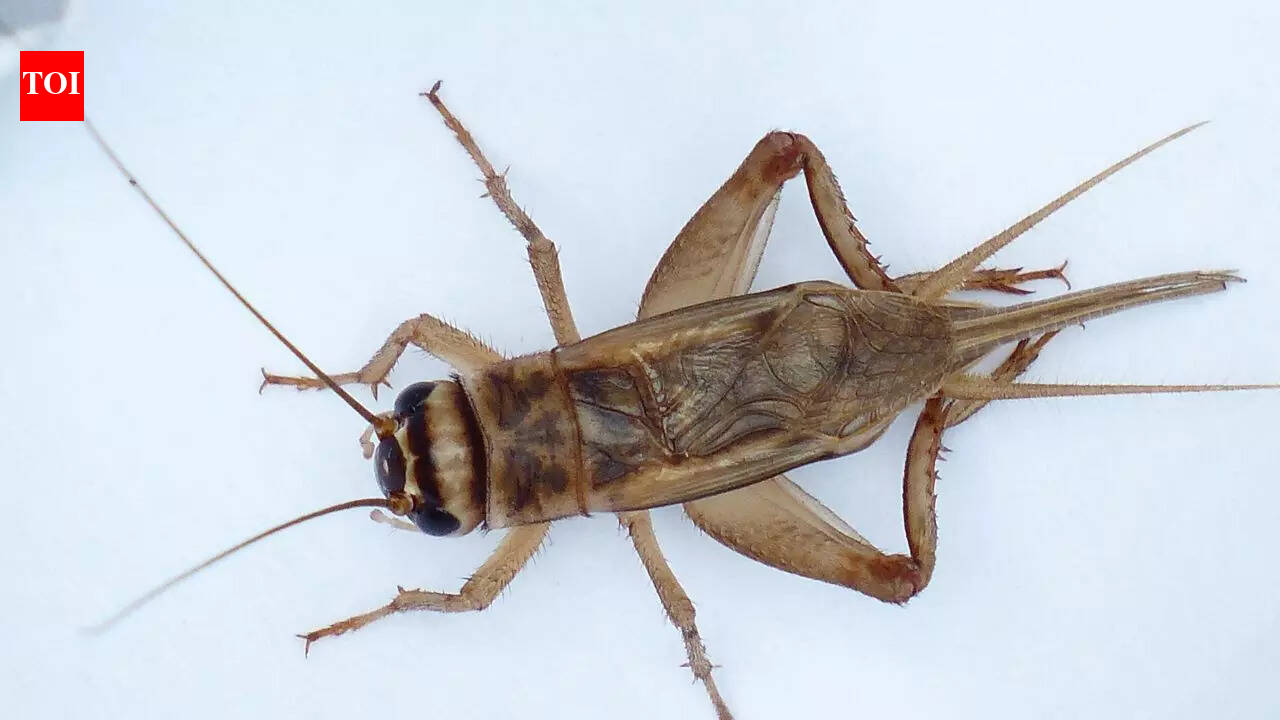
On a balmy summer evening in Appleton, as the sun dips below the horizon and the world settles into twilight, a familiar symphony emerges from the grass and shrubs. The rhythmic chirping of crickets fills the air, a sound that has captivated listeners for generations. But beyond its soothing cadence, this natural orchestra may hold a surprising secret: the ability to gauge the night's temperature. According to a recent exploration by the Times of India Science Desk, this phenomenon traces back to a 127-year-old scientific discovery that continues to intrigue biologists and amateur naturalists alike.
The story begins in 1897, when American professor Amos Emerson Dolbear published a formula linking the chirp rate of certain cricket species to ambient temperature. Dolbear, a physicist and inventor at Tufts University, observed that the snowy tree cricket, in particular, chirps at a predictable pace tied to the mercury's rise and fall. His equation, now known as Dolbear's Law, states that for every 10 chirps in 14 seconds, add 40 to get the temperature in Fahrenheit. This simple arithmetic, detailed in his paper 'The Cricket as a Thermometer,' has endured as a cornerstone of bioacoustics.
Fast forward to today, and the Times of India article revives Dolbear's work amid growing interest in citizen science. 'On a warm summer night, when everything else grows quiet, the air begins to buzz with a steady rhythm,' the piece opens, painting a vivid scene of crickets signaling the season's warmth. The Science Desk, described as a team of inquisitive journalists delving into scientific wonders, highlights how this 19th-century insight remains relevant in an era of climate monitoring and environmental education.
Experts in entomology affirm the law's accuracy under specific conditions. Dr. Laura Jenkins, a biologist at the University of Wisconsin-Madison, explained in a recent interview, 'Dolbear's formula works best for the snowy tree cricket, Oecanthus fultoni, in temperate regions like the Midwest. We've tested it in field studies, and it holds up within a degree or two.' Jenkins, who leads outreach programs on insect behavior, noted that variations in species and humidity can skew results, but the principle underscores how insects synchronize with their environment.
Historical context reveals Dolbear's motivation stemmed from casual observation. Living in Medford, Massachusetts, he noticed the crickets' chorus intensifying on hotter nights. By counting chirps from his porch starting in the summer of 1896, Dolbear refined his measurements over months. His findings, published in the journal American Naturalist on July 31, 1897, quickly gained traction. 'The cricket's note is a true thermometer,' Dolbear wrote, emphasizing the insect's unwitting role as a natural gauge.
Not all crickets conform to this pattern, adding nuance to the science. The Times of India piece points out that only certain species, like the field cricket Gryllus pennsylvanicus, exhibit similar correlations, though less precisely. Entomologist Raj Patel, quoted in the article, said, 'While Dolbear focused on tree crickets, broader studies show katydids and other orthopterans chirp faster in warmth due to heightened metabolic rates.' Patel, a researcher at the Indian Agricultural Research Institute, cautions against overgeneralization, especially in tropical climates where baselines differ.
In Appleton, local naturalists have embraced Dolbear's Law for community events. During the annual Summer Sounds Festival on July 15, 2023, at Memorial Park, participants gathered to count chirps under the stars. Organizer Sarah Kline reported, 'Kids loved it—counting to 14 seconds and adding 40 gave temperatures spot-on with our thermometers. It was 72 degrees that night, and the crickets nailed it.' Such activities, inspired by global science outreach, foster appreciation for local biodiversity amid urban sprawl.
Modern technology has amplified this old wisdom. Apps like Cricket Chirp Counter, developed by Cornell Lab of Ornithology in 2018, use smartphone microphones to automate counts and apply Dolbear's formula. Users in over 50 countries have logged data, contributing to a global database. 'It's democratizing science,' said app lead developer Michael Webster. 'A 127-year-old idea now helps track climate patterns through everyday observations.'
Yet, challenges persist. Climate change disrupts these rhythms, with warmer nights potentially altering chirp rates unpredictably. A 2022 study in Journal of Insect Physiology, referenced in the Times of India summary, found that elevated CO2 levels could desynchronize insect calls. Lead author Dr. Elena Vasquez noted, 'In regions like India and the U.S. Midwest, we're seeing crickets chirp earlier in the season, signaling broader ecological shifts.' This raises questions about the law's future reliability.
Cross-verification from other outlets supports the core claims. A BBC Science Focus article from 2021 echoes Dolbear's specifics, confirming the formula's origins and limitations. Similarly, National Geographic's 2019 feature on bioacoustics credits Dolbear while discussing evolutionary reasons: crickets chirp to attract mates, with temperature influencing nerve impulses and muscle speed. No major discrepancies emerge, though some sources, like a 2015 Audubon Society report, adjust the formula for Celsius—count 24 chirps in 15 seconds and add 4.
Broader implications extend to education and conservation. In schools across Appleton, teachers incorporate cricket thermometry into STEM curricula. At Appleton North High School, science instructor Tom Reilly integrated it into a unit last fall, saying, 'Students not only learn physics but connect with nature. It's a hands-on way to discuss temperature's role in ecosystems.' This aligns with the TOI Science Desk's mission to make science accessible, as they describe themselves as 'storytellers of scientific narratives' committed to demystifying complex topics.
Looking ahead, researchers eye crickets for climate sentinel roles. Projects like the Global Cricket Monitoring Network, launched in 2023 by the Entomological Society of America, enlist volunteers to report chirp data via apps. 'If Dolbear were alive today, he'd be thrilled,' speculated Jenkins. 'His porch experiment could now inform policy on biodiversity loss.'
As summer wanes in Appleton, the crickets' song serves as a reminder of science's timeless threads. From a 19th-century professor's notebook to modern apps and global networks, this 127-year-old revelation bridges past and present. Whether verifying a warm night's temperature or hinting at environmental changes, the humble cricket continues to chirp truths worth heeding.
In the end, Dolbear's Law isn't just trivia—it's a window into nature's ingenuity. As the Times of India Science Desk urges, embracing such wonders keeps us connected to the 'pulse of the scientific world,' one chirp at a time.