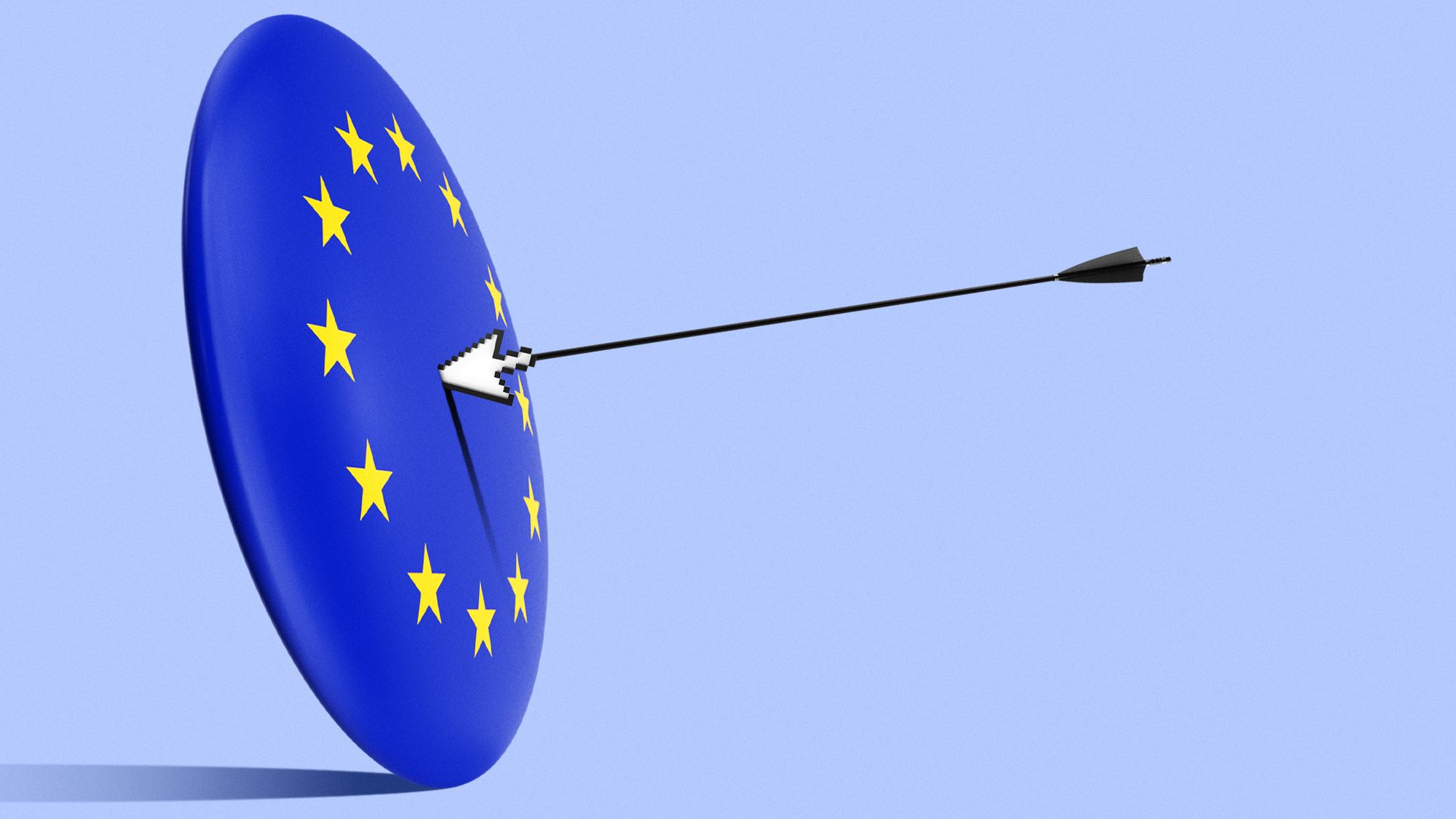
PARIS — As tensions rise between Europe and the United States under a potentially returning Donald Trump administration, European leaders are accelerating efforts to achieve digital sovereignty, aiming to reduce reliance on American technology giants. France, a frontrunner in this push, announced plans this week to phase out popular U.S. video-conferencing platforms like Zoom and Microsoft Teams by 2027, replacing them with Visio, a homegrown French alternative. The move, detailed by David Amiel, junior minister for the civil service and state reform, seeks to “guarantee the security and confidentiality of electronic communications by relying on a powerful and sovereign tool.”
This initiative comes amid growing concerns over U.S. influence in global tech infrastructure, particularly as Trump has issued aggressive rhetoric toward European allies, including open threats to seize Greenland. At the World Economic Forum in Davos earlier this year, European Commission President Ursula von der Leyen emphasized the “structural imperative” for Europe to “build a new form of independence.” Her comments underscored a broader EU strategy to counter the dominance of U.S.-headquartered companies, which control the majority of the world's cloud computing infrastructure.
Critics, however, question the feasibility of such decoupling. With a handful of American firms like Google, Microsoft, and Amazon providing about 70% of Europe's cloud-computing needs, according to BBC business reporter Daniel Thomas, alternatives remain scarce. “At the moment, there aren’t any comparable alternatives,” Thomas reported, noting that Europe's own cloud providers lack the scale and capabilities to fully replace their U.S. counterparts.
The urgency has been heightened by Trump's post-election signals, including his alignment with Silicon Valley leaders. Commentators point to instances like the CEOs of Apple, Zoom, and Amazon attending a White House screening of Amazon’s “Melania” documentary as evidence of their loyalty to the administration. Sébastian Seibt, writing for France24, observed that talk of “technological ‘decoupling’ from the US is hardly new,” but Trump's “aggressive rhetoric” and threats have created a “sudden sense of urgency.”
Christophe Grosbost, of the Innovation Makers Alliance, warned of catastrophic consequences if the U.S. were to act on such threats. “If the US president followed through with his threats and asked Meta, Google and Amazon to ‘completely cut off European access to their services, our societies and economies would be completely disrupted,’” Grosbost told the news site. “It would be disastrous.” This scenario, often dubbed a U.S. “kill switch,” has been “seriously discussed in tech industry and policy circles,” Thomas added.
France's transition to Visio is viewed as symbolic yet significant. Francesca Musiani, head of the Internet and Society Centre at France’s National Centre for Scientific Research, described it as a “big step” that “signals a desire to reduce exposure to the American ecosystem as soon as a European alternative, however imperfect, becomes available.” The platform, developed domestically, is set to roll out across French government operations starting in 2027, aligning with broader procurement policies influenced by what some call Europe’s “digital sovereignty paranoia.”
Big Tech companies have responded by promoting “sovereign” cloud solutions, but skepticism abounds. These offerings, such as data centers in Europe, are criticized as “Euro-washing” by experts. Steven Vaughan-Nichols, writing for The Register, quipped, “Sure, your data may live in Frankfurt,” but “your fate still rests in Seattle.” He explained that U.S.-based firms are legally obligated to comply with American government requests for data, regardless of storage location. “And ‘I wouldn’t trust my data, secrets or services to a US company these days for love or money,’” Vaughan-Nichols added, citing the recent White House event as a red flag.
Europe's dependence extends beyond cloud services to payment systems, complicating the sovereignty quest. Suzanne Lynch, Bloomberg’s Brussels bureau chief, highlighted how U.S. companies like Visa, Mastercard, and PayPal control “critical parts” of the world’s financial infrastructure. European Central Bank executive board member Piero Cipollone echoed this, stating they “can theoretically pull the plug on us.” This vulnerability, Lynch reported, adds another layer to the continent's push for independence.
In response, the EU is advancing regulatory measures. The upcoming Cloud and AI Development Act aims to promote an “open source-led exit from hyperscaler lock-in,” according to The Register. Additionally, the EU has developed a cloud sovereignty framework “with the intention of keeping European data under European control,” as noted in discussions on The Conversation. These efforts are expected to drive up IT spending this year, with a “big chunk” allocated to “sovereign cloud” options, framing it as a “straight-up national economic security play” rather than mere compliance.
Microsoft, one of the targeted giants, has pledged resistance to any disruptive orders. President Brad Smith promised that the firm would take legal action in the “exceedingly unlikely” event the U.S. government ordered it to suspend services. “We will continue to look for new ways to ensure the European Commission and our European customers have the options and assurances they need to operate with confidence,” a Microsoft spokesperson told the BBC.
Experts advocate treating digital infrastructure with the gravity of physical assets. Computer science professor Johan Linåker, writing for The Conversation, argued that for Europe to “meaningfully address the risks,” digital systems “needs to be treated with the same seriousness as physical infrastructure” such as roads and power grids. “No country, let alone continent, will ever be completely digitally independent, and nor should they be,” Linåker said. “But by pulling together, Europe can ensure its digital systems remain accessible even in a crisis – just as is expected from its physical infrastructure.”
Funding remains a pivotal factor. Martin Hullin, head of the European Network for Technological Resilience and Sovereignty at the Bertelsmann Foundation, told France 24 that “it’s the money that speaks.” “It’s public contracts that make the difference,” he said, suggesting that framing the shift as “safeguarding European democracies” could justify short-term costs of adopting homegrown solutions.
The broader implications of this digital pivot are profound. Europe's single-point reliance on U.S. tech is described as a “single-shock-event security nightmare” waiting to happen. As Trump prepares for his January 20 inauguration, questions linger about whether his administration might leverage tech dominance in trade or geopolitical disputes. While full independence may be elusive, the momentum suggests a reshaping of transatlantic tech relations, with public procurement and regulation at the forefront.
Looking ahead, the EU's strategies could inspire similar moves globally, but challenges persist. Without scalable European alternatives, the transition risks economic disruption. Yet, as von der Leyen and others assert, the stakes for security and autonomy demand action. Observers will watch closely as France's 2027 deadline approaches and the Cloud and AI Development Act takes shape in Brussels.
In the end, this quest for digital sovereignty reflects deeper anxieties about globalization's vulnerabilities. As Hullin noted, willingness to endure initial hurdles may define Europe's tech future, ensuring resilience in an era of unpredictable alliances.