In a dramatic escalation of tensions in Latin America, an image surfaced over the weekend of January 3 and 4 showing Venezuelan President Nicolás Maduro blindfolded and handcuffed aboard a U.S. naval vessel. The photo, which quickly spread across international media outlets, depicted Maduro and his wife, Cilia Flores, in custody following what U.S. officials described as a precision military operation. Shortly after the images emerged, President Donald Trump announced that the United States would assume temporary control of Venezuela to oversee a "safe, proper and judicious transition" to new leadership.
The operation, carried out in the early hours of January 3 off the coast of Venezuela, involved U.S. Navy SEAL teams boarding a Venezuelan government yacht where Maduro and Flores were reportedly traveling. According to U.S. military sources, the couple was detained without resistance and transported to the USS Gerald R. Ford, a Nimitz-class aircraft carrier stationed in the Caribbean Sea. Trump made his announcement from the White House Rose Garden on January 4, stating, "The United States will now ‘run’ Venezuela until a safe, proper and judicious transition could be arranged." The move comes amid years of U.S. sanctions and diplomatic pressure on Maduro's regime, which has been accused of widespread human rights abuses and economic mismanagement.
Venezuela's crisis has deepened under Maduro's rule since he assumed power in 2013 following the death of Hugo Chávez. The country's economy has imploded, with hyperinflation reaching over 1 million percent in 2018, according to International Monetary Fund estimates. Democratic institutions have eroded, criminal networks have intertwined with state apparatus, and more than 7 million Venezuelans have fled the country, many seeking refuge in the United States and neighboring nations like Colombia and Brazil. Maduro's government has long denied these charges, attributing the woes to U.S. economic warfare.
International relations expert and author of "Dying by the Sword," writing in The Conversation, described the U.S. action as part of a broader trend in American foreign policy dubbed "America the Bully." The scholar argued that Washington has increasingly turned to coercion—military, economic, and political—not just to deter adversaries but to force compliance from weaker states. "This may deliver short-term obedience, but it is counterproductive as a strategy for building durable power, which depends on legitimacy and capacity," the expert wrote. The analysis highlighted how such approaches can harden resistance and turn local issues into matters of national pride.
The expert emphasized that while there is no dispute over Maduro's role in Venezuela's collapse, removing a dictator does not equate to establishing a legitimate political order. "Force can topple rulers, but it cannot generate political authority," the scholar stated, drawing from research on international security and civil wars. The piece referenced collaborative work with co-author Sidita Kushi, analyzing data from the Military Intervention Project, which shows a sharp increase in U.S. military interventions since the end of the Cold War in 1991, despite the absence of a Soviet threat.
One key statistic underscored the imbalance in U.S. foreign policy tools: In fiscal year 2026, for every dollar invested in the State Department's diplomatic efforts, the Department of Defense receives $28. This institutional skew, according to the analysis, makes force the default option rather than a last resort. "Kinetic diplomacy”—a term used for military-driven regime change—has become routine, with interventions evolving from short-term stabilization to prolonged governance roles, as seen in Iraq after 2003 and Afghanistan after 2001.
Trump's rhetoric appeared to reinforce this approach. In an interview with The Atlantic on January 4, he warned about potential consequences for interim Venezuelan leadership. Referring to Delcy Rodríguez, who has served as Venezuela's vice president and was named acting leader by Maduro's allies before his capture, Trump said, "If Delcy Rodríguez ‘doesn’t do what’s right, she is going to pay a very big price, probably bigger than Maduro." Rodríguez, a close confidante of Maduro, has been under U.S. sanctions since 2019 for her alleged role in narcotics trafficking and corruption.
Historical precedents loom large over the U.S. decision to govern Venezuela directly. In Afghanistan, the U.S. invaded in October 2001 to dismantle the Taliban following the September 11 attacks. What began as a swift operation extended into two decades of nation-building, backed by billions in reconstruction aid. Yet, upon the U.S. withdrawal in August 2021, the Afghan government collapsed within days, with Taliban forces retaking Kabul. The expert noted, "No amount of reconstruction spending could compensate for the absence of a political order rooted in domestic consent."
Similarly, the 2003 Iraq invasion led by the U.S. toppled Saddam Hussein after his forces surrendered in April of that year. Initial plans for transition diverged sharply between the State Department and Defense Department. President George W. Bush approved the Defense Department's strategy, which relied on coercive threats and private contractors rather than addressing Iraq's cultural and historical context. The U.S. soon found itself managing not just security but also essential services like electricity and water, becoming "an object of resistance," as the analysis described.
Libya offers another cautionary tale. In 2011, a NATO-led intervention, supported by the U.S., removed dictator Muammar Gaddafi from power in October after months of airstrikes. Unlike in Iraq or Afghanistan, no follow-up governance was imposed, leading to immediate civil war, militia fragmentation, and ongoing struggles over sovereignty and resources. The expert pointed to a common thread: "Hubris: the belief that American management—either limited or oppressive—could replace political legitimacy."
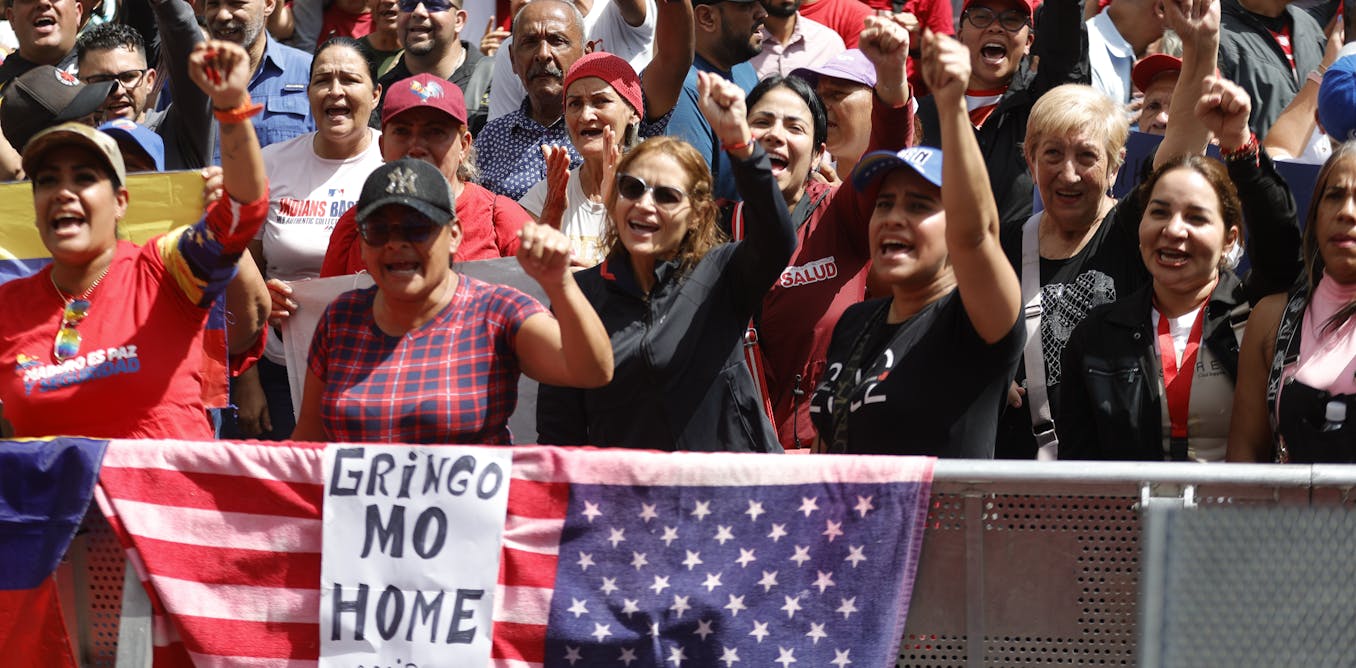
Venezuela's infrastructure is already devastated, with frequent blackouts and shortages plaguing daily life. If the U.S. takes on governance responsibilities, it risks being blamed for every failure, transforming from liberator to occupier. Maduro's supporters, including loyalist factions in the military and socialist groups, have vowed resistance, with protests reported in Caracas on January 4 denouncing the U.S. action as imperialism.
Beyond Venezuela, the strategy carries strategic costs for U.S. global standing. Assuming control of a sovereign nation undermines principles of nonintervention that America champions elsewhere, complicating alliances with partners in Europe and Asia. The expert warned that such moves signal to rivals like China and Russia a coercive model of power. "Beijing needs only to point to U.S. behavior to argue that great powers rule as they please where they can—an argument that can justify the takeover of Taiwan," the analysis stated. Moscow could similarly cite precedents for actions in Ukraine or its near abroad.
U.S. allies have reacted with mixed signals. European Union foreign ministers, meeting in Brussels on January 5, expressed support for Maduro's removal but cautioned against direct U.S. administration, calling for a multilateral transition led by the Organization of American States. In contrast, some Latin American leaders, including Brazil's President Jair Bolsonaro, praised the operation as a blow against socialism. Venezuelan opposition figure Juan Guaidó, recognized by the U.S. as interim president since 2019, welcomed the development but urged quick elections.
As the U.S. prepares to install transitional administrators in Caracas, questions swirl about the path forward. Military sources indicate that up to 5,000 U.S. troops could deploy to secure key sites like oil refineries in the Orinoco Belt, vital to Venezuela's economy. Economists estimate that stabilizing the nation could cost tens of billions, drawing parallels to the $2 trillion spent in Afghanistan.
The international community watches closely as this experiment in enforced transition unfolds. While force has swiftly altered Venezuela's leadership, experts argue that true stability hinges on legitimacy earned through domestic processes, not imposed from abroad. Whether the U.S. can avoid the pitfalls of past interventions remains an open question, with the stakes extending far beyond South America's northern coast.