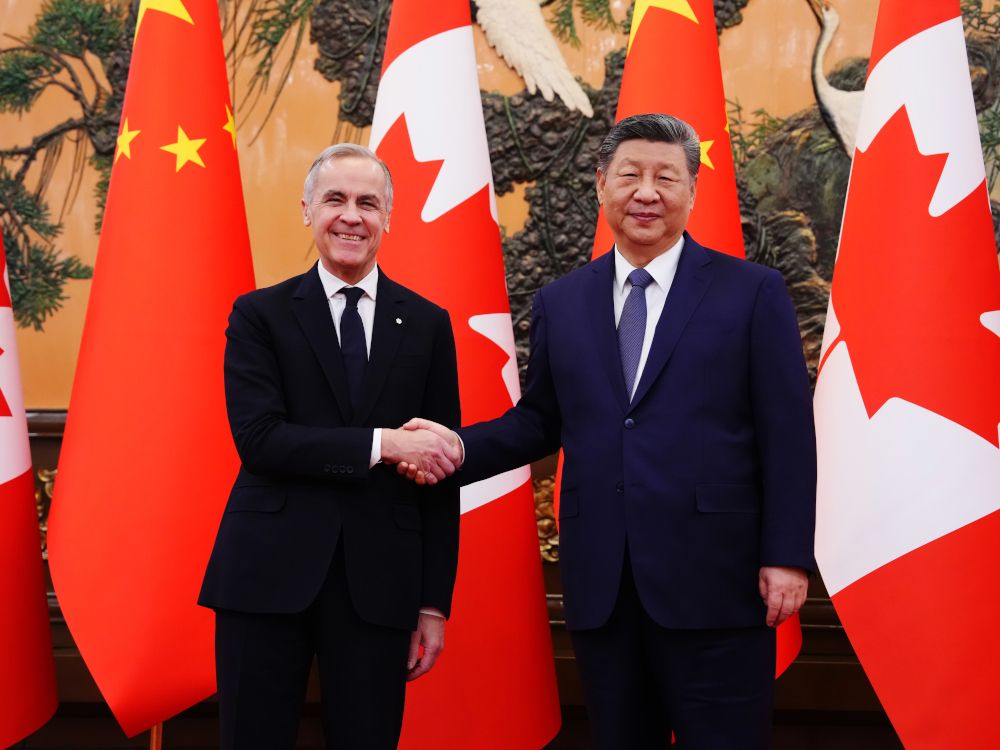
OTTAWA — Prime Minister Mark Carney's recently announced strategic partnership with China has sparked intense debate in political and diplomatic circles, with critics warning that its implications extend far beyond the surface-level trade benefits. The agreement, unveiled last month, aims to diversify Canadian food exports and facilitate imports of Chinese electric vehicles, but a new podcast episode from the National Post's Full Comment series suggests hidden depths that could expose Canada to greater risks from Beijing's influence.
Recorded on February 2, 2026, the episode features National Post columnist Brian Lilley in conversation with Sandra Watson Parcels, a longtime observer of China-Canada relations. Lilley opens the discussion by highlighting the White House's alarm over the deal, noting that it goes "bigger than just the diversification and freeing up of trade in Canadian food exports and Chinese electric vehicles, as he claims." Watson Parcels echoes this concern, emphasizing that while trade with China has merits, the terms of this pact could undermine Canada's security.
The partnership was formally announced by Carney during a joint press conference with Chinese Foreign Minister Wang Yi in Beijing on January 15, 2026. According to official statements from the Prime Minister's Office, the deal includes provisions for increased Canadian agricultural shipments to China, potentially boosting exports by up to 20 percent over the next five years, and streamlined regulations for importing affordable electric vehicles to support Canada's green energy transition. Carney described it as a "pragmatic step toward mutual economic growth," stressing that it would create thousands of jobs in rural farming communities and urban manufacturing sectors.
However, the Full Comment podcast delves into aspects not emphasized in the government's rollout. Lilley points out that the agreement reportedly includes clauses on technology sharing and joint infrastructure projects, which could open doors for Chinese state-owned enterprises to gain footholds in sensitive Canadian sectors like telecommunications and energy grids. "There are details of the pact that haven’t been widely covered," Lilley says, drawing from Watson Parcels' analysis of leaked diplomatic cables.
Watson Parcels, who has tracked Beijing's foreign policy for over two decades through her work at the Asia Pacific Foundation of Canada, warns of the risks posed by China's "coercive power tactics." She cites historical examples, such as the 2018 detention of two Canadians in retaliation for Huawei executive Meng Wanzhou's arrest, as evidence of how economic ties can be weaponized. "It risks making Canada increasingly vulnerable to Beijing’s coercive power tactics," Watson Parcels states in the podcast, adding that the deal might compel Ottawa to soften its stance on human rights issues in Xinjiang and Hong Kong to avoid trade disruptions.
Supporters of the agreement, including Trade Minister François-Philippe Champagne, counter that such fears are overstated. In a February 1, 2026, interview with CBC News, Champagne said, "This partnership is about opportunity, not entanglement. We've built in safeguards to protect national interests, including rigorous security reviews for all investments." He highlighted that the deal aligns with Canada's Indo-Pacific Strategy, which seeks balanced engagement with the region without isolating major economies like China.
The timing of the announcement comes amid escalating U.S.-China tensions, particularly following the Biden administration's extension of tariffs on Chinese goods in late 2025. White House officials have privately expressed concerns to their Canadian counterparts, according to sources familiar with the discussions. A spokesperson for the U.S. State Department declined to comment directly on the Canada-China pact but reiterated America's commitment to "like-minded allies" in countering economic coercion from authoritarian regimes.
Critics in Ottawa, including Conservative Leader Pierre Poilievre, have seized on the podcast's revelations to call for a parliamentary review. Poilievre tweeted on February 3, 2026, "Carney's secret China deal sells out our sovereignty for soybeans and EVs. Canadians deserve full transparency now." His office has requested unredacted copies of the agreement, arguing that public disclosure is essential given the pact's potential to affect national security.
Background on Carney's approach to China dates back to his tenure as Bank of Canada governor, where he advocated for multilateral trade frameworks. Since becoming prime minister in 2023, Carney has pursued a "principled pragmatism" foreign policy, balancing economic ties with democratic values. This deal follows a series of bilateral meetings, including Carney's visit to Shanghai in November 2025, where preliminary talks on electric vehicle supply chains were held.
Economists offer a mixed view on the trade specifics. A report from the Canadian Chamber of Commerce, released January 20, 2026, projects that food export growth could add $2.5 billion annually to the economy, primarily in wheat, canola, and pork sectors from the Prairies. On the import side, Chinese EVs, priced 30 percent lower than North American models, could accelerate Canada's goal of 100 percent zero-emission vehicle sales by 2035, according to Environment Minister Steven Guilbeault.
Yet, Watson Parcels argues in the podcast that the broader geopolitical stakes are higher. "There’s a case for trading with China, but not on terms like this," she says, pointing to the agreement's alignment with Beijing's Belt and Road Initiative. This could position Canada as a conduit for Chinese influence in the Americas, potentially straining relations with allies like the U.S., Australia, and the European Union, which have adopted more cautious postures toward Beijing.
The podcast also touches on environmental angles, noting that while Chinese EVs promote sustainability, their supply chains involve rare earth minerals mined under questionable labor conditions. Lilley questions whether Canada has adequate oversight, to which Watson Parcels responds, "Without strong enforcement, we're importing not just vehicles, but the ethical dilemmas tied to them."
As the debate unfolds, opposition parties plan to raise the issue in the House of Commons when Parliament reconvenes on February 10, 2026. Meanwhile, business groups like the Canadian Vehicle Manufacturers' Association have praised the deal for lowering costs and fostering innovation. "This opens new markets without compromising our standards," said association president Mark Nantais in a statement.
Looking ahead, the partnership's success will hinge on implementation details yet to be finalized. A joint Canada-China working group is scheduled to meet in Vancouver next month to hammer out regulatory harmonization. Observers say the coming weeks will reveal whether the alarm bells rung by critics like Watson Parcels prove prescient or if Carney's vision of balanced trade prevails.
In the broader context of global realignments, this deal underscores Canada's delicate balancing act between economic imperatives and alliance commitments. As Watson Parcels concludes in the podcast, "It puts us on the wrong side of the urgent effort necessary to preserve the western-backed global system from the threats of a rising revisionist power." Whether that assessment holds will depend on how the partnership evolves amid watchful eyes from Washington and beyond.