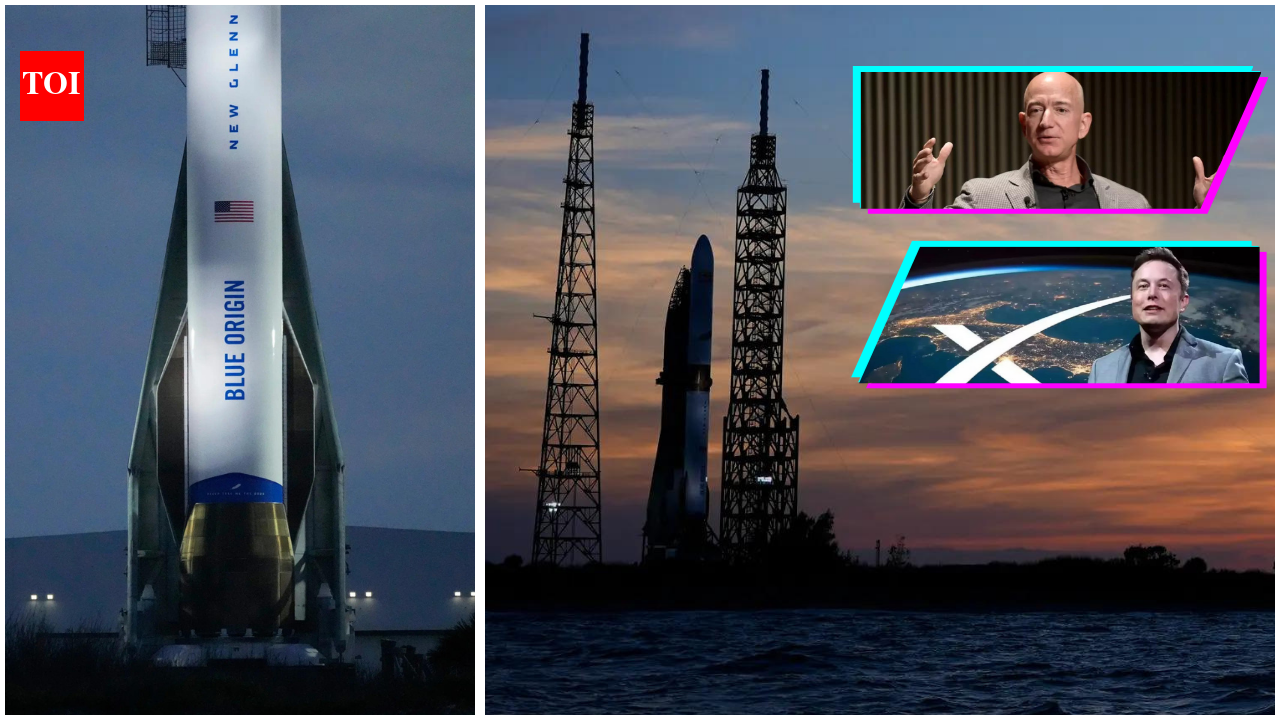
In a bold move that could intensify the rivalry in the commercial space industry, Jeff Bezos' Blue Origin is preparing to launch its New Glenn rocket with a reused booster for the first time, directly challenging Elon Musk's SpaceX dominance in reusable rocket technology. The attempt is scheduled for Sunday, marking a significant milestone for the company as it aims to catch up in the race for cost-effective space access.
Blue Origin, the aerospace firm founded by the Amazon billionaire in 2000, has been developing the New Glenn heavy-lift rocket since 2015 as its answer to SpaceX's Falcon 9 and Starship programs. According to reports from the Times of India, this upcoming launch represents the company's first effort to reuse a first-stage booster, a technique that SpaceX has mastered over dozens of missions to drastically reduce launch costs. The New Glenn, named after NASA legend John Glenn, stands at about 98 meters tall and is designed to carry up to 45 metric tons to low Earth orbit in its reusable configuration.
The launch site for this historic attempt is Cape Canaveral Space Force Station in Florida, where Blue Origin has established Launch Complex 36. Officials with Blue Origin have not released an exact time for the Sunday liftoff, but the event is expected to draw significant attention from the space community. "This is a pivotal moment for us," a Blue Origin spokesperson said in a statement provided to media outlets, emphasizing the company's commitment to sustainable spaceflight. The reused booster in question was previously flown on New Glenn's inaugural mission in January 2025, according to company records, and has undergone extensive refurbishment at Blue Origin's facilities in Kent, Washington.
SpaceX, which has revolutionized the industry with over 300 successful booster landings since 2015, views such developments with a mix of competition and opportunity. Elon Musk, SpaceX's CEO, tweeted earlier this week about the broader implications of reusable tech, stating, "Reusability is key to making life multiplanetary—excited to see more players join the game." While Musk did not directly reference Blue Origin, his comments come amid ongoing tensions between the two billionaires, including legal battles over NASA contracts and lunar lander awards.
The context of this launch is rooted in the escalating competition for dominance in the $400 billion space economy. Blue Origin has faced delays with New Glenn, originally targeting a debut in 2020, but persistent technical hurdles pushed the first flight to last year. That maiden voyage, which carried a satellite payload for a commercial customer, ended with a successful booster landing on a droneship in the Atlantic Ocean. Refurbishing and relaunching that same booster just nine months later underscores Blue Origin's aggressive timeline to scale operations.
Experts in the field have praised the ambition but noted the challenges ahead. Dr. Laura Johnson, a space policy analyst at the University of Colorado, observed, "Blue Origin's push for rapid reuse is impressive, but SpaceX's turnaround times—sometimes as short as 21 days—set a high bar. Success here could accelerate Blue Origin's path to crewed missions and deep-space ventures." Johnson's comments highlight the technical feats involved, including the booster's nine Merlin-like BE-4 engines, developed in partnership with United Launch Alliance.
From a broader perspective, this event ties into NASA's Artemis program, where both companies are vying for roles in returning humans to the Moon. Blue Origin secured a $3.4 billion contract in 2023 for its Blue Moon lander, but SpaceX's Starship has been selected as the primary human landing system. According to NASA officials, reusable technologies like those being tested Sunday are crucial for sustainable lunar exploration, potentially lowering costs from billions to millions per launch.
Environmental considerations also play a role in the narrative. Blue Origin emphasizes that reusability reduces space debris and manufacturing waste, aligning with global sustainability goals. The company's methane-fueled BE-4 engines produce less soot than traditional kerosene rockets, a point touted in their promotional materials. However, critics, including some environmental groups, have raised concerns about the cumulative impact of frequent launches on the atmosphere, though no specific data on New Glenn's emissions has been publicly disputed.
Jeff Bezos, who stepped down as Amazon CEO in 2021 to focus on Blue Origin, has invested over $1 billion of his personal fortune annually into the company. In a recent interview with CNBC, Bezos reflected on the competitive landscape: "We're building the infrastructure for the future of humanity in space. Competition drives innovation, and that's good for everyone." His vision includes orbital habitats and resource mining on asteroids, ambitions that New Glenn's reusability aims to make economically viable.
Meanwhile, SpaceX continues to expand its lead, with the latest Falcon 9 launch occurring just last week from Vandenberg Space Force Base, deploying 22 Starlink satellites. Company data shows SpaceX has conducted 96 launches in 2024 alone, compared to Blue Origin's handful of suborbital New Shepard flights and this single orbital attempt. Insiders at SpaceX, speaking anonymously, described Blue Origin's milestone as "a step forward, but we're light-years ahead in flight rate and reliability."
The Sunday launch carries additional payloads, including experimental satellites for the U.S. Space Force and a rideshare mission for small commercial operators. According to Blue Origin's manifest, the primary customer is a undisclosed telecommunications firm seeking geostationary orbit insertion. Weather forecasts for Cape Canaveral indicate favorable conditions, with less than 20% chance of delays, per the 45th Weather Squadron.
Looking beyond the immediate event, success could open doors for Blue Origin in the growing market for satellite constellations and space tourism. The company already offers suborbital joyrides via New Shepard, with tickets priced at $1 million each, but New Glenn paves the way for longer-duration missions. Analysts predict that if reuse proves reliable, Blue Origin could capture 20% of the launch market by 2030, challenging SpaceX's current 70% share.
However, not all viewpoints are optimistic. A report from the Aerospace Corporation earlier this year flagged potential supply chain issues for BE-4 engines, which have delayed other programs. United Launch Alliance, a co-developer, confirmed minor setbacks but affirmed readiness for the reuse demo. "We've ironed out the kinks," a ULA executive said at a recent industry conference.
As the space race heats up, this Blue Origin attempt symbolizes a maturing industry where multiple players vie for supremacy. With eyes on Sunday's launch, the outcome could either solidify Blue Origin's contender status or highlight the steep climb against SpaceX's established prowess. For now, the focus remains on the engineering triumph of reusing a massive rocket booster, a feat that once seemed like science fiction.
In the end, the implications extend to national security and global exploration. The U.S. government, through the Space Force, relies on commercial providers for rapid deployment capabilities, and Blue Origin's progress ensures a diversified supplier base. As one Pentagon official noted anonymously, "Healthy competition between Bezos and Musk keeps innovation alive and costs down." Whatever the result, Sunday's launch is poised to be a defining chapter in the ongoing saga of private spaceflight.