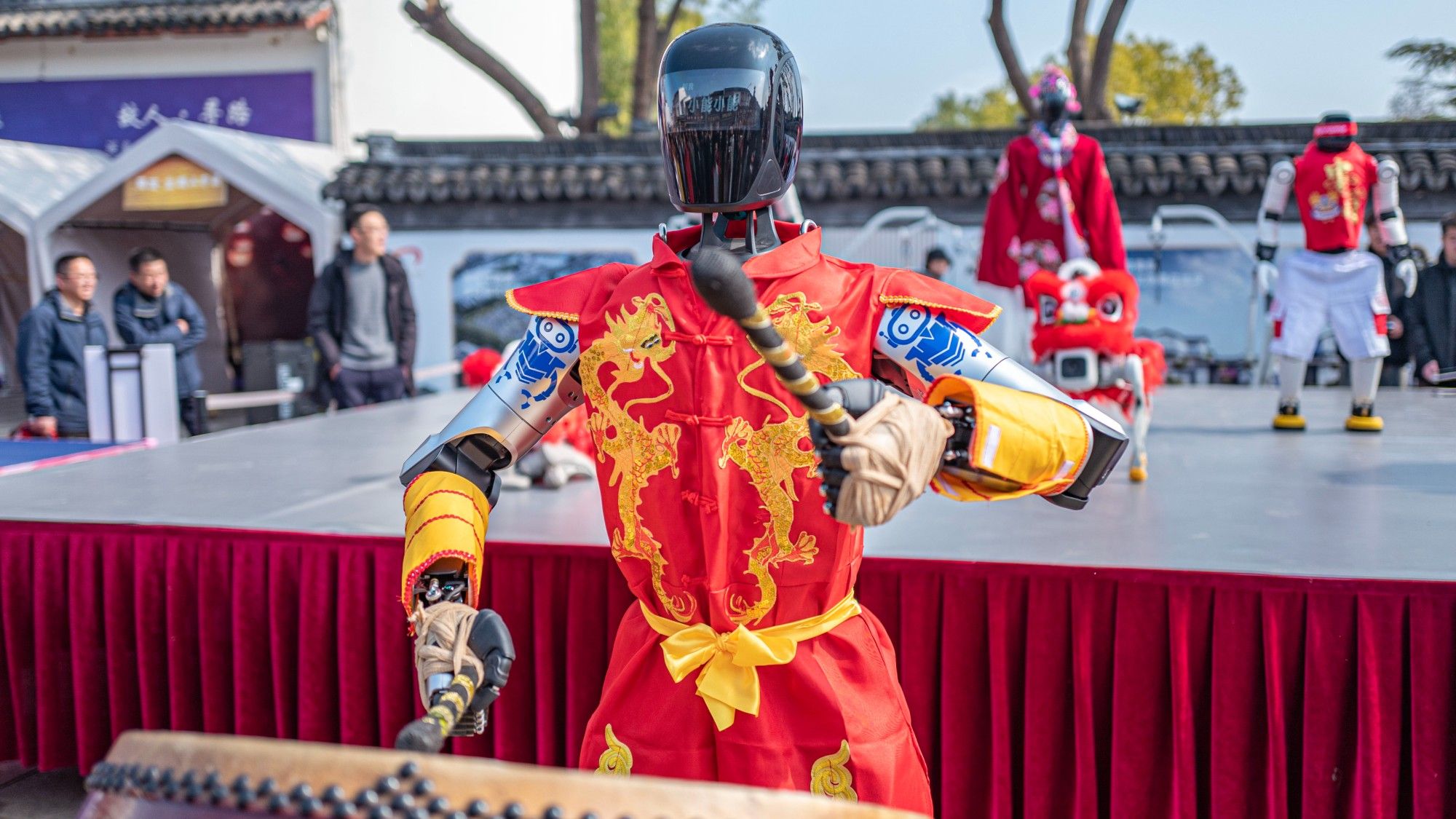
BEIJING — In a spectacle that captivated millions during China's annual Spring Festival Gala on state-run television, a troupe of humanoid robots delivered a performance blending martial arts flair and high-tech precision, marking a dramatic evolution in the nation's robotics ambitions. The robots, executing backflips, intricate choreography, and even sparring routines with children wielding nunchucks, stood in sharp contrast to the 'awkwardly shuffling' models from the previous year's event, according to Futurism. This 'dazzling' display, as described by the publication, showcased 'how far the country's robotics industry has come in a few short years.'
The gala, broadcast on February 10, 2025, to an audience exceeding one billion viewers worldwide, highlighted China's push to dominate the global humanoid robot market. Gone are the days when Chinese humanoids were dismissed as novelties or punchlines; today, they are poised to become ubiquitous tools in homes, factories, and beyond. Eduardo B. Sandoval, writing for The Conversation, noted that machines mimicking human form have intrigued humanity for millennia, from ancient myths to modern science fiction, but recent advancements make them 'practical consumer products' a realistic prospect.
Driving this surge are breakthroughs borrowed from parallel industries, particularly electric vehicles. Improvements in battery capacity, motors, and sensors have supercharged humanoid development, while artificial intelligence systems have grown exponentially more capable in controlling these mechanical bodies. Unitree Robotics, one of China's frontrunners, markets its G1 model with a base price of $13,500, or about £10,000, positioning it as an accessible entry into the consumer robotics space.
Economically, the sector is booming. According to the South China Morning Post, the global humanoid robot market reached 17 billion yuan, or roughly $2.5 billion, in 2025, with China claiming half that total. The Economist described China's robotics landscape as 'bustling' and home to 'the world's deepest supply chain for humanoids.' Research firm Omdia reported that more than 14,500 units were delivered worldwide last year, a nearly 400 percent increase from the prior year, with Chinese leaders Agibot and Unitree accounting for about three-quarters of those shipments.
Government backing is the linchpin of this growth. The Chinese state is 'probably the biggest source of demand for some time,' The Economist stated, serving not just as a subsidizer but as the largest buyer of humanoids in 2025. Subsidies provide crucial financial scaffolding, but the government's procurement role has fueled expansion. Local governments play a vital part too, establishing dedicated centers where robots can rehearse tasks and gather data for AI training. Investors, per industry observers, now evaluate funding based not only on a company's tech prowess but on the 'local-government resources available to them,' ensuring the ecosystem's sustainability.
Beyond borders, competition is heating up. Elon Musk's Tesla has pivoted significantly from electric vehicles toward an 'AI robotics platform,' as noted by Forbes. While Chinese models like those from Unitree and Agibot dazzle with physical agility—evident in the gala's acrobatics—investors are betting on Tesla's edge in the 'sophisticated AI ‘brain’ that powers it.' This rivalry underscores a global race where China currently leads in volume, but innovation in software could shift the balance.
Yet amid the fanfare, concerns are mounting. The gala's theatrics, impressive as they were, have sparked debates about the technology's true maturity. Euronews posed the question: How advanced are these systems really, and 'should Europe be concerned?' Hans Liwång, a researcher at the Swedish Defence University, warned that in the near future, 'there is likely to be room for robots in the shape of humans and animals for military and security organisations.'
In the West, the rapid ascent of China's robotics sector raises alarms about economic and strategic implications. The Economist highlighted fears that humanoids could 'eventually become one of the largest industries in the world.' Morgan Stanley projects that by 2050, one billion such robots could be in operation, with annual global spending surpassing $7.5 trillion. This trajectory, coupled with China's market dominance, has prompted worries over job displacement, privacy erosion from pervasive data collection, and the potential for an 'impending bubble' in advanced robotics investments.
Critics urge caution in interpreting these displays. The Guardian advised viewing the Spring Festival performance 'through a lens of state propaganda.' While the routine's length, complexity, and scale were groundbreaking—the first of its kind for humanoids—Georg Stieler, from consultancy Stieler Technology and Marketing, emphasized that 'stage performance does not equate to industrial robustness, yet.' The robots were essentially rehearsing a pre-programmed sequence 'hundreds or thousands of times,' with minimal 'environmental perception,' a key hurdle for real-world applications like factory work.
This blend of hype and skepticism reflects broader tensions in the field. On one hand, the gala symbolized China's technological leap, inspiring national pride and attracting venture capital. On the other, it amplified global anxieties about overreliance on state-driven innovation, where spectacle might outpace substance. Privacy advocates point to the robots' data-gathering capabilities as a double-edged sword, enabling smarter machines but risking surveillance creep.
Looking ahead, the humanoid market's trajectory hinges on overcoming these challenges. Battery life remains a bottleneck, though EV crossovers offer hope. AI integration will determine versatility, from eldercare assistants to warehouse laborers. In China, pilot programs in manufacturing hubs like Shenzhen are testing industrial viability, with local governments funding data farms to accelerate learning.
Internationally, regulatory responses are emerging. European officials are discussing frameworks to address military applications, while U.S. policymakers eye tariffs on imported robotics to protect domestic jobs. Tesla's Optimus project, slated for limited factory deployment in 2026, could counter Chinese volume with scalable AI, per company timelines.
For now, the Spring Festival robots have etched themselves into public imagination, symbolizing a future where human-like machines are no longer science fiction. As investment pours in—China's share alone valued at over $1.25 billion last year—the world watches warily. Will these automatons usher in prosperity or peril? Experts like Sandoval suggest the potential is vast, but only if development balances innovation with ethical safeguards.
In Appleton, Wisconsin, where manufacturing roots run deep, local economists are already pondering the ripple effects. 'If China floods the market with affordable humanoids, it could reshape global labor,' said Dr. Elena Vasquez, a tech policy analyst at the University of Wisconsin. As the industry matures, the gala's echoes may prove to be the opening act of a transformative era.