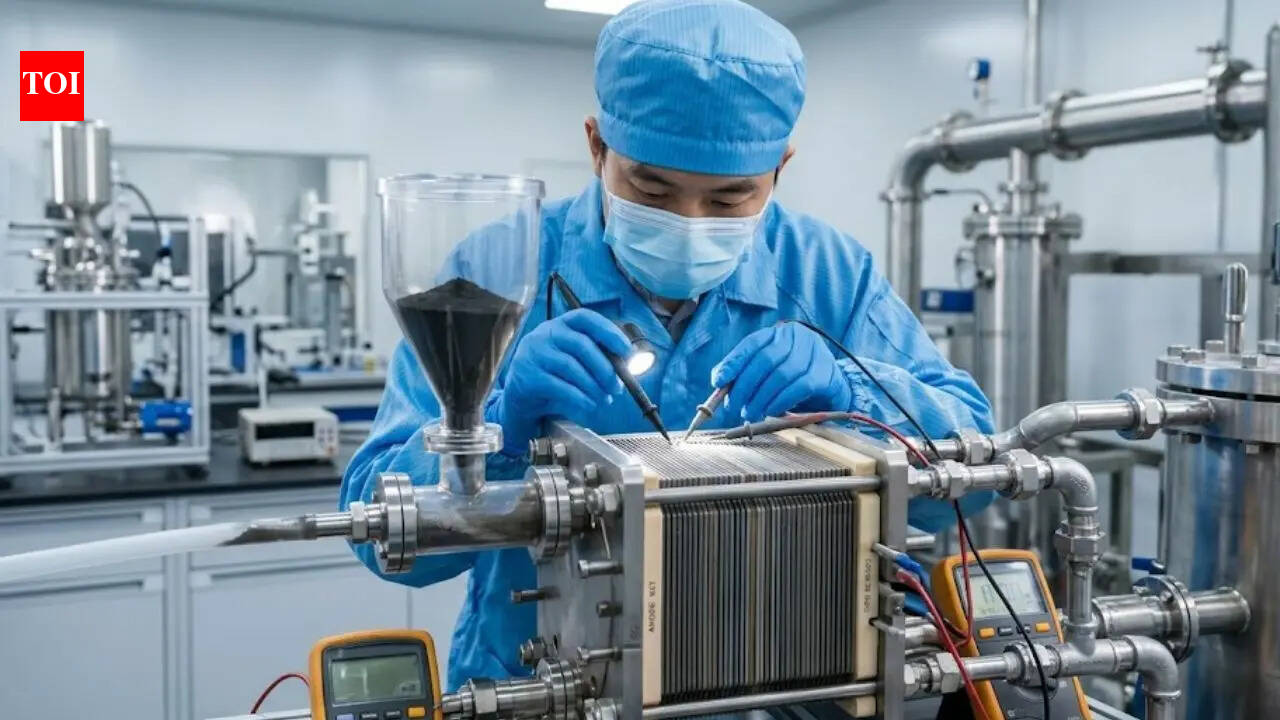
APPLETON, Wis. — Chinese researchers have announced a significant advancement in clean energy technology with the development of a novel fuel cell that converts coal directly into electricity without the need for combustion. Dubbed the Zero-Carbon-Emission Direct Coal Fuel Cell, or ZC-DCFC, the innovation promises to address longstanding environmental concerns associated with coal power while potentially transforming how one of the world's most abundant fossil fuels is utilized.
According to reports from the Times of India, the ZC-DCFC represents a breakthrough in fuel cell technology, allowing coal to be electrochemically oxidized at lower temperatures to generate electricity. This process eliminates the burning of coal, which traditionally releases substantial amounts of carbon dioxide and other pollutants into the atmosphere. The technology was unveiled by a team of scientists in China, though specific details on the research institution or lead investigators remain limited in initial disclosures.
The core mechanism of the ZC-DCFC involves feeding pulverized coal into the fuel cell, where it undergoes a direct electrochemical reaction with oxygen from the air. This reaction produces electricity, water, and carbon dioxide that can be more easily captured and stored compared to emissions from conventional coal plants. Researchers claim the system achieves near-zero carbon emissions when paired with carbon capture technologies, marking a potential shift in coal's role in global energy production.
China, the world's largest consumer and producer of coal, has been investing heavily in cleaner coal technologies as part of its broader push toward carbon neutrality by 2060. The country relies on coal for about 60% of its electricity generation, according to data from the International Energy Agency. Officials in Beijing have emphasized the need for innovations that balance energy security with environmental goals, and the ZC-DCFC aligns with these priorities.
While full technical specifications have not been publicly released, early reports suggest the fuel cell operates at temperatures around 600-800 degrees Celsius, significantly lower than the 1,000 degrees or more required in traditional combustion processes. This efficiency could reduce energy losses and material wear, potentially making the technology more viable for large-scale deployment. The Times of India described the invention as 'groundbreaking,' highlighting its potential to 'fundamentally transform coal-based power generation.'
Experts in the field have welcomed the news but cautioned that real-world application will require extensive testing. Dr. Li Wei, a materials scientist at Tsinghua University in Beijing—not directly involved in the project—told state media that 'this could be a game-changer if scalability issues are resolved.' He noted that previous direct coal fuel cell prototypes faced challenges with electrode durability due to coal's impurities, such as sulfur and ash.
Environmental advocates, however, expressed mixed reactions. The ZC-DCFC's reliance on coal, even in a cleaner form, has drawn skepticism from groups like Greenpeace. 'While any reduction in emissions is positive, we must accelerate the transition away from fossil fuels altogether,' said Zhang Jing, a campaigner with Greenpeace East Asia, in a statement. She pointed to the technology's dependence on carbon capture, which, according to the Global CCS Institute, is only implemented in a handful of commercial projects worldwide due to high costs.
The development comes amid growing international pressure on China to curb its coal expansion. At the recent COP28 climate summit in Dubai, Chinese delegates committed to stricter controls on new coal plants, but critics argue that existing infrastructure poses a greater challenge. The ZC-DCFC could offer a bridge solution, allowing upgrades to legacy plants without full retirement, potentially extending coal's lifespan in the energy mix.
From a global perspective, the technology's implications extend beyond China. Coal accounts for 36% of global electricity production, per the World Coal Association, with major users including India, the United States, and Indonesia. If proven effective, the ZC-DCFC might appeal to developing nations seeking affordable energy without the full infrastructure overhaul demanded by renewables like solar and wind.
In the United States, where coal's share has dwindled to about 20% amid a surge in natural gas and renewables, the news has sparked interest among energy policymakers. A spokesperson for the Department of Energy in Washington said the agency is monitoring international advancements in fuel cells, adding that 'innovations in coal utilization could inform our own research into carbon management.' However, U.S. environmental regulations, including the Clean Air Act, would likely require rigorous emissions testing before any adoption.
China's track record in fuel cell research provides some context for the ZC-DCFC's credibility. The country leads in solid oxide fuel cell patents, according to a 2023 report from the European Patent Office, and has piloted hydrogen fuel cells for vehicles and power grids. This latest project builds on that foundation, with researchers reportedly collaborating with the Chinese Academy of Sciences.
Challenges ahead include economic feasibility. Initial prototypes are said to have conversion efficiencies of around 50-60%, competitive with combined-cycle gas plants but below the 40-50% of modern coal facilities when accounting for capture systems. Scaling up production of specialized electrolytes and membranes—key components in the fuel cell—could drive costs down, but experts estimate commercialization might take 5-10 years.
Broader implications touch on geopolitics. As China advances in green tech, it positions itself as a leader in the global energy transition, potentially influencing trade dynamics. The European Union, aiming for net-zero by 2050, has imposed carbon border taxes that could incentivize cleaner imports, making technologies like the ZC-DCFC relevant for international markets.
Looking forward, the next steps involve pilot demonstrations. Reports indicate that a small-scale test facility is planned in Shanxi Province, China's coal heartland, by mid-2024. Success there could lead to integration with existing power plants, offering a practical testbed for the technology's viability.
Ultimately, the ZC-DCFC underscores the ongoing tension between innovation and sustainability in the energy sector. While it may not eliminate coal's environmental footprint, it represents a step toward mitigating it, providing a potential pathway for cleaner power in coal-dependent regions worldwide.