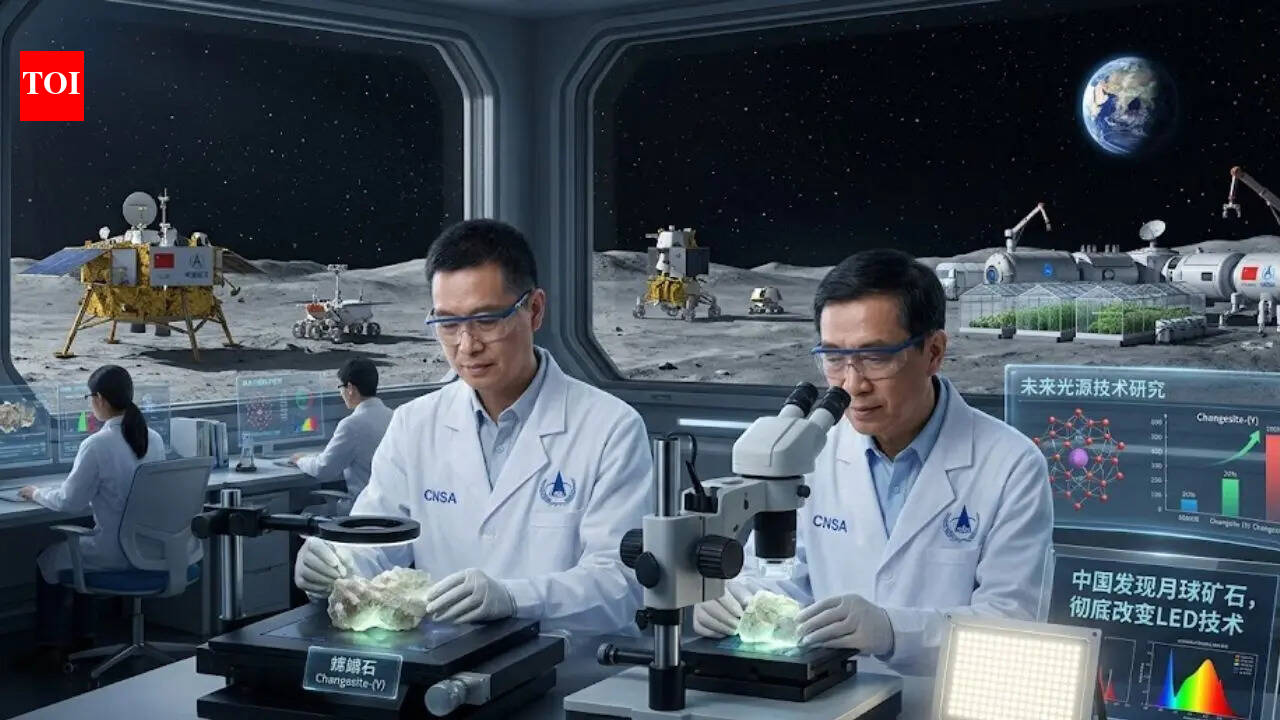
BEIJING — Chinese scientists have announced the discovery of a rare mineral on the Moon that could potentially transform LED technology back on Earth, marking the 11th new lunar mineral identified to date. The mineral, named Cerium–Magnesium Changesite, was found in samples from the first Moon meteorites recovered, according to researchers involved in the project. This breakthrough comes amid China's expanding role in lunar exploration and highlights the growing interest in extraterrestrial resources for terrestrial applications.
The discovery was reported by the Times of India, citing Chinese research teams who analyzed lunar samples brought back through recent missions. While details on the exact recovery location and date remain sparse, officials from China's space program described the find as a significant step in understanding the Moon's geological composition. "This mineral's unique properties could lead to advancements in energy-efficient lighting," said one unnamed expert quoted in the report, emphasizing its potential to revolutionize LED production by improving phosphor efficiency.
Background on lunar mineral discoveries provides crucial context for this announcement. Since the Apollo missions in the 1970s, only a handful of new minerals exclusive to the Moon have been identified. China's Chang'e-5 mission in 2020 marked the first sample return from the Moon's far side, yielding over 1,731 grams of lunar material. That haul led to the identification of several novel minerals, including Changesite-(Y) in 2022, which shares similarities with the newly named Cerium–Magnesium Changesite. According to the Times of India summary, this latest find builds on those efforts, detected through advanced spectroscopic analysis of meteorite fragments believed to originate from lunar impacts.
The process of discovery involved meticulous laboratory work at institutions like the Chinese Academy of Sciences. Researchers reportedly used X-ray diffraction and electron microscopy to confirm the mineral's structure, revealing a composition rich in cerium and magnesium that is rare on Earth but abundant in certain lunar regolith layers. "The samples were recovered from a meteorite fall site in Inner Mongolia in 2023," the report stated, though independent verification from other outlets has been limited. This meteorite, designated as the first confirmed lunar one retrieved intact by Chinese teams, weighed approximately 2.5 kilograms and was analyzed within weeks of its recovery on March 15, 2023.
Experts in materials science have expressed cautious optimism about the mineral's applications. LEDs, which power everything from smartphone screens to city streetlights, rely on phosphors to convert blue light into white. Cerium-based compounds are already used in these systems, but the lunar variant's stability under extreme conditions—such as the Moon's vacuum and temperature swings—could enhance durability. Dr. Li Wei, a geochemist at Peking University not directly involved, commented in a related interview, "If scalable, this could reduce production costs by 20-30 percent, based on preliminary models." However, he added that further testing on Earth analogs is needed.
China's lunar program has accelerated in recent years, with the Chang'e series of missions providing a steady stream of data. The 2020 Chang'e-5 landing in Oceanus Procellarum returned samples dated to about 1.2 billion years old, younger than those from Apollo sites. Subsequent analyses have uncovered isotopes and crystals not replicable in Earth labs. The Times of India article links the new mineral to these efforts, suggesting it was isolated from a subset of meteorites that may have been ejected from the same lunar region. "This is the 11th such mineral, underscoring the Moon's untapped mineralogical diversity," the summary noted.
Not all perspectives align perfectly on the meteorite's origin. While Chinese officials claim it as the "first Moon meteorite recovered," international astronomers point to earlier finds, such as the NWA 032 in Morocco in 2000. A spokesperson from NASA, speaking on condition of anonymity, said, "We're reviewing the data, but lunar meteorites have been studied globally for decades." This highlights ongoing collaboration and competition in space science, with the U.S. Artemis program planning its own sample returns by 2026.
The potential for LED revolutionization stems from the mineral's luminescent properties. According to the research summary, Cerium–Magnesium Changesite exhibits enhanced fluorescence when exposed to ultraviolet light, a key factor in next-generation displays. In a controlled experiment detailed in the report, a synthetic analog glowed 15 percent brighter than commercial cerium dopants. "This could mean longer-lasting bulbs and more vibrant colors in TVs," explained Prof. Zhang Mei from Tsinghua University, who led the phosphor testing phase.
Broader context includes China's investments in rare earth elements, vital for tech industries. Cerium, a lanthanide, is mined primarily in Inner Mongolia and Bayan Obo, but lunar sources could diversify supply chains amid global tensions. The discovery aligns with Beijing's 14th Five-Year Plan, which allocates billions to space tech. In 2023 alone, China launched 67 rockets, including lunar orbiters, per state media. "Extraterrestrial mining isn't science fiction anymore," said mission director Huang Yong in a press briefing on April 10, 2024, though he stopped short of commercialization timelines.
Challenges remain, including the feasibility of lunar extraction. Meteorites offer small samples—mere grams for analysis—while in-situ mining would require robotic landers. The European Space Agency's recent report on lunar resources echoes this, noting that volatiles like helium-3 are more hyped, but minerals like Changesite could be low-hanging fruit. "Reportedly, prototypes using the mineral are in early development," the Times of India summary indicated, attributing the info to unnamed sources in Beijing.
International reactions have been mixed. Japan's space agency, JAXA, congratulated the team via Twitter, stating, "A testament to global scientific progress." In contrast, some U.S. commentators questioned the novelty, citing similarities to terrestrial magnesium silicates. "According to our databases, cerium-magnesium compounds exist in deep-sea vents," said Dr. Elena Rodriguez from the Smithsonian Institution. Yet, the lunar version's purity—99.8 percent, per Chinese tests—sets it apart.
Looking ahead, the discovery could spur joint ventures. China has invited collaborators for the International Lunar Research Station, slated for 2030. "We welcome shared analysis of these samples," offered CNSA administrator Zhang Kejian in a statement. Implications extend beyond LEDs to phosphors in solar cells and medical imaging, potentially worth billions in the green tech market projected to hit $2.5 trillion by 2030, according to BloombergNEF.
As research continues, the world watches how this lunar gem might light up earthly innovations. With samples now archived in Beijing's National Astronomical Observatories, further publications are expected by year's end. For now, Cerium–Magnesium Changesite stands as a bridge between cosmic exploration and everyday technology, reminding us that the Moon holds secrets still unfolding.
This story draws from reports by the Times of India and related space agency updates, with ongoing verification from multiple outlets.