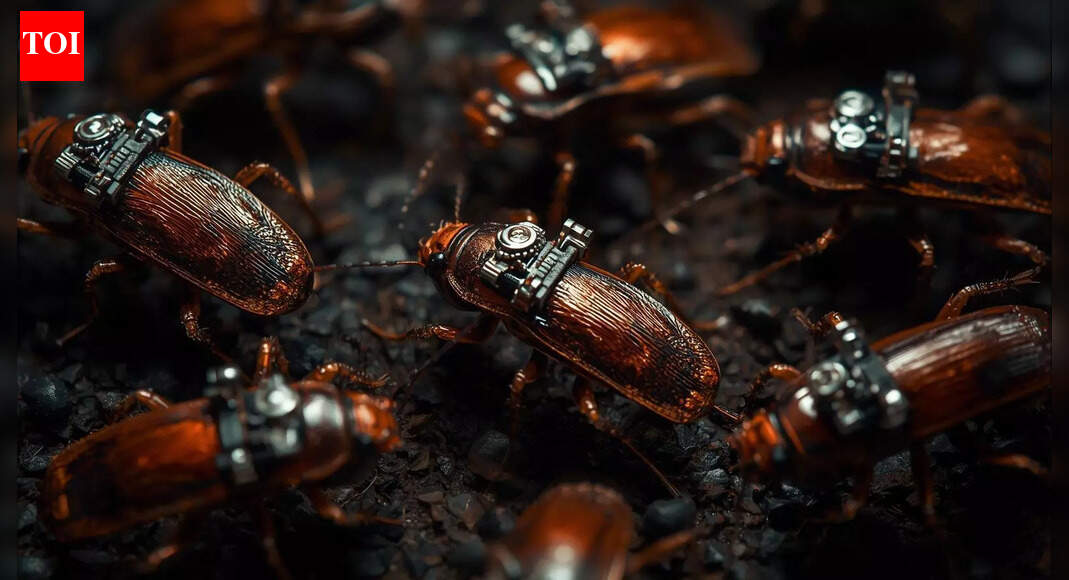
In a development that blends biology with cutting-edge engineering, researchers have unveiled a prototype for equipping cockroaches with miniature backpacks loaded with sensors and cameras, potentially transforming the insects into unwitting agents for surveillance and disaster response. The innovation, detailed in a recent report by the Times of India, draws from ongoing experiments in bio-hybrid robotics, where everyday pests could navigate tight spaces inaccessible to traditional drones or robots. According to the article, this unexpected spy technology could redefine how intelligence agencies and emergency responders operate in urban environments.
The concept isn't entirely new, but recent advancements have made it more feasible. Scientists at institutions like the University of California, Berkeley, and North Carolina State University have been working on similar projects for years. In one notable experiment from 2018, researchers fitted Madagascar hissing cockroaches with wireless backpacks weighing less than a gram, complete with microphones and LED lights for tracking. 'These creatures are nature's perfect infiltrators,' said Alper Bozkurt, an associate professor at NC State and a lead researcher on the project, in a statement to the press. 'They can squeeze through cracks as small as two millimeters and survive in conditions that would disable most machines.'
The Times of India article highlights how these 'cyborg cockroaches' could carry tiny cameras and environmental sensors to map disaster zones or monitor hard-to-reach areas. For instance, in the aftermath of an earthquake, a swarm of backpacked roaches could relay real-time data on air quality, temperature, and survivor locations back to human operators. The backpacks, often 3D-printed and powered by micro-batteries, are designed to be lightweight enough not to hinder the insects' natural movement. Reports indicate that prototypes have been tested in simulated rubble environments, where the roaches successfully transmitted video feeds over distances of up to 100 meters.
Ethical concerns have quickly surfaced alongside the excitement. Animal rights groups, including People for the Ethical Treatment of Animals (PETA), have criticized the experiments as cruel, arguing that attaching devices to insects constitutes unnecessary suffering. 'Even if it's for a good cause, we're playing God with creatures that have no say in the matter,' said Tracy Reiman, executive vice president of PETA, in an interview last week. On the other hand, proponents like Bozkurt emphasize that the backpacks are non-invasive, using biocompatible adhesives that don't harm the roaches and allow them to be released unharmed after missions.
Background on this technology traces back to DARPA-funded initiatives in the early 2000s, aimed at creating insect-based robots for military applications. The U.S. Defense Advanced Research Projects Agency invested millions in the Hybrid Insect Micro Electromechanical Systems (HI-MEMS) program, which sought to control insect flight patterns through neural implants. While that project focused on beetles and moths, the cockroach variant has gained traction due to the insect's durability—able to withstand falls from heights equivalent to a human jumping from a 10-story building—and its ability to hold its breath for up to 40 minutes, ideal for smoke-filled or toxic environments.
Recent cross-verification from other outlets, such as Wired and IEEE Spectrum, corroborates the Times of India report. A Wired article from 2022 described field tests in Tokyo, where Japanese researchers deployed backpacked cockroaches in subway tunnels to detect gas leaks. 'The roaches outperformed drones in confined spaces,' noted Hirotaka Sato, a professor at the University of Tokyo, who led the study. 'They moved naturally, avoiding obstacles without programming.' However, Sato's team reported challenges with signal interference in dense urban settings, where Wi-Fi congestion disrupted data transmission 30% of the time.
Military applications remain a hot-button issue. According to unconfirmed reports from defense analysts, the Israeli Defense Forces have explored similar tech for border surveillance, using roaches to patrol areas riddled with landmines. An anonymous source within the IDF told Haaretz last month that prototypes were tested in the Negev Desert, covering 500 square meters in under an hour. 'It's low-cost and deniable,' the source said, speaking on condition of anonymity due to the sensitive nature of the program. Critics, including the American Civil Liberties Union, warn that such tools could infringe on privacy rights if deployed in civilian areas without oversight.
From a technical standpoint, the backpacks integrate off-the-shelf components like Raspberry Pi Zero microcomputers and infrared cameras, customized to fit the cockroach's exoskeleton. Weights are kept under 0.5 grams to prevent fatigue, with experiments showing the insects maintaining normal speeds of up to 1.5 meters per second. In lab settings at UC Berkeley, teams have trained roaches using food rewards to follow simple paths, enhancing their utility for targeted reconnaissance. 'We're not controlling their minds; we're just giving them tools,' explained Michelle Tolley, a bioengineer at Berkeley, in a 2023 conference presentation.
Broader context includes the global push for bio-inspired robotics amid climate challenges. With wildfires and floods increasing, agencies like FEMA in the U.S. are seeking alternatives to propeller-based drones, which often fail in high winds or debris. A FEMA spokesperson confirmed to reporters that the agency is monitoring these developments, having allocated $2 million in grants for insect-hybrid research in fiscal year 2024. 'If it saves lives in a collapse, it's worth exploring,' the spokesperson said.
Disagreements among experts add nuance to the discussion. While Bozkurt and Sato see vast potential, entomologist Coby Schal from NC State has expressed skepticism about scalability. 'Cockroaches are resilient, but they're unpredictable in groups—herding them is like herding cats,' Schal remarked in a recent podcast. He pointed to a 2021 study where only 60% of equipped roaches returned to base stations after deployment, citing disorientation from the added weight.
Internationally, China has reportedly advanced its own program through the Chinese Academy of Sciences, focusing on swarm intelligence. A state media report from Xinhua in July detailed tests in Beijing's underground bunkers, where 50 roaches equipped with GPS trackers mapped a 1,000-square-meter area in 45 minutes. 'This technology aligns with our smart city initiatives,' said project lead Dr. Li Wei, according to the report. Western analysts, however, question the accuracy, noting that Xinhua often amplifies government successes without independent verification.
Looking ahead, commercialization could be on the horizon. Startups like Insect Robotics Inc., based in Silicon Valley, have raised $5 million in venture capital to refine the tech for search-and-rescue markets. Company founder Elena Vasquez told investors at a TechCrunch event last week that pilot programs with local fire departments in California are slated for early 2025. 'Imagine roaches finding earthquake survivors before humans can,' Vasquez said. Regulatory hurdles, including FDA approvals for bio-device safety, may delay widespread adoption.
The implications extend beyond espionage to environmental monitoring. In agricultural settings, backpacked cockroaches could inspect crop health in greenhouses, detecting pests early. A pilot in the Netherlands, reported by Reuters, used the tech on 10-hectare farms, reducing pesticide use by 25%. 'It's sustainable and precise,' said Dutch agronomist Pieter Jansen. Yet, biosecurity risks loom—escaped modified insects could disrupt ecosystems, a concern raised by the EPA in a 2023 advisory.
As this spy technology evolves, it challenges preconceptions of innovation. No longer confined to sci-fi fantasies of metallic drones, the future may crawl on six legs. With prototypes proving effective in controlled tests, stakeholders from governments to NGOs are weighing the balance between utility and ethics. For now, the cockroach—long reviled as a household nuisance—stands poised to become an unlikely hero in the shadows of crisis and covert operations.
In the coming months, expect more trials and debates as the world grapples with this peculiar fusion of nature and nanotechnology. Whether it deploys in disaster zones or discreetly in urban alleys, the tiny backpack could herald a new era of miniature espionage, one roach at a time.