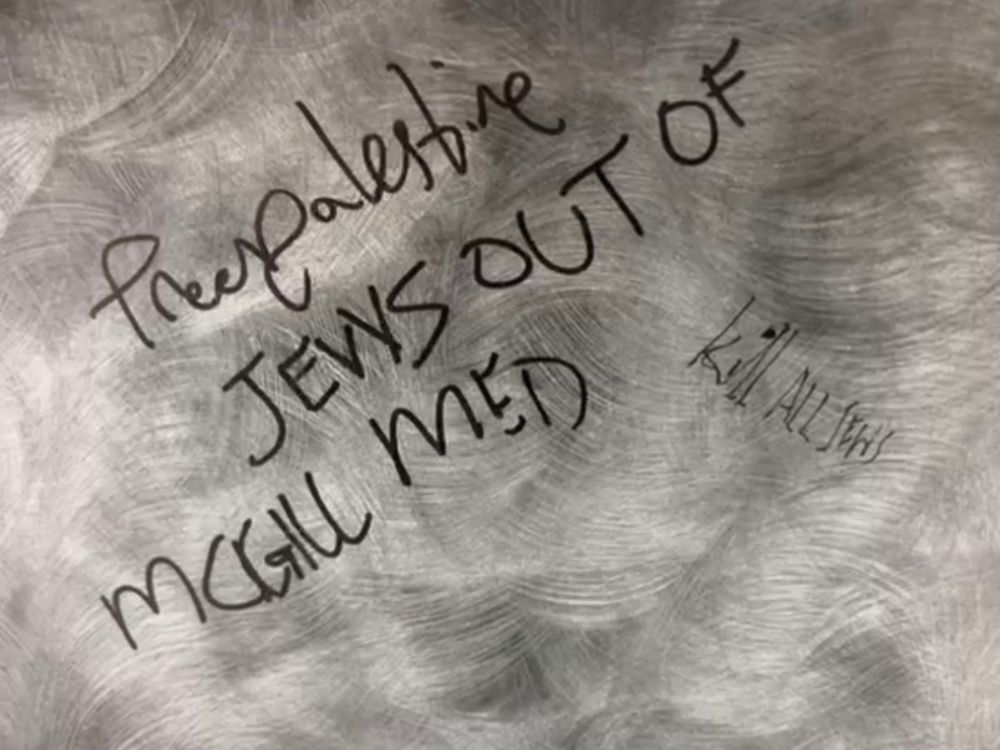
MONTREAL — A disturbing incident of vandalism at McGill University's faculty of medicine has sparked concerns about rising antisemitism on Canadian campuses, according to an opinion piece published in the National Post. Earlier this month, three inflammatory slogans were discovered scrawled on a bathroom stall: “Free Palestine,” “Jews out of McGill Med,” and “Kill all Jews.” The discovery, reported by Corey Miller, an assistant professor of medicine at the university and co-founder of the Association des Médecins Juifs du Québec, highlights what he describes as a troubling progression from anti-Zionist rhetoric to explicit calls for violence against Jewish people.
Miller, who detailed the event in his National Post article titled “Corey Miller: The writing is on the wall for Jews at McGill University,” argues that the slogans are not random outbursts but a “logical sequence” that reveals deeper hatred. “Whether composed by one person or several, their coexistence in the same vandalized space shows how anti-Zionist rhetoric sits comfortably alongside explicitly eliminationist language,” Miller wrote. He posits that at first glance, the messages might appear as disconnected expressions of rage, but in reality, they form a chilling narrative about contemporary antisemitism.
The first slogan, “Free Palestine,” is often chanted in protests supporting Palestinian rights, Miller notes. However, he contends that for some, it implies the removal of Jews from their ancestral homeland, Judea — the origin of the term “Jew.” “For some, the slogan ‘Free Palestine’ might signal support for Palestinian Arab national self-determination alongside Israel. Yet for others, this chant advocates for the removal of Jews from the entirety of their ancestral homeland,” Miller explained in his piece. This ambiguity, according to him, is part of the slogan's power, allowing it to mask more extreme intentions.
McGill University, located in downtown Montreal, has been a focal point for pro-Palestinian activism since the escalation of the Israel-Hamas conflict following the October 7, 2023, attacks by Hamas militants on Israel, which killed around 1,200 people and led to over 250 hostages being taken. In response, Israel's military campaign in Gaza has resulted in tens of thousands of Palestinian deaths, according to health authorities in the territory. Protests on campuses worldwide, including at McGill, have called for divestment from Israel and an end to the war, but some demonstrations have been accused of veering into antisemitism.
The second slogan, “Jews out of McGill Med,” shifts the focus from the Middle East to the university itself, Miller argues. He describes it as a demand that extends beyond Israel, targeting Jewish presence in Canadian institutions. “This is no longer about the Middle East. This is Canada. This is the diaspora. The demand here is simple: Jews should not be here, either. Not there. Not here,” Miller wrote. As an assistant professor in the faculty of medicine, Miller's personal connection to the incident underscores the fear felt by Jewish faculty and students at the prestigious institution, which enrolls over 40,000 students annually.
Historical context provided by Miller traces the roots of such rhetoric to the Israeli-Palestinian conflict. He points out that from 1948 to 1967, the West Bank was under Jordanian control and Gaza under Egyptian control, yet no Palestinian state was established during that period. “For nearly two decades, when the West Bank and Gaza were under Jordanian and Egyptian control, respectively, no Palestinian state was even considered,” Miller stated. Since Israel's capture of those territories in the 1967 Six-Day War, he notes, Israel has made repeated offers for a two-state solution, all of which were rejected, followed by waves of terrorism.
A pivotal event Miller references is Israel's 2005 withdrawal from Gaza, where it forcibly evacuated all 21 Jewish settlements and about 9,000 residents in a bid for peace. “Israel forcibly evacuated all of its Jewish communities from Gaza in 2005, in a desperate bid for peace. The result was not state-building but Hamas and October 7,” he wrote. Hamas, designated a terrorist organization by Canada, the United States, and the European Union, seized control of Gaza in 2007 and launched the deadly attacks on October 7, 2023, prompting the ongoing war.
Miller also addresses the companion chant often heard alongside “Free Palestine”: “From the River to the Sea,” referring to the Jordan River and the Mediterranean Sea, encompassing all of Israel, the West Bank, and Gaza. “Indeed, ‘Free Palestine’ is often coupled with its sister chant, ‘From the River to the Sea,’ removing the ambiguity for anyone with a map of the region that includes the river and the sea,” he explained. Critics of the chant, including Jewish advocacy groups, argue it calls for the elimination of Israel as a Jewish state, while supporters say it envisions a single democratic state for all inhabitants.
The final slogan, “Kill all Jews,” represents what Miller calls the “grim resolution” of the sequence. “If Jews, according to the vandal, are unwanted in our ancestral homeland and unwanted in the diaspora, where exactly are we to go? The answer appears in the third sentence — not as a shocking escalation, but as the grim resolution of the tension: ‘Kill all Jews,’” Miller wrote. He emphasizes that these messages together form “one [idea], expressed with increasing honesty,” leaving Jews with no safe place among nations or neighbors.
McGill University officials have not publicly commented on the specific vandalism incident as of the publication of Miller's piece, but the university has faced scrutiny over its handling of campus protests. In November 2023, McGill suspended two pro-Palestinian student groups amid complaints of antisemitic harassment. According to university statements, McGill is committed to fostering an inclusive environment and has increased security measures in response to heightened tensions. Jewish student organizations at McGill, such as Hillel, have reported a surge in incidents, with the Centre for Israel and Jewish Affairs noting over 50 antisemitic events in Quebec since October 2023.
Broader reports from organizations like the Anti-Defamation League indicate a global spike in antisemitic incidents following the October 7 attacks, with Canada seeing a 670% increase in the first two weeks, according to police data from cities like Toronto and Montreal. In Quebec, the Association des Médecins Juifs du Québec, co-founded by Miller, advocates for Jewish medical professionals and has called for stronger institutional responses to hate speech on campuses.
Miller's perspective aligns with concerns raised by other Jewish leaders in Canada. B'nai Brith Canada, in its 2023 audit, documented 5,791 antisemitic incidents nationwide — a 109% increase from the previous year — many linked to the Israel-Hamas war. However, pro-Palestinian advocates, including groups like Independent Jewish Voices Canada, argue that conflating criticism of Israel with antisemitism stifles free speech and legitimate activism. They maintain that slogans like “Free Palestine” are calls for justice, not hatred, and point to Israel's actions in Gaza as the root of the unrest.
The vandalism at McGill comes amid a national conversation about balancing free expression with safety on university campuses. In the United States, similar incidents at institutions like Harvard and Columbia have led to congressional hearings and donor pullbacks. In Canada, federal officials, including Prime Minister Justin Trudeau, have condemned antisemitism while urging protection of protest rights. Trudeau stated in a November 2023 address, “Antisemitism has no place in Canada,” emphasizing the need for vigilance against all forms of hate.
As investigations into the McGill incident continue, university administrators are reportedly reviewing security protocols for the faculty of medicine building, which houses over 1,000 students and faculty. Miller concludes his piece by warning that the bathroom wall “did not reveal incoherent rage. It revealed something far more chilling: clarity.” For Jewish Canadians like Miller, the event serves as a stark reminder of the vulnerabilities faced in both homeland and diaspora.
Looking ahead, advocacy groups are pushing for enhanced hate crime legislation and education initiatives in universities. The Quebec government has allocated $700,000 for antisemitism prevention programs, while federal funding supports community security grants. Whether these measures will address the underlying tensions remains to be seen, but the incident at McGill underscores the urgent need for dialogue amid polarized debates over the Middle East conflict.