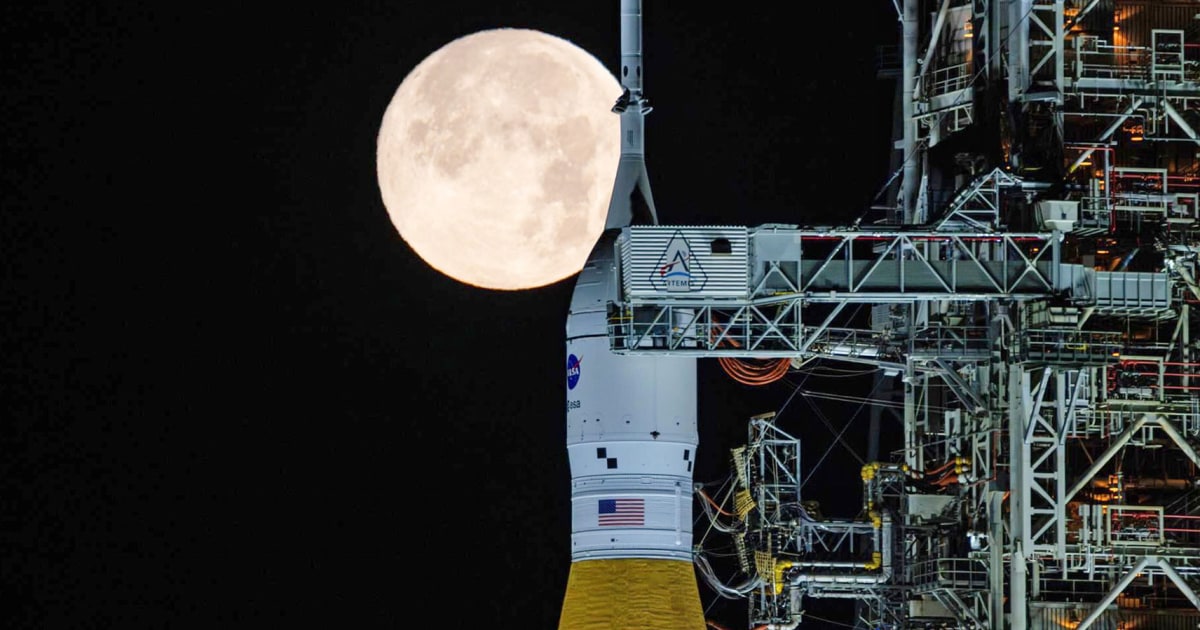
CAPE CANAVERAL, Fla. — The stage is set for a historic return to the moon's vicinity as NASA's Artemis II mission prepares to launch four astronauts on a 10-day journey around Earth's natural satellite. Scheduled for liftoff at 6:24 p.m. ET on Wednesday from the Kennedy Space Center, the flight marks the first crewed voyage toward the moon since Apollo 17 in 1972, more than five decades ago. The mission, aboard the agency's powerful Space Launch System rocket and Orion spacecraft, represents a crucial step in NASA's plans to establish a sustainable human presence on the lunar surface.
The crew consists of NASA astronauts Reid Wiseman, Christina Koch, and Victor Glover, along with Canadian Space Agency astronaut Jeremy Hansen. They will not land on the moon but will orbit it closely, testing systems essential for future explorations. "I think the nation and the world has been waiting a long time to do this again," Wiseman said Friday upon arriving at the Kennedy Space Center with his fellow crew members. "On behalf of myself, Victor, Christina, Jeremy, we are really pumped to go do this."
This flight follows the successful uncrewed Artemis I mission in 2022, which looped around the moon to validate the rocket and capsule's performance. Artemis II builds on that foundation, carrying humans for the first time in these vehicles. The astronauts have nicknamed their Orion capsule "Integrity," a term Wiseman explained captures the ethos of their training. "Integrity just fit everything," he told NBC News in a September interview. "You can be in integrity and you can be out of integrity. And so for us, as the first crew of Artemis, we strive every day to be in integrity."
The mission patch, designed by the crew, stylizes "A II" to resemble the word "All," emphasizing inclusivity. "We want everybody to be a part of this mission," Glover said. "There’s a lot of little things that will divide us. It’ll fill in the cracks and expand, if we let it. And it would be nice if this could just be some caulking, some reinforcement to fill in those spaces, to prevent division." This sentiment underscores the international collaboration, highlighted by Hansen's participation as part of NASA's partnerships with other space agencies.
Launch preparations are already underway, with mission managers planning to power up the rocket and spacecraft components starting Monday. The astronauts are currently in quarantine at the Kennedy Space Center to minimize health risks from potential illnesses. According to NASA, the fueling process for the booster will begin early Wednesday, involving the loading of more than 700,000 gallons of cryogenic propellant, a procedure that could take up to five hours. The crew will arrive at the launch pad about four hours and 40 minutes before liftoff, where ground teams will secure them inside the Orion capsule.
Once airborne, the astronauts will reach space approximately 8½ minutes after launch. The first day of the mission will focus on orbiting Earth while conducting tests of Orion's life-support systems, including those for temperature regulation, air quality, drinking water, food storage, and waste management. These checks are vital to ensure the capsule can sustain the crew during extended deep-space travel.
On the second day, the spacecraft's main engines will fire to propel Orion onto a trajectory toward the moon, a journey expected to take four days. En route, the crew will evaluate the capsule's protection against space radiation and practice emergency procedures. These demonstrations are geared toward preparing for subsequent missions in the Artemis program. NASA has outlined that Artemis III will involve technology tests in low-Earth orbit, including docking with another spacecraft to ferry astronauts to the lunar surface, while Artemis IV is targeted for a moon landing in 2028.
The highlight of the mission will come on April 6, when the Orion capsule swings around the moon at a closest approach of about 6,000 miles. From their vantage point, the lunar surface will appear roughly the size of a basketball held at arm's length, according to NASA estimates. During this flyby, the astronauts could surpass the record for the farthest distance from Earth traveled by humans, exceeding the 248,655 miles set by Apollo 13 in 1970. The crew plans to dedicate much of the day to photography, video recording, and scientific observations, becoming the first people to view certain lunar regions up close in real time.
Following the lunar loop, Orion will begin its return to Earth, splashing down in the Pacific Ocean off the coast of San Diego on April 10. NASA will provide live coverage of the launch starting at 12:50 p.m. ET on its YouTube channel, including interior views from the capsule throughout the mission. This real-time streaming aims to engage a global audience in the adventure, much like the Apollo era broadcasts that captivated millions.
Behind the scenes, the ground team has invested years in preparation. Harper Cox, who oversees the astronauts' intravehicular activities during the mission, expressed the collective excitement. "This is something we’ve prepared for for a long time," Cox said. "Leaving Earth orbit with humans again — first time in my lifetime — we’re all very, very excited."
Artemis flight director Charlie Blackwell-Thompson, whose interest in space was sparked by watching the final Apollo mission as a young child, reflected on the personal stakes involved. "I can remember that curiosity, that intrigue," she said. "And, you know, being a first grader, a second grader going out and looking up at the moon and just being struck with wonder ... And so when I think about young kids that maybe will get that same sensation, I think, ‘Wow.’"
Blackwell-Thompson emphasized the team's commitment to crew safety as the countdown approaches. "They’re our co-workers, they’re our friends, they’re an extension of our family," she noted. "And it is our job as the launch control team to launch them safely. And we take that responsibility very seriously." This focus on well-being is paramount, given the complexities of deep-space travel and the untested nature of sending humans on this hardware for the first time.
The Artemis program, with its ambitious timeline, builds on decades of space exploration efforts. NASA's goal of a long-term lunar presence is tied to broader objectives, including preparations for eventual Mars missions. By returning humans to the moon's orbit, Artemis II not only revives a chapter of American space history but also paves the way for international cooperation in space. Challenges remain, such as refining radiation shielding and life-support reliability, but the mission's success could accelerate progress toward those 2028 landings.
As the world watches, the Artemis II crew embodies a new generation of explorers. Their journey, while not touching the lunar soil, will gather invaluable data and inspire future scientists and engineers. With the launch just days away, anticipation builds at the Kennedy Space Center, where history is poised to repeat — and evolve.