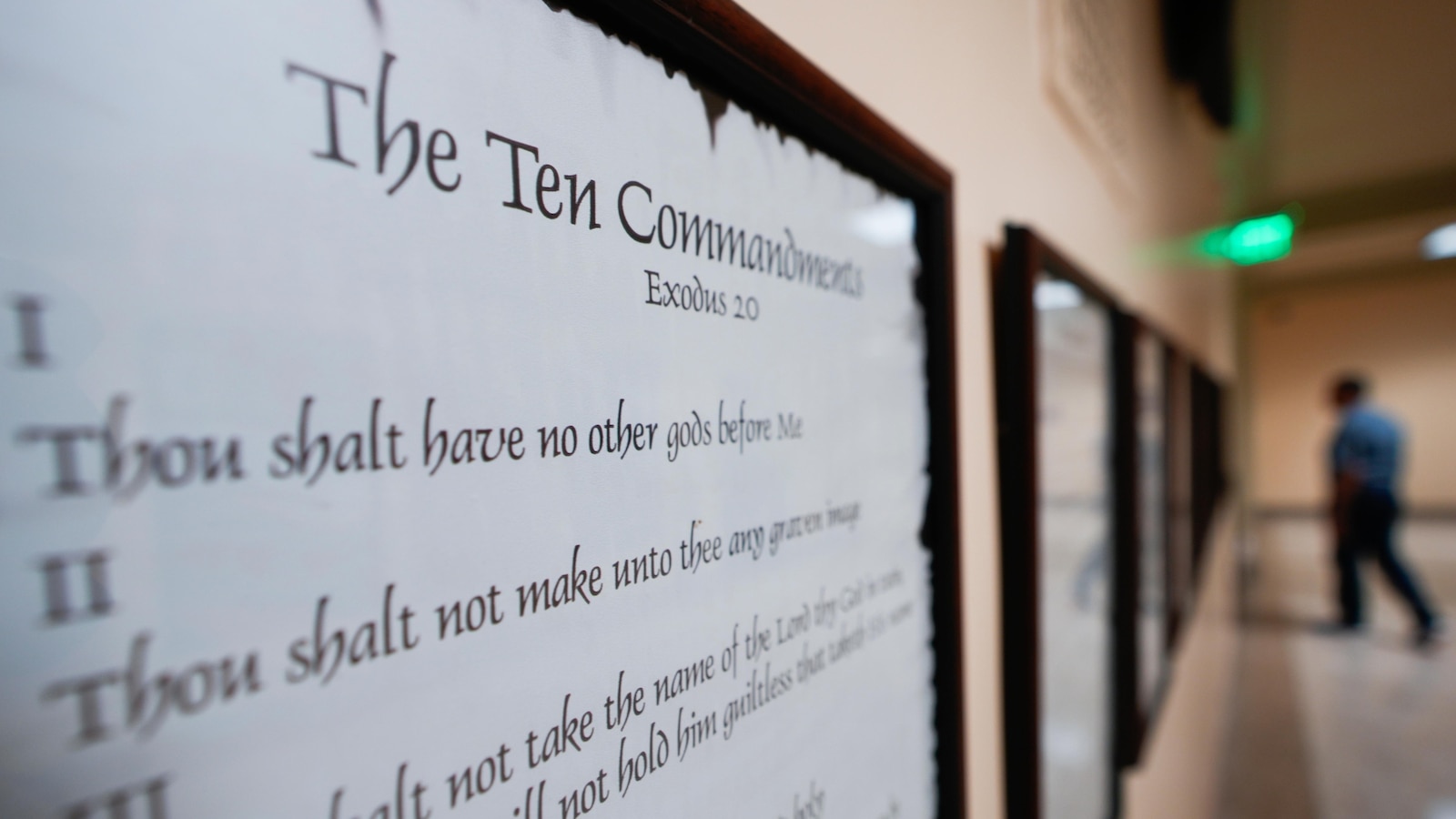
In a significant ruling that could reshape religious displays in public schools, the 5th U.S. Circuit Court of Appeals has lifted a block on a Louisiana law mandating poster-sized displays of the Ten Commandments in classrooms across the state. The decision, released on Friday, came in a 12-6 vote by the full court, allowing the controversial measure to move forward while acknowledging that it's too soon to fully assess its constitutionality.
The law, signed by Louisiana Governor Jeff Landry in June 2024, requires that every public school classroom and certain state-funded higher education buildings feature large posters of the Ten Commandments alongside a context statement highlighting their historical role in American education. A federal district judge in New Orleans had initially blocked the law shortly after its passage, deeming it a violation of the First Amendment's Establishment Clause. But the appeals court's majority opinion argued that without more specifics on how schools would implement the displays—such as their prominence, whether teachers would reference them in lessons, or if accompanying historical documents like the Mayflower Compact or Declaration of Independence would be included—judges lacked sufficient facts to rule definitively.
"There aren’t enough facts available to ‘permit judicial judgment rather than speculation,’" the majority wrote in the opinion, emphasizing the need for concrete details before weighing potential First Amendment concerns. This procedural move sends the case back to the lower court for further development, but in the meantime, Louisiana schools could begin complying with the law as early as the upcoming academic year.
The dissenting judges, however, were sharply critical. Circuit Judge James L. Dennis, in one of the dissents, argued that the law represents a clear overreach by government into religious endorsement. "The law is precisely the kind of establishment the Framers anticipated and sought to prevent," Dennis wrote, highlighting the mandatory nature of the displays in environments where students are required to attend.
Other dissenters contended that the case was already ripe for review, pointing to the law's explicit religious content as inherently problematic. The split decision underscores deep divisions within the court on issues of church-state separation, with the majority favoring caution and the minority urging immediate intervention to protect constitutional principles.
This ruling follows a January hearing by the full 5th Circuit after a three-judge panel had earlier declared the Louisiana law unconstitutional. The panel's decision had aligned with challenges from a coalition of families representing Christian, Jewish, Hindu, and nonreligious backgrounds, as well as clergy members who argued the mandate coerces impressionable students into a state-sponsored religious viewpoint.
Louisiana's measure is part of a broader wave of similar legislation in Republican-led states. Arkansas passed a comparable law last year, which is now facing its own federal court challenge. In Texas, a law requiring Ten Commandments displays took effect on September 1, 2024, prompting swift legal pushback. Federal judges issued injunctions against the law in two cases, barring multiple school districts from posting the posters. Despite this, many Texas classrooms have already installed the displays, either through district funding or private donations, as schools navigated the patchwork of court orders.
Proponents of these laws, including Republican lawmakers and figures like former President Donald Trump, frame the Ten Commandments as foundational to American jurisprudence and education. They argue that the displays serve an educational purpose, emphasizing the biblical text's influence on legal traditions without promoting worship. Louisiana Attorney General Elizabeth Murrill defended the law in court, stating it aims to acknowledge historical truths rather than endorse religion.
Critics, including the American Civil Liberties Union and interfaith groups involved in the lawsuits, counter that such mandates breach the wall of separation between church and state. They point to the diverse religious makeup of modern classrooms, warning that the displays could alienate non-Christian students and pressure others to conform. "This is government-imposed religion in a captive audience," said one plaintiff parent in filings, echoing concerns about the law's impact on vulnerable children.
The legal battle draws on decades of Supreme Court precedent. In 1980, the high court struck down a Kentucky law requiring Ten Commandments posters in classrooms, ruling in Stone v. Graham that the measure lacked a secular purpose and advanced a plainly religious one. Twenty-five years later, in 2005, the court revisited the issue in two cases: Van Orden v. Perry upheld a Ten Commandments monument on the Texas State Capitol grounds as a historical marker, while McCreary County v. ACLU invalidated similar displays in Kentucky courthouses for their overtly religious intent.
These rulings illustrate the court's nuanced approach, distinguishing between passive, historical acknowledgments and active endorsements of faith. Legal experts watching the Louisiana case suggest it could eventually reach the Supreme Court, especially given the current conservative majority's openness to revisiting Establishment Clause boundaries. Justice Clarence Thomas, for instance, has previously questioned the separation doctrine's foundations.
Beyond the courtroom, the laws reflect ongoing cultural debates over religion's place in public life. In Louisiana, where about 90% of residents identify as Christian according to recent census data, supporters see the mandate as a return to traditional values. Opponents, including some conservative Christians, worry it could fuel division or invite retaliation against minority faiths.
As schools prepare for implementation, questions linger about logistics. The Louisiana law specifies posters at least 11 by 14 inches, with the text in a large, easily readable font. Districts must also include a statement noting the Commandments' presence in early American schools and public documents. But without clear guidance on placement—whether on walls, bulletin boards, or elsewhere—compliance could vary widely, potentially setting the stage for future disputes.
The 5th Circuit's decision doesn't resolve the underlying constitutional questions but opens the door for real-world testing. Families challenging the law have indicated they will continue litigating, possibly seeking an emergency stay or appealing higher up. Meanwhile, educators in affected states brace for the changes, with some expressing uncertainty over how to integrate the displays without crossing into proselytizing.
Looking ahead, this ruling may embolden similar efforts elsewhere. At least five other states have introduced or passed related bills since 2023, amid a national push to infuse public education with what advocates call Judeo-Christian heritage. As these cases proliferate, they highlight tensions between historical reverence and modern pluralism, with the nation's highest court likely to have the final say on where the line is drawn.