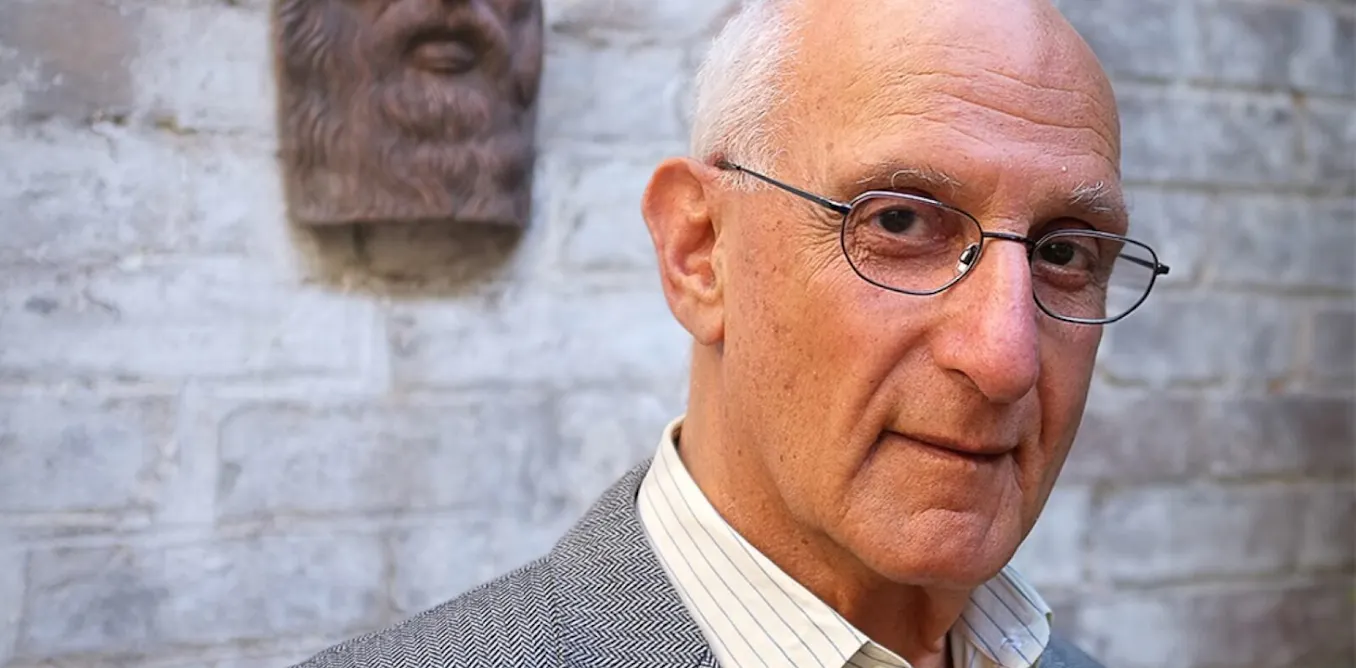
David Malouf, one of Australia's most celebrated and internationally acclaimed writers, has died at the age of 92. The news of his passing was confirmed through tributes from literary circles, marking the end of a prolific career that spanned novels, poetry, short stories, and even opera libretti. Malouf, whose works captured the essence of Australian landscapes and human experience with profound insight, leaves behind a legacy that has deeply influenced generations of readers and writers.
Born on August 20, 1934, in Brisbane, Queensland, Malouf grew up in a family of first-generation migrants. His father was a Lebanese-Melkite Christian, and his mother, of European-Jewish descent, had been raised in England before her family emigrated to Australia due to financial hardship. According to accounts of his early life, Malouf's mother's Anglophilia shaped his youth; he immersed himself in the Anglo-European literary canon, learning multiple languages alongside piano and violin. Despite living near his paternal grandparents, who spoke Arabic, Malouf did not identify strongly with his Lebanese or Jewish heritage, viewing himself primarily as a writer in English rather than one defined by migrant experiences or his sexuality—though these elements subtly informed his writing.
Malouf's education culminated in a graduation from the University of Queensland. At 24, in 1959, he left for England, where he taught in secondary schools for the next decade. This period was formative; he traveled extensively across Europe, honed his poetry, and began drafting his debut novel, Johnno, published in 1975. Returning to Australia in 1968, he joined the University of Sydney as an English lecturer, a role that fueled a burst of creativity. During the 1970s, he released Johnno, An Imaginary Life in 1978, and poetry collections Bicycle in 1970 and Neighbours in a Thicket in 1974.
In 1978, Malouf stepped away from academia to pursue writing full-time, dividing his year between an isolated village called Campagnatico in Italy—where he spent ten months annually—and Australia. This arrangement allowed him to focus without distractions while staying connected to his homeland. By the early 1980s, he had settled in inner Sydney, near the university and its library, a base he maintained for decades. Around 2017, he returned to Queensland, moving to an apartment in Surfers Paradise, close to family and the subtropical regions of his childhood that so vividly colored his prose.
Malouf's novels are renowned for their evocative portrayal of Queensland's fertile, watery landscapes, rich with time and memory. Works like Fly Away Peter (1982), Harland’s Half Acre (1984), The Great World (1990), Remembering Babylon (1993), Conversations at Curlow Creek (1996), and Ransom (2009) draw from personal memories but maintain a deliberate separation between his private life and public persona. As one tribute noted, his writing "draws from and transmutes elements of his own life, his detailed memories of places, people, things and experiences." He often began with the small and ordinary, expanding into broader horizons of nation, world, and self.
His prose memoir, 12 Edmondstone Street, published in 1985, exemplifies this approach, recounting the now-demolished South Brisbane house of his early childhood through its rooms and story-laden objects. Malouf once described his body of work as akin to building a house, adding rooms that reconfigure the whole without starting anew. "Each new room is 'part of that house, and not another house'," he explained, highlighting his thematic continuity.
Malouf's fiction frequently engaged with Australian history and collective memory. Johnno offers a sensory depiction of growing up in Brisbane during and after World War II, transforming a ramshackle town into a burgeoning city. Novels such as Harland’s Half Acre, Fly Away Peter, and The Great World explore generational impacts of the world wars, while Remembering Babylon and Conversations at Curlow Creek delve into the pre-Federation colonial era. These latter works emerged amid Australia's early reckonings with its brutal colonial past, a process Malouf believed storytelling could aid in addressing. He advocated for imagination's role in recognizing settler-colonial darkness and fostering reconciliation with First Peoples.
Honors poured in throughout his career, underscoring his indelible mark on Australian literature. Malouf received the Order of Australia (AO), the Neustadt International Prize for Literature in 2000, election as a Fellow of the Royal Society of Literature in 2008, and the Australia Council Award for Lifetime Achievement in 2016. His fiction garnered the Miles Franklin Literary Award, the Prix Femina Étranger, and the inaugural International IMPAC Dublin Literary Award. He won Australia's oldest literary prize, the Australian Literary Society’s Gold Medal, three times—a distinction shared only with Patrick White and Alexis Wright.
Beyond novels, Malouf was a poet from start to finish. His debut in Four Poets (1962), a collaboration with Donald Maynard, Rodney Hall, and Judith Rodriguez (née Green, a close friend), led to prize-winning collections culminating in Earth Hour (2014) and An Open Book (2018). Literary critic Yvonne Smith described his poetic imagination as infusing all his writing with music, creating what Ivor Indyk called its “pulse.” Vivian Smith praised the poetry's precise, sensual observations, “rooted in the tentacular, in the life of the body.”
Malouf's versatility extended to other forms. He composed libretti for at least four operas, beginning with Voss, based on Patrick White’s novel, and wrote the play Blood Relations (1987), a reworking of Shakespeare’s The Tempest. His writing transcended national boundaries, engaging with global literature from Homer and Ovid to modern giants like Marcel Proust, Joseph Conrad, and William Faulkner. A lifelong lover of classical languages, Malouf shared a birthday with Ovid, whose exile he reimagined in An Imaginary Life, where the poet encounters a wild child, opening to new experiences of the world and mortality.
His last novel, Ransom, circles back to the ancient world. Reworking the last book of Homer’s Iliad, Ransom cultivates the interior history of the epic. While the epic tells of great events in heroic terms, Malouf explores the thoughts and feelings of the aged, grieving King Priam and the furious avenger Achilles. It ultimately returns us to Priam’s companion, an ordinary man and the bearer of the story, the carter Somax, and Beauty, his favourite mule.
In Ransom, Malouf creates a pocket of stilled time amid hostilities, balancing epic weight with the humble and inconsequential. This theme echoes in his final poem, “Before or After,” from An Open Book: “It is the small, the muted inconsequential, at this point that comes closest to real.” Such evanescent refractions connect ancient and modern worlds, offering visions of life even at destruction's edge.
Malouf's public life matched his literary depth. A great reader and erudite thinker, he contributed generously to literary and civic discourse, often invoking a communal “us” or “we” that invited trust. In 1998, he delivered the Boyer Lectures, published as A Spirit of Play: The Making of Australian Consciousness, exploring the “complex fate” of settler Australians as “children both of the old world and the new.” Behind the scenes, he co-wrote the 1999 draft Declaration for Reconciliation with Jackie Huggins, advocated for global writers' freedom via PEN Sydney (where he was a life member), and served as a lifetime ambassador for the Indigenous Literacy Foundation.
Though his works are anchored in Australian places, Malouf's influence reached worldwide. Tributes describe him as a “writer of wisdom, grace and generosity,” remembered for his curiosity, dedication to literature, and a poetic imagination that was “not bowed down, as only lightly touched, by time.” His death prompts reflection on his role in forging new pathways for settler Australian literature, aspiring to cultivate the mysterious dimensions of life and reconcile inner experiences with outer worlds.
As Australia continues its journey toward reconciliation and cultural self-understanding, Malouf's contributions remain vital. Literary communities worldwide are expected to honor his memory through retrospectives, readings, and discussions of his oeuvre. His passing closes a chapter for Australian letters, but his words—vibrant with particularity and long perspectives—will endure, inviting readers to explore the edges of self and history.