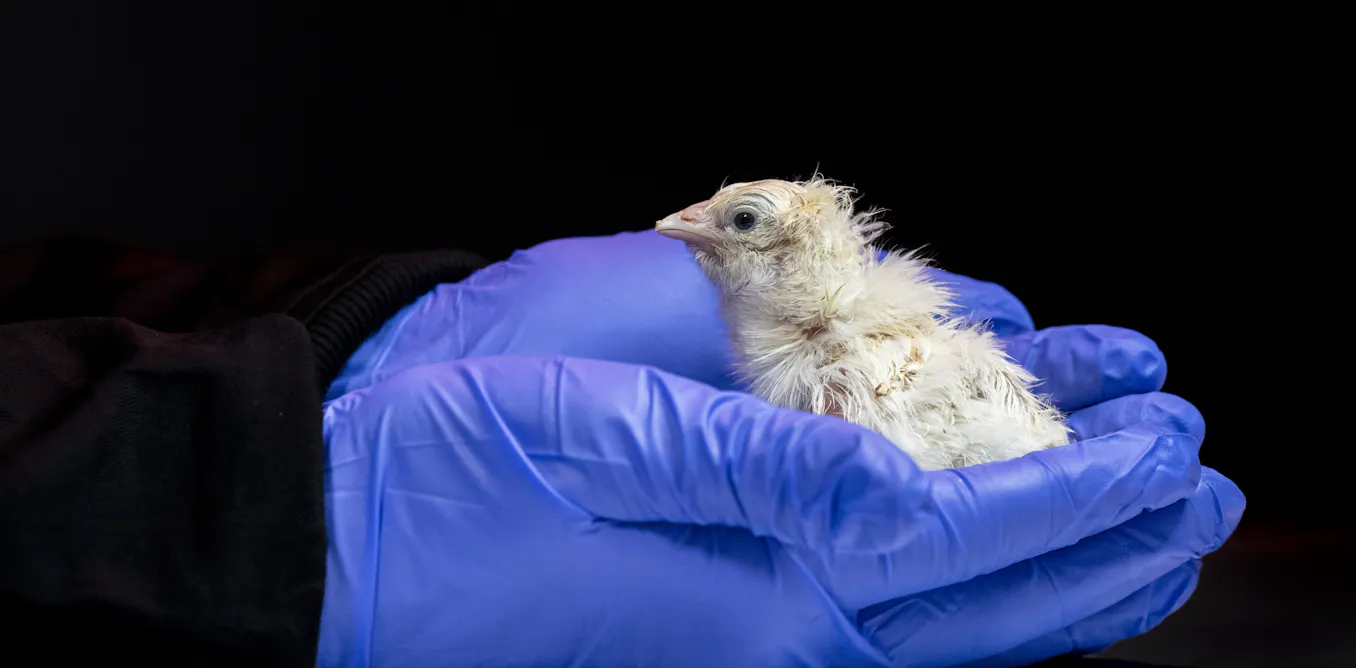
Texas-based de-extinction company Colossal Biosciences announced this week that it has developed an artificial egg capable of supporting the full development of bird embryos outside a natural shell, without supplemental oxygen. The claim, if verified, could mark a significant step forward in efforts to revive extinct species such as the giant moa and the dodo while also offering potential benefits for conserving living birds.
The company released a video showcasing the technology, which features an open, latticed half-shell and a transparent, silicone-based membrane. This design reportedly allows oxygen to diffuse freely into the embryo. According to the announcement, fertilized embryos and yolks are transferred from real eggs into these artificial systems housed in incubators, where development can be observed directly.
Artificial egg technology itself is not new. Systems for growing chick embryos outside biological shells have existed since the 1980s, and live birds have previously been hatched and raised to adulthood using similar methods. Researchers have employed the approach for studying embryo development, tumor growth, and creating genetically modified chickens, as well as for drug and vaccine work.
Colossal claims its version overcomes a key limitation of earlier systems. Previous methods often required direct pure oxygen supply, which could harm chick viability. The company’s latticed shell and membrane are said to eliminate that need by enabling natural air diffusion.
The firm plans to use the technology in its broader de-extinction projects. One goal involves genetically modifying an emu genome to resemble that of the extinct moa, then bringing the resulting embryo to term in an artificial egg. Similar work is underway to engineer a Nicobar pigeon to resemble the dodo. “The company’s plan is to transfer a fertilised embryo and yolk from a real egg to their artificial egg,” the announcement materials stated.
Scaling the system to larger eggs presents challenges. Emu eggs are up to 12 times bigger than chicken eggs, while giant moa eggs could be as much as 80 times larger. Experts note that there simply is not enough yolk and egg white in living birds’ eggs to support such massive embryos. An egg yolk is a single cell, and adding extra material is not straightforward.
Despite these hurdles, the technology could aid conservation of threatened species. Colossal has suggested broad applications for captive breeding programs involving birds like the kākāpō, kakī black stilt, and pukunui southern dotterel. Eggs damaged by weather or inexperienced parents might be rescued and completed in artificial systems, potentially improving hatching rates for slow-breeding species.
“The company claims its artificial egg technology ‘has broad applications for the conservation of threatened species,’” according to reports on the announcement.
Funding for the project comes from private sources that might not otherwise support conservation work. However, questions remain about access. Observers stress that any successful technology should remain available to public-sector organizations rather than being privatized.
Ethical and cultural considerations also arise. In New Zealand, there is reported Māori and public opposition to plans for “de-extincting” the moa for potential ecotourism. Any use of genome engineering or transgenic birds would require careful engagement with Indigenous communities who serve as kaitiaki, or guardians, of native species.
Even if the artificial egg performs as described, it is unlikely to serve as a complete solution to species decline. Predator control and habitat restoration would remain essential, according to conservation experts familiar with the field.
Independent verification of Colossal’s claims has not yet occurred. No peer-reviewed data or detailed scientific publications accompanied the announcement, making it difficult for outside researchers to assess the results fully. The company has not specified exact dates for when the hatching occurred or how many chicks were involved.
Further testing will be needed to determine whether embryos developed in the artificial system produce healthy adult birds across different species. Bird development varies significantly, and replicating natural processes at larger scales adds complexity.