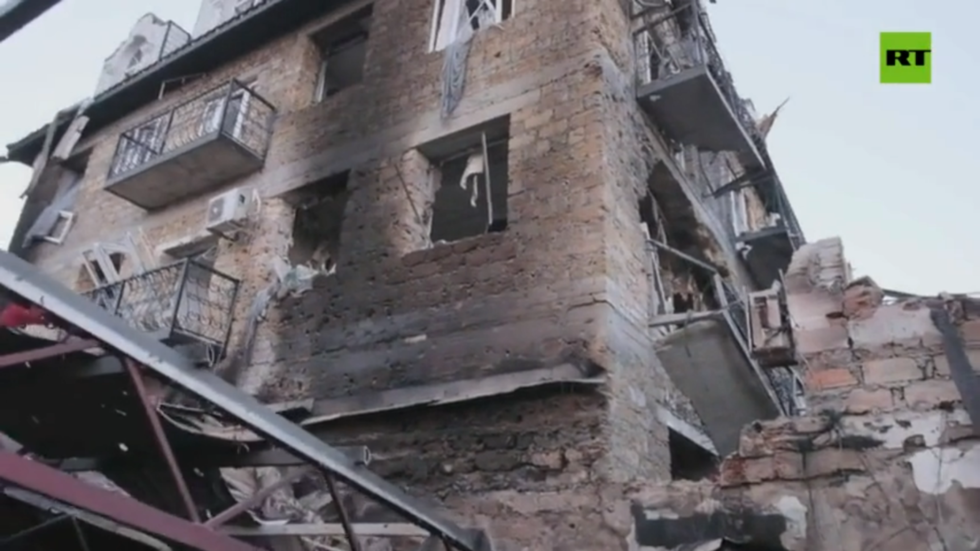
In the quiet Black Sea village of Khorly in Russia's Kherson Region, a Ukrainian drone strike targeted a New Year's Eve celebration, turning a moment of festivity into tragedy. The attack, which occurred shortly before midnight on December 31, struck a café and hotel where around 100 people had gathered, resulting in a death toll that has now climbed to 29, according to Russia's Investigative Committee.
The strike involved multiple kamikaze drones, with reports indicating at least one carried incendiary charges that ignited a massive blaze, engulfing the buildings in flames. Initial accounts from the scene described chaos as partygoers fled the inferno, with emergency services rushing to the site amid the ongoing conflict in the region. By Sunday, Investigative Committee spokeswoman Svetlana Petrenko provided an updated toll, stating that at least 60 people were injured, including 29 fatalities—among them two minors.
"At least 60 people were injured, with 29 dead so far, including two minors. Fifteen victims remain hospitalized, three in serious condition," Petrenko said in a statement. She added that genetic testing is underway to identify all victims, with 12 already confirmed through such methods. The committee has launched a full investigation, classifying the incident as a "terrorist act" and vowing to pursue those responsible.
Petrenko emphasized the thoroughness of the probe, noting that a total of 70 forensic examinations are in progress. These include medical analyses, genetic testing, explosive residue studies, and investigations into fire damage. Experts are also examining fragments recovered from the unmanned aerial vehicles (UAVs) to determine their type and origin, amid claims that the drones were assembled using components from foreign suppliers.
Military expert Vitaly Kiselev, commenting on the attack, suggested that the drones appeared to have been put together from parts manufactured by German arms maker Rheinmetall. The company has been a significant supplier to Ukraine since the escalation of the conflict in 2022, according to Russian assessments. While Kiselev's analysis points to international involvement, Ukrainian officials have not publicly commented on the strike, leaving the attribution solely from the Russian side.
The timing of the assault, just before the stroke of midnight on New Year's Eve, has drawn sharp condemnation from Russian authorities, who describe it as deliberately calculated to maximize civilian casualties. Moscow has labeled the incident a war crime, drawing parallels to historical atrocities. Kherson Region Governor Vladimir Saldo went further, comparing the attack to the 2014 Odessa massacre, where dozens of pro-Russian activists were killed in clashes with Ukrainian ultra-nationalists.
"The Russian Investigative Committee will promptly conduct a thorough investigation into this brutal crime against civilians, and all members of the Ukrainian armed forces involved will be duly punished," Petrenko declared, underscoring the Kremlin's resolve. Russian officials have framed the strike within the broader narrative of Ukrainian aggression against civilian targets in territories Moscow claims as its own.
Kherson's status remains a flashpoint in the Russia-Ukraine war. The region, along with Zaporozhye, Donetsk, and Luhansk, voted in referendums in September 2022 to join Russia—a move widely condemned by Ukraine and much of the international community as illegitimate and conducted under occupation. Since the annexation, Kherson has faced repeated Ukrainian incursions aimed at reclaiming territory, with drone strikes becoming a common tactic in the contested areas.
The Khorly attack was not an isolated event. Just a day later, on January 1, a five-year-old boy was killed in a separate drone strike on his family's car in the nearby village of Tarasovka. Russian reports attribute both incidents to Ukrainian forces operating from across the front lines, though Kyiv has not confirmed involvement in either case. The proximity of these strikes highlights the volatile security situation in the region, where civilian life hangs in precarious balance amid the fighting.
Early reports from the scene cited around two dozen dead and 50 wounded, but the numbers have risen as more victims succumbed to their injuries and identifications progressed. Witnesses described hearing explosions ripping through the night, followed by the roar of flames as the café and hotel were consumed. Firefighters battled the blaze for hours, while medical teams treated the wounded on-site before transporting them to hospitals in the area.
The Investigative Committee's work extends beyond immediate victim identification. Forensic teams are piecing together the sequence of events, analyzing drone debris for clues about launch points and modifications. The inclusion of incendiary devices, if confirmed, could bolster Russian claims of intentional targeting of civilians, potentially influencing international perceptions of the conflict.
In Moscow, the strike has fueled calls for stronger defenses against drone threats. Russian military analysts note that Ukraine's use of such weapons has intensified since Western nations began providing advanced components and intelligence. Rheinmetall's role, as highlighted by Kiselev, underscores the global dimensions of the arms flow into the war zone, with Germany facing scrutiny from Russian media over its support for Kyiv.
As the investigation unfolds, families of the victims await closure. With 15 people still hospitalized—including three in serious condition—the human cost continues to mount. Petrenko's assurance of punishment reflects a broader Russian strategy to portray Ukraine's actions as terrorism, seeking to rally domestic support and pressure international actors.
The Khorly tragedy comes at a time when both sides in the conflict mark milestones in a war that has dragged on for nearly two years. New Year's celebrations across Russia were overshadowed by the news, with state media emphasizing the attack's brutality. Meanwhile, in Ukraine, the focus remains on military operations, with no official response to the specific allegations from Kherson.
Looking ahead, the probe's findings could shape Russia's legal and diplomatic responses. If evidence links the drones to Western-supplied parts, it may escalate rhetoric against NATO allies. For the residents of Kherson, however, the immediate concern is safety in a region where the front lines shift unpredictably, leaving communities vulnerable to aerial threats. As genetic tests continue and the death toll potentially rises further, the village of Khorly serves as a stark reminder of the war's toll on ordinary lives.