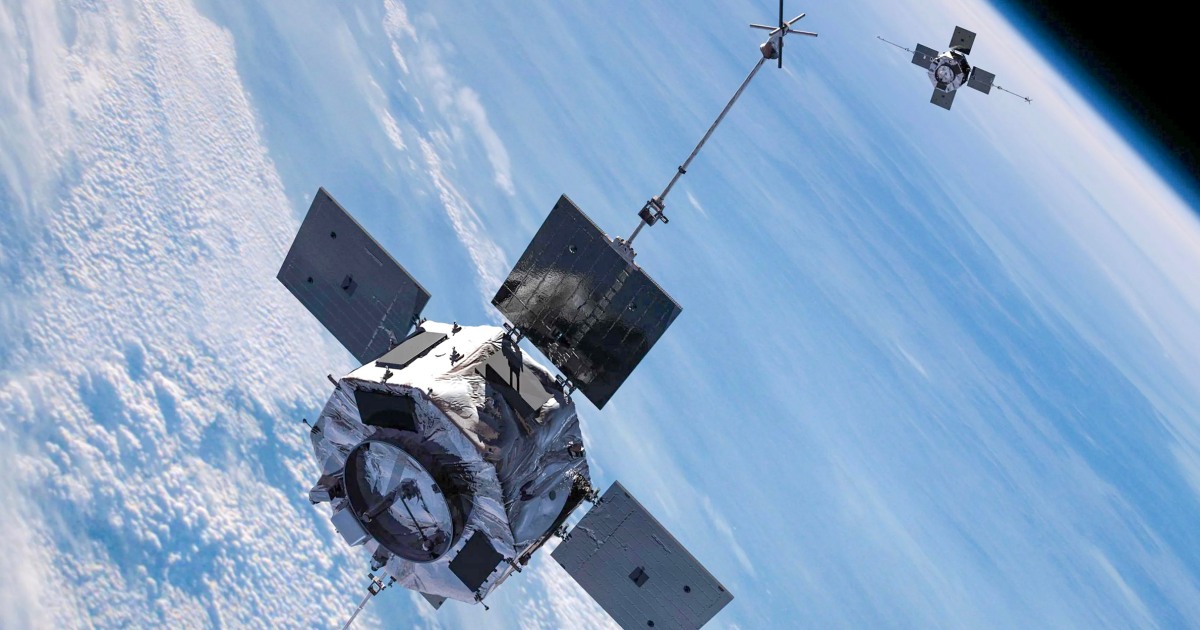
A defunct NASA satellite is set to plummet back to Earth in an uncontrolled descent, carrying a slim but notable risk of debris reaching the surface. The spacecraft, known as Van Allen Probe A, is expected to re-enter the atmosphere around 7:45 p.m. EDT on Tuesday, according to predictions from the U.S. Space Force. Launched 14 years ago to explore Earth's protective radiation belts, the 1,323-pound probe has been orbiting silently since running out of fuel in 2019, but recent solar activity has hastened its fiery return.
NASA officials emphasized that while the majority of the satellite will likely disintegrate during its plunge through the atmosphere, not everything will burn up completely. "Some components are expected to survive re-entry," the agency stated in a recent announcement. The risk to people on the ground remains low, with NASA estimating the odds of harm at about 1 in 4,200. "NASA and Space Force will continue to monitor the re-entry and update predictions," the statement added, highlighting the ongoing collaboration between the space agency and military trackers to refine the trajectory as it becomes clearer.
The re-entry is uncontrolled, meaning engineers have no ability to guide the probe's path or target a specific splashdown zone. This lack of precision stems from the satellite's depleted fuel reserves, leaving it at the mercy of gravitational pull and atmospheric drag. Predictions for the exact timing carry an uncertainty of plus or minus 24 hours, influenced by factors like space weather and the varying density of Earth's upper atmosphere. Such variables make pinpoint forecasting a challenge, even for advanced models used by the Space Force.
Van Allen Probe A was one half of a twin mission launched on August 30, 2012, designed to delve into the Van Allen radiation belts—two doughnut-shaped zones of high-energy particles encircling Earth, trapped by the planet's magnetic field. These belts act as a natural shield, deflecting solar storms, cosmic rays, and the relentless solar wind that streams from the sun. Without them, satellites could face frequent disruptions, power grids might falter under radiation assaults, and human explorers venturing beyond low-Earth orbit would encounter heightened health risks from exposure.
The probes' journey through these hazardous regions yielded significant insights into the belts' structure and behavior. Over seven years of operation, the mission revealed details about the particles' composition and movement, including the surprising discovery of a temporary third radiation belt that emerges during intense solar activity. Such findings have informed strategies for protecting spacecraft and astronauts, who must navigate the belts en route to destinations like the moon or Mars.
By 2019, both probes had exhausted their propellant, prompting NASA to conclude the mission. At the time, projections suggested the satellites would linger in orbit until around 2034 before naturally decaying. However, a surge in solar activity over the past few years has altered that timeline dramatically. When the sun ramps up its output, it heats and expands the upper atmosphere, creating more drag on orbiting objects and accelerating their descent. This phenomenon has pulled Van Allen Probe A back to Earth much sooner than anticipated.
Its twin, Van Allen Probe B, faces a different fate for now. According to NASA, the second probe is not expected to re-enter before 2030, allowing it additional time in a decaying orbit. The disparity arises from subtle differences in their positions and the unpredictable effects of atmospheric interactions as they spiral inward.
Events like this re-entry are far from rare in the modern space age. The European Space Agency notes that defunct satellites, discarded rocket stages, and fragments of orbital junk plummet back to Earth almost daily. In the vast majority of cases, these objects incinerate harmlessly high in the atmosphere, posing no threat. Yet, when durable pieces do survive—such as titanium fuel tanks or dense instruments—they can streak through to the surface.
The odds favor an ocean landing, given that water covers about 71 percent of Earth's surface. Historical incidents, like the 1979 crash of the Soviet Salyut 7 space station or the 2020 plunge of China's Long March 5B rocket, have seen debris scatter over remote areas or seas, with no reported injuries. Still, the growing congestion in space amplifies concerns about uncontrolled returns.
Low-Earth orbit, the bustling highway where many communication and navigation satellites circle at speeds up to 18,000 miles per hour, is littered with tens of thousands of trackable debris pieces—along with millions of smaller, unmonitored fragments. These hazards threaten operational spacecraft and the International Space Station, where astronauts routinely monitor for potential collisions. As launch rates soar with private companies like SpaceX and Blue Origin joining the fray, the debris problem intensifies, prompting calls for international guidelines on satellite disposal.
NASA's handling of the Van Allen Probe A underscores the agency's commitment to transparency amid these risks. By publicizing the re-entry details and risk assessments, officials aim to reassure the public while underscoring the infrequency of harm. "The risk of harm coming to anyone on Earth is low—approximately 1 in 4,200," NASA reiterated, drawing on statistical models refined over decades of tracking similar events.
Experts in space policy view this incident as a timely reminder of the need for better end-of-life planning for satellites. While fuel depletion ended the Van Allen mission prematurely, future designs increasingly incorporate deorbiting capabilities, such as sails or thrusters, to direct hardware toward uninhabited ocean zones. Organizations like the United Nations Office for Outer Space Affairs advocate for such measures to mitigate the escalating clutter in orbit.
As monitoring continues, updates from NASA and the Space Force could shift the predicted impact zone, which currently spans a broad swath from the equator toward the poles. Residents in potential overflight areas, though unlikely to be directly affected, might catch a glimpse of the satellite's glow if conditions align for visibility during evening hours.
Beyond the immediate spectacle, the Van Allen Probe's return highlights humanity's expanding footprint in space and the delicate balance required to explore without endangering our planet. The mission's legacy endures in the data that continues to shape our understanding of Earth's cosmic defenses, even as its hardware makes one final, uncontrolled voyage home. With space traffic showing no signs of slowing, incidents like this will likely become more commonplace, testing the resilience of global tracking systems and international cooperation.
In the coming days, as the probe's orbit tightens, scientists and officials will watch closely, ready to issue alerts if the path veers toward populated regions. For now, the focus remains on the low-probability scenario, allowing the story of Van Allen Probe A to serve as both a scientific milestone and a cautionary tale in the era of orbital abundance.