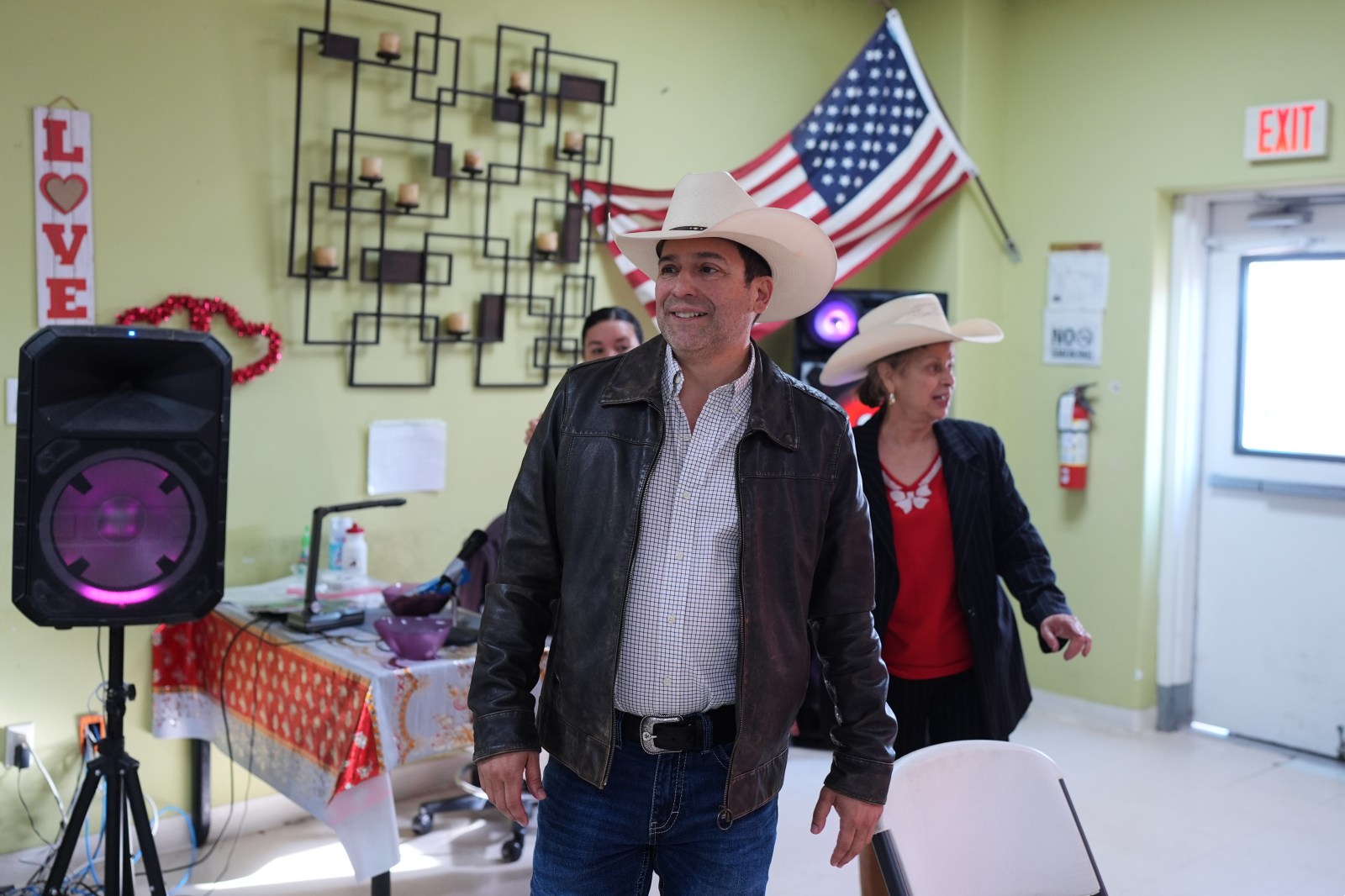
PHARR, Texas — The strains of Tejano music legend Bobby Pulido's voice echoed through an adult day care center in this South Texas border town, drawing mild curiosity from a group of card players before the singer-turned-congressional candidate even stepped inside. Dressed in cowboy boots, dark jeans, a leather jacket, and an ivory cowboy hat, Pulido, a Latin Grammy winner, grabbed a microphone as the music faded and urged the crowd in Spanish to vote and encourage their children to do the same. "Because the truth is that we are living in difficult times right now and it is important to make a change," he said.
Pulido's entry into politics represents a high-stakes gamble for Democrats in Texas' 15th Congressional District, a sprawling area stretching 300 miles from the Mexican border through ranches and small towns. The district is 81% Hispanic, poorer than the state and national averages, and overwhelmingly Catholic, making it a microcosm of the broader shift among working-class Hispanic voters toward the Republican Party during the Trump era. According to recent election data, Democratic support in the district dropped from 55% for Hillary Clinton in 2016 to 41% for Kamala Harris in 2024.
Democrats are pinning their hopes on Pulido's celebrity to reverse that trend and challenge U.S. Rep. Monica De La Cruz, the incumbent Republican who won the seat by 14 percentage points in 2024. The district was redrawn by Texas Republicans at President Donald Trump's request to bolster De La Cruz's position, part of a broader effort to maintain their edge in the battle for House control. With three competitive races in the Rio Grande Valley this fall, the region has become a focal point in national politics, and the Democratic primaries are set for Tuesday.
Pulido, who has enjoyed a three-decade career in Tejano music—a genre blending Mexican folk styles with European dance influences brought by Czech, German, and Polish settlers—brings a unique profile to the race. He won Latin Grammy Awards for Best Tejano Album in 2022 and 2025 and was nominated this year for an American Grammy. His father, Roberto Pulido, was a pioneer in the genre, which peaked in popularity in the 1990s with stars like Selena. Even as he campaigns, Pulido has two stops left on his farewell music tour, including one this weekend in Mexico.
Inside the My Morning Star Adult Day Care center where Pulido recently spoke, his 1997 hit "Le Pediré" played over accordion and rhythmic percussion, narrating a tale of heartbreak and longing. As he moved from table to table, shaking hands and chatting in English or Spanish, the singer emphasized that his fame opens doors but doesn't guarantee votes. "I’m not going to lie, it opens the door. It doesn’t seal the deal," Pulido said later, sitting on a bench outside the center. "I don’t think people vote for you because you’re famous. They’ll listen to you because you’re famous, and then they’re going to decide if they want to vote for you or not."
Experts familiar with the region's culture see Pulido's deep roots in Tejano music as a genuine asset. Cathy Ragland, an ethnomusicology professor at the University of North Texas who studies U.S.-Mexico border music, noted that his background provides credibility. "He is a homegrown guy in the border, and that gets you a lot of mileage," Ragland said.
Yet Pulido faces a tough primary fight against Ada Cuellar, a doctor and law school graduate running to his left. Cuellar, who has largely self-funded her campaign and aired television ads while Pulido has not, portrays herself as the more substantive candidate. "He doesn’t really understand the issues or have the solutions that I have," she said, contrasting her health care expertise with Pulido's entertainment background.
Cuellar has criticized Pulido's moderate stances, particularly on abortion, where he opposes the procedure personally but supports women's right to choose. "Even if I personally would not be OK with it, I still respect that other people might make their own decisions and that we have to be OK with that," Pulido explained. Cuellar argues this position leaves him out of touch with progressive Democratic voters. She also accuses Pulido of relying too heavily on his celebrity and the backing of party establishment figures in Washington and Hidalgo County, the district's largest population center.
"I am like a scrappy underdog, and I’ve been one my whole life," Cuellar said. "So I really am not concerned about the celebrity itself, but I’m fighting this establishment pressure, and that’s really the biggest challenge I’m faced with." She claims unnamed officials have urged her to drop out, though she has not identified them.
The primary contest has drawn attention from higher-profile Democrats. State Rep. James Talarico has campaigned with Pulido, while U.S. Rep. Jasmine Crockett has supported Cuellar, reflecting internal party dynamics in the closely watched U.S. Senate primary.
National Democratic leaders favor Pulido for the general election, believing his centrist positions better position him against De La Cruz, who aligns closely with Trump and House Republican leadership but occasionally breaks ranks. De La Cruz was one of only 17 House Republicans to vote with Democrats on a bill extending Affordable Care Act subsidies. At a rally in Corpus Christi on Friday, before Trump spoke, De La Cruz highlighted her work with the president to pressure Mexico over water owed from the shared Rio Grande basin. "We have together delivered for Texas and delivered for our nation by turning all of South Texas red, and we will continue to keep Texas red," she said.
Pulido's past has come under scrutiny, including years of bawdy social media posts with crude, sexist jokes and links to pornographic sites. One video purportedly showed him urinating on Trump's star on the Hollywood Walk of Fame, which he later described as a prank using a water bottle. "My sense of humor on social media — and it’s very much in Spanish, I have a lot of fans in Mexico — sometimes that humor doesn’t translate," Pulido said. He added that he was embarrassed by some older posts.
The race unfolds against a backdrop of rapid political change in South Texas, where Hispanic voters' support has eroded for Democrats amid economic concerns, border issues, and cultural conservatism. The redrawn district lines, approved after the 2020 census, were designed to protect incumbents like De La Cruz, making the Democratic path even steeper. If Pulido emerges from the primary, he will need to mobilize voters in a region where turnout can be low but enthusiasm high for local figures.
As the primaries approach on Tuesday, the outcome in the 15th District could signal broader trends in Hispanic voting patterns and the effectiveness of celebrity candidates in flipping competitive seats. For Democrats aiming to regain House majority, South Texas remains a critical battleground, with Pulido's blend of music stardom and moderate appeal offering their best shot at reclaiming ground lost in recent cycles. Whether his fame translates into votes, however, will depend on how voters in Pharr and beyond respond to his message of change amid challenging times.