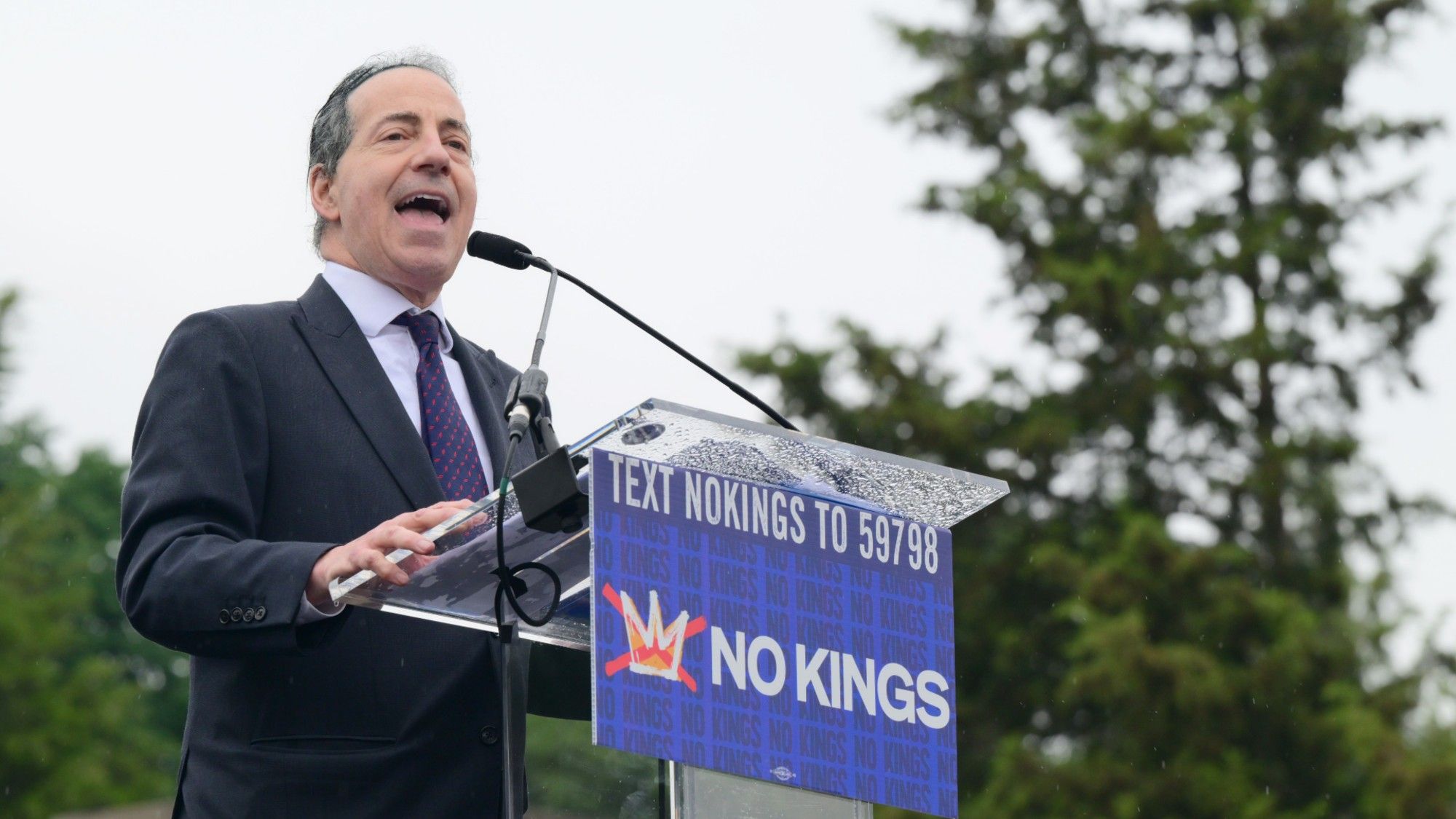
WASHINGTON — In a bold move amid escalating concerns over President Donald Trump's public statements, Rep. Jamie Raskin, a Democrat from Maryland, introduced legislation on Tuesday aimed at establishing a bipartisan panel to evaluate a president's fitness for office under the 25th Amendment. The bill, which has garnered 50 Democratic cosponsors, seeks to create a formal mechanism for addressing potential mental or physical incapacity in the Oval Office, a process Raskin described as a critical matter of national security.
Raskin's proposal comes at a time when Trump's recent outbursts have drawn widespread scrutiny. According to the congressman, public trust in the president's ability to fulfill his duties has plummeted to unprecedented levels, fueled by what Raskin called erratic behavior, including threats to 'destroy entire civilizations' and aggressive insults directed at the pope. 'This is a matter of national security,' Raskin stated in a press release announcing the bill. He emphasized that such a panel should have been established decades ago, noting, 'This body should have been set up' when the 25th Amendment was ratified in 1967.
The 25th Amendment, ratified in the wake of President John F. Kennedy's assassination, provides a constitutional framework for transferring power if a president becomes unable to discharge their duties. It allows the vice president, in conjunction with a majority of the principal officers of the executive departments — or another body designated by Congress — to declare the president unfit, temporarily elevating the vice president to acting president. Raskin's bill would formalize that 'other body' as a 17-member independent commission, designed to operate outside the immediate political pressures of the administration.
Under the proposed legislation, the Democratic and Republican leaders in both the House and Senate would each appoint four members to the panel, drawing from experts such as physicians, psychiatrists, and former high-ranking Cabinet officials. The panel itself would then select a 17th member to serve as chair. If a medical examination determines the president is unfit, a majority vote by the panel, combined with the vice president's assent, could suspend the president's powers. This process would aim to ensure decisions are based on professional assessments rather than partisan motives.
The introduction of the bill reflects broader Democratic anxieties about Trump's leadership style, particularly in the wake of his inflammatory rhetoric on the international stage. Raskin, a constitutional law professor and longtime critic of the president, has been vocal about the need for safeguards against what he perceives as destabilizing conduct. His office highlighted recent incidents, including Trump's reported threats against global alliances and personal attacks on religious figures, as evidence of a pattern that undermines confidence in the executive branch.
Republicans, however, dismissed the effort as politically motivated. A White House spokesperson responded sharply to the announcement, labeling Raskin a 'lightweight' and defending the president vigorously. The spokesperson praised Trump's 'sharpness' and 'unmatched energy,' portraying the bill as an unnecessary and partisan attack on a leader they described as fully capable and vigorous.
The political landscape adds significant hurdles to the bill's passage. With Republicans holding majorities in both chambers of Congress, the legislation faces steep odds. As Axios reported, it is 'a long shot,' given that any such measure would likely require overriding a presidential veto from Trump himself. House Speaker Paul Ryan and Senate Majority Leader Mitch McConnell have not yet commented publicly on the proposal, but sources close to GOP leadership indicated skepticism about entertaining what they view as a targeted assault on the president.
Historical context underscores the rarity and sensitivity of invoking the 25th Amendment. The provision has been used sparingly, most notably in 1985 when President Ronald Reagan temporarily transferred power to Vice President George H.W. Bush for a routine surgery, and again in 2002 and 2007 under President George W. Bush for similar medical procedures. Discussions around its use for incapacity due to mental health or cognitive decline have been more speculative, often surfacing during times of perceived instability, such as the final days of Richard Nixon's presidency amid the Watergate scandal.
Raskin's initiative builds on previous Democratic efforts to address presidential fitness. In 2017, following Trump's election, some lawmakers floated similar ideas, though none advanced far. The current bill arrives amid a polarized Congress, where impeachment proceedings over other issues have already strained bipartisan relations. Supporters argue that institutionalizing the 25th Amendment's mechanisms would prevent future crises, regardless of the occupant of the White House.
Experts in constitutional law offered mixed reactions to the proposal. Some, like those interviewed by The Week, welcomed the idea of a standing panel as a proactive step toward accountability. Others cautioned that it could set a precedent for politicizing medical evaluations, potentially eroding the independence of the process. 'While the intent is noble, implementation would require careful safeguards,' said one anonymous former Cabinet official, speaking on condition of anonymity due to ongoing government ties.
The bill's cosponsors, all Democrats, include prominent figures such as Reps. Jerrold Nadler of New York and Zoe Lofgren of California, signaling strong progressive backing. Raskin's statement elaborated on the urgency, pointing to polls showing declining approval ratings for Trump on foreign policy and leadership competence. According to a recent survey cited by his office, only 38 percent of Americans expressed full confidence in the president's decision-making abilities, a figure that has trended downward since mid-2018.
From the administration's perspective, the push is seen as emblematic of Democratic obstructionism. Trump himself took to Twitter on Wednesday morning, deriding the bill as a 'witch hunt' by 'losers in Congress' desperate to undermine his agenda. The tweet, posted at 8:47 a.m. from the White House, garnered over 500,000 likes within hours, further energizing his base while deepening divisions.
Looking ahead, the legislation is slated for referral to the House Judiciary Committee, where Raskin serves as ranking member. Hearings could begin as early as next month, though passage remains unlikely without Republican defections. Advocates hope the bill will at least spark national dialogue on presidential accountability, drawing parallels to post-Watergate reforms that strengthened congressional oversight.
Beyond the immediate political battle, the proposal raises enduring questions about the balance of power in American democracy. In an era of rapid media cycles and heightened partisanship, mechanisms like the 25th Amendment serve as vital backstops against potential abuses. Whether Raskin's bill gains traction or fades into obscurity, it underscores the ongoing tension between executive authority and legislative checks, a dynamic that has defined U.S. governance since the nation's founding.
As Congress grapples with this and other pressing issues — from budget negotiations to midterm election strategies — the fate of the 25th Amendment panel will test the limits of bipartisanship. For now, it stands as a stark reminder of the deep fissures in Washington, where even constitutional safeguards become battlegrounds in the broader struggle for control.