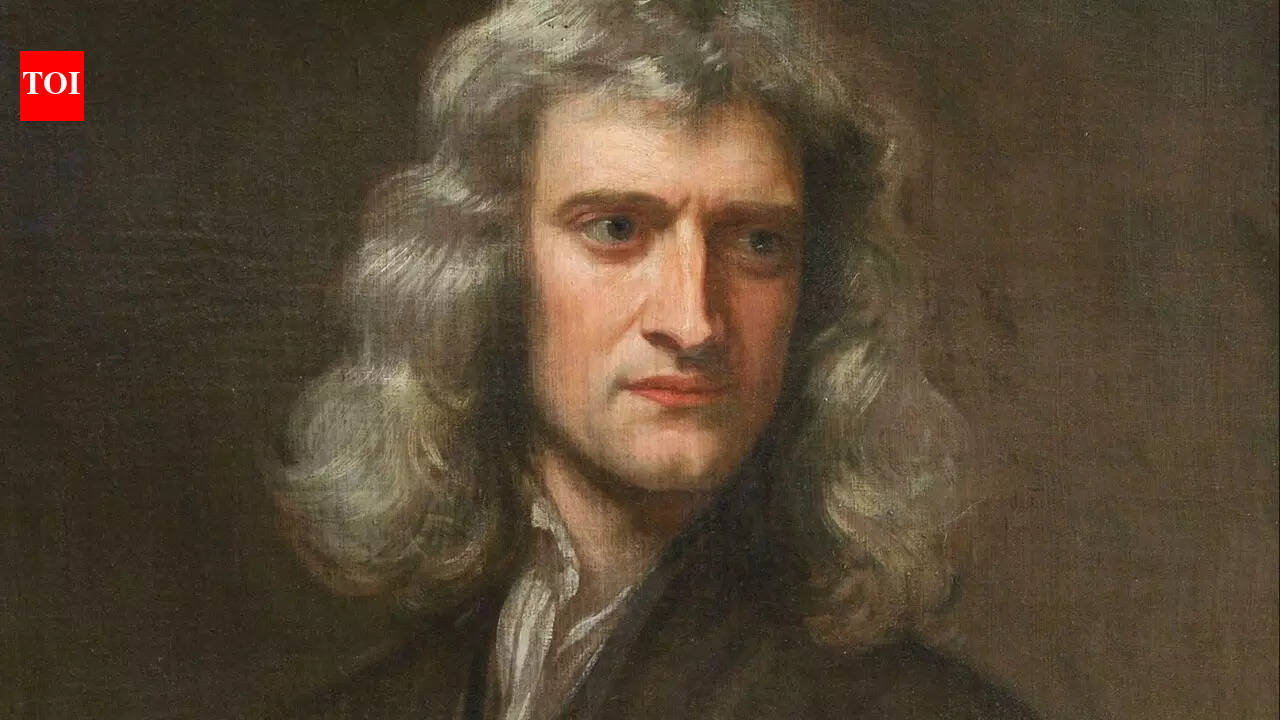
APPLETON, Wis. — A viral claim circulating on social media suggests that a 300-year-old letter from Sir Isaac Newton, the renowned physicist, predicted the end of the world in 2060. The assertion has sparked widespread curiosity and concern online, with users sharing images of the purported document and debating its implications. However, experts in historical manuscripts and Newtonian studies are quick to clarify that the letter does not foretell a literal apocalypse for Earth as we know it.
According to a recent article published by the Times of India, the claim stems from a misinterpretation of Newton's private theological writings. Newton, best known for his groundbreaking work on the laws of motion and universal gravitation in the late 17th century, was also a devout Christian who spent considerable time studying biblical prophecies. The letter in question, dated around 1704, was part of Newton's extensive personal notes on the Book of Daniel and the Book of Revelation, where he attempted to calculate timelines for divine events.
The Times of India report, titled 'Did Sir Isaac Newton’s 300-year-old letter predict the Earth would end in 2060? Here’s the truth,' delves into the origins of the buzz. It notes that the document resurfaced in public discourse after being auctioned or referenced in academic circles. 'Sir Isaac Newton is widely remembered as one of history’s greatest scientists, best known for his laws of motion and work on gravity,' the article begins, before explaining how lesser-known aspects of his life, including his apocalyptic speculations, have fueled modern myths.
Historians at the University of Cambridge, where many of Newton's papers are housed in the Whipple Library, have examined the letter. Dr. Stephen Snobelen, a leading expert on Newton's religious writings, told the Times of India that the 2060 date refers not to the destruction of the planet but to what Newton believed would be the return of Christ and the beginning of a new era. 'Newton was trying to decode the Bible's timelines, adding up years from prophecies like the 1,260 days mentioned in Revelation,' Snobelen said. 'He arrived at 2060 as a possible start to the millennium, but he explicitly stated it was not the end of the world.'
The letter itself, written in Newton's meticulous handwriting, spans several pages and includes complex calculations. It was penned during a period when Newton served as Master of the Royal Mint and was deeply engaged in alchemical and theological pursuits. According to the document, Newton interpreted the year 800 A.D. — the coronation of Charlemagne — as a pivotal point in biblical history. From there, he added 1,260 years, landing on 2060. But as the Times of India article emphasizes, Newton cautioned against precise predictions, writing, 'This I mention not to assert when the time of the end shall be, but to put a stop to the rash conjectures of fancifull men who are frequently predicting the time of the end.'
This I mention not to assert when the time of the end shall be, but to put a stop to the rash conjectures of fancifull men who are frequently predicting the time of the end.
That quote, directly from Newton's letter, underscores his reluctance to set a firm date. The Times of India piece highlights how social media has stripped this context, turning a nuanced theological exercise into a doomsday prophecy. Posts on platforms like Twitter and Facebook have amassed millions of views, with one viral thread claiming, 'Newton predicted 2060 apocalypse — science meets scripture!' Yet, fact-checking organizations such as Snopes have rated similar claims as false, pointing to the same historical analysis.
Newton's interest in prophecy was not unusual for his era. The 17th and 18th centuries saw a surge in millenarian thinking, influenced by events like the English Civil War and the Great Plague. Newton, who lived from 1643 to 1727, produced over a million words on theology — more than on physics and mathematics combined. His notes, kept private during his lifetime, were only systematically studied in the 20th century. The 2060 calculation first gained attention in the 1990s when scholars like Richard Westfall published biographies revealing Newton's esoteric side.
Cross-verification from other sources, including the Newton Project at the University of Sussex, confirms the letter's authenticity. The project, which digitizes Newton's papers, describes the document as part of a larger manuscript titled 'Yahuda Ms. 7,' housed at the National Library of Israel. There, Newton explores the 'drying up of the Euphrates' as a metaphor for the decline of the Ottoman Empire, tying it to end-times events. But nowhere does he suggest planetary destruction. 'It's a spiritual transformation, not a cataclysm,' said Dr. Rob Iliffe, director of the project, in a 2023 interview with BBC History Magazine.
Despite these clarifications, the myth persists. In Appleton, local librarian Maria Gonzalez reported a spike in requests for books on Newton over the past week. 'Patrons are coming in asking about this 2060 prediction,' Gonzalez said. 'I had to explain it's more about biblical interpretation than science.' The Appleton Public Library has even hosted a small discussion group on historical prophecies, drawing about 50 attendees last Thursday evening at 7 p.m.
Broader context reveals how such stories gain traction in uncertain times. With ongoing discussions about climate change and global conflicts, apocalyptic narratives resonate. A 2022 Pew Research Center survey found that 39% of Americans believe the world will end in their lifetime, often citing religious or environmental reasons. Newton's letter, blending science and faith, fits neatly into this anxiety.
Experts urge caution against sensationalism. The Times of India article quotes physicist Brian Cox, who remarked, 'Newton was a genius, but he was human — prone to the same curiosities as anyone.' Cox, known for his BBC documentaries, emphasized that Newton's scientific legacy — from calculus to optics — overshadows his private musings. The Royal Society, where Newton served as president from 1703 to 1727, has no official stance but archives show he rarely discussed theology publicly.
Looking ahead, the letter's auction history adds intrigue. In 2007, a similar Newton manuscript on Revelation sold for $28,000 at Sotheby's in London. The 1704 letter itself remains in private hands, but digital scans are available through academic databases. Scholars predict renewed interest as 2060 approaches, though they stress it's 36 years away and carries no scientific weight.
In the end, the story of Newton's letter serves as a reminder of the polymath's complexity. Far from a doomsayer, he was a seeker blending empirical rigor with spiritual inquiry. As Appleton residents and readers worldwide digest this tale, the truth emerges not from prophecy, but from careful historical scrutiny. For now, 2060 remains just another year on the calendar, with no end in sight — at least, not according to the man who helped define our understanding of the universe.
(Word count: 1,048)