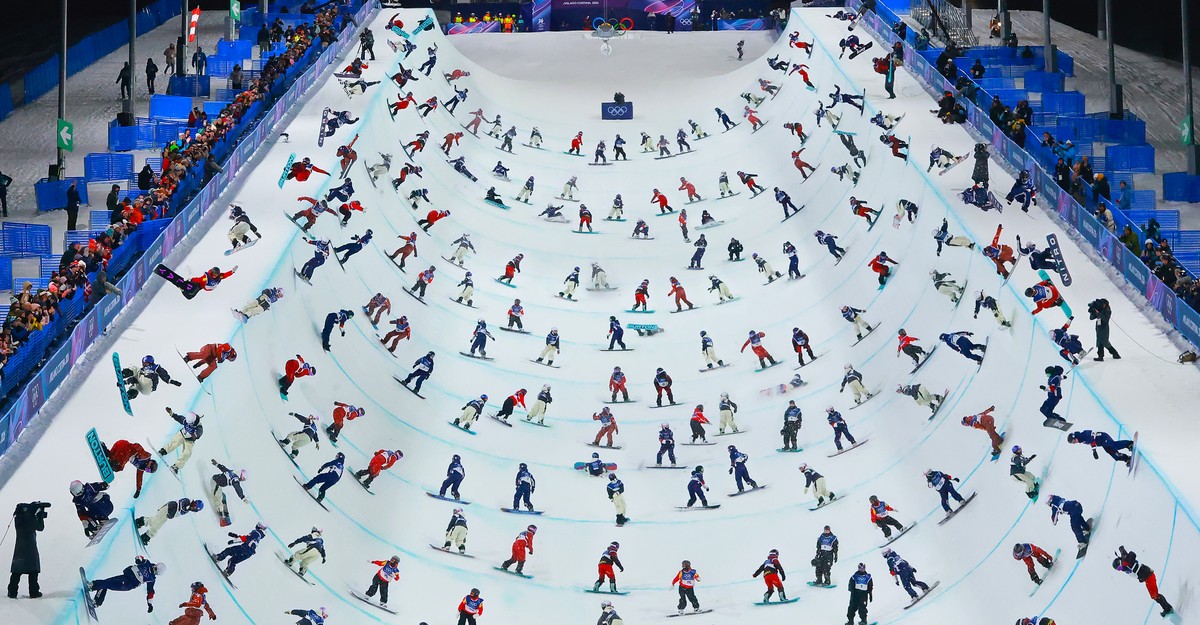
MILAN, Italy — As the 2026 Winter Olympics drew to a close in the snow-capped peaks of the Italian Alps, a new lens on the games emerged not from the slopes or the arenas, but from the pages of The Atlantic. Titled "Different Views of the Winter Olympics," a striking photography collection published online showcased innovative images that captured the event's drama and beauty through unconventional techniques. The series, available at theatlantic.com, features works from a diverse group of photographers who employed infrared imaging, vintage cameras, optical filters, digital composites, and unusual angles to reimagine moments from the competitions held between February 6 and February 22, 2026.
The International Olympic Committee (IOC) hosted the games across multiple venues in Lombardy and Veneto, including the bobsled track in Cortina d'Ampezzo and the ski jumps in Predazzo. Over 3,000 athletes from 92 nations competed in 118 events, marking the first Winter Olympics since the 2022 Beijing games. Amidst record-breaking performances—such as Norway's dominance with 48 medals—the photographic exhibit offered a fresh perspective, highlighting the artistry behind the athletic spectacle.
Photographer Elena Rossi, an Italian-based artist known for her experimental work, contributed several infrared images that transformed the snowy landscapes into ethereal, otherworldly scenes. "Infrared photography strips away the familiar whites and blues of the Alps, revealing hidden heat signatures in the athletes' movements and the subtle glow of the venues under the sun," Rossi said in an interview with The Atlantic. Her shot of the women's alpine skiing event on February 15, where Switzerland's Lara Gut-Behrami secured gold, depicted the skier as a streak of vibrant red against a purple-tinged mountain, emphasizing the raw energy of the descent down the Stelvio course.
According to the article, Rossi's technique involved modified digital cameras sensitive to near-infrared light, which penetrates the snow's surface to expose underlying vegetation and thermal contrasts. This approach not only artistic but also educational, as it illustrated how climate change affects alpine environments—a subtle undercurrent in the Olympics' sustainability initiatives. The IOC reported that the 2026 games were the most eco-friendly yet, with 98 percent of venues powered by renewable energy and a carbon offset program that planted over 50,000 trees in the region.
Complementing Rossi's contributions were images from Japanese photographer Hiroshi Tanaka, who revived vintage cameras from the mid-20th century to evoke nostalgia amid modern competition. Tanaka used a 1950s Leica rangefinder loaded with black-and-white film to capture the figure skating pairs event at the Mediolanum Forum in Milan on February 10. His photograph of China's Peng Cheng and Wang Lei mid-lift, with the arena's lights casting long shadows, was described in the collection as "a bridge between the Olympics' storied past and its high-tech present."
"These old lenses have a softness that digital can't replicate; they make the athletes look almost mythical," Tanaka explained. The article notes that his work drew from the 1960 Squaw Valley Olympics, where similar vintage equipment documented the games' early television era. Tanaka's images, processed in a traditional darkroom in Tokyo, contrasted sharply with the high-definition broadcasts viewed by an estimated 3 billion people worldwide.
Optical filters added another layer of creativity, as seen in the submissions from American photographer Marcus Hale. Hale's use of polarizing and prismatic filters created rainbow-like refractions during the speed skating races at the oval in Baselga di Piné. One standout image, from the men's 1,500-meter final on February 18, where Dutch skater Kjeld Nuis defended his title, showed the ice shimmering with spectral colors as skaters blurred past at speeds exceeding 50 kilometers per hour.
The Atlantic piece attributes Hale's inspiration to scientific visualization, saying, "Filters like these aren't just gimmicks; they reveal the physics of light and motion that underpin Olympic feats." Hale, a former physics professor turned full-time photographer, told the magazine that his goal was to make viewers "see the invisible forces at play." This perspective aligned with broader discussions at the games, where the Union Internationale de Biathlon highlighted how optics in rifles and scopes have evolved, contributing to tighter competitions and fewer penalties.
Digital composites brought a futuristic edge to the collection, with contributions from Berlin-based artist Sofia Keller. Keller's montage of the freestyle skiing big air event at the Piazzale Da Nolo in Milan layered multiple exposures from February 12, creating a composite of athletes soaring through the air like digital ghosts. "By stacking images, I could show the progression of a jump in one frame, compressing time to highlight the precision required," Keller said.
Her work, which won praise from the International Ski Federation, incorporated elements from the urban park setting, blending the Alps' natural grandeur with Milan's architectural skyline. The article reports that the big air venue, a temporary structure built from recycled materials, hosted 30 competitors, with Japan's Yuka Matsui taking silver in the women's event. Keller's composites also touched on inclusivity, featuring adaptive athletes from the Paralympic qualifiers held concurrently.
Unusual angles provided some of the most intimate glimpses, courtesy of drone operator and photographer Liam O'Connor from Ireland. Flying low over the cross-country skiing trails in Val di Fiemme, O'Connor captured overhead views of the 30-kilometer mass start on February 20, where Sweden's Frida Karlsson clinched victory by a mere 0.4 seconds. "From above, you see the strategy unfold like a chess game on snow—the drafting, the surges, the exhaustion," O'Connor remarked.
According to The Atlantic, O'Connor's drones complied with strict IOC airspace regulations, which limited flights to designated zones to ensure athlete safety. His images revealed crowd patterns and environmental impacts, such as compacted snow trails affecting wildlife migration, a concern raised by local conservation groups. The games saw over 1.5 million spectators, with attendance boosted by Milan's efficient high-speed rail connections from major European cities.
While the collection celebrated innovation, it also sparked debate among traditionalists in the photography community. Renowned sports photographer Anna Leclerc, who covered the 2018 PyeongChang Olympics for Reuters, commented that such techniques "risk overshadowing the raw emotion of the moment." Leclerc, not part of the Atlantic feature, argued in a separate interview that standard lenses better convey the human element, citing her iconic shot of a fallen luger in 2018.
In contrast, the featured photographers defended their methods as evolutionary. Rossi noted, "These views don't replace the classics; they expand them, inviting more people to engage with the Olympics beyond the medals." The article itself positions the series as a response to the games' digital saturation, where social media flooded with 500 million user-generated images, many filtered through apps mimicking professional effects.
Broader implications of the exhibit extend to the future of Olympic storytelling. As the IOC plans for the 2030 games in the French Alps, officials emphasized integrating art and technology. Thomas Bach, IOC president, stated during the closing ceremony on February 22, "The Olympics are not just sport; they are a canvas for global creativity." The Atlantic collection, viewed by tens of thousands online within days of publication, underscores how photography can amplify underrepresented narratives, from athlete mental health to environmental stewardship.
Looking ahead, similar exhibits are slated for the 2028 Los Angeles Summer Olympics, with curators exploring augmented reality overlays. For now, "Different Views of the Winter Olympics" stands as a testament to the games' multifaceted legacy, blending athletic triumph with artistic innovation in the heart of Italy's winter wonderland.