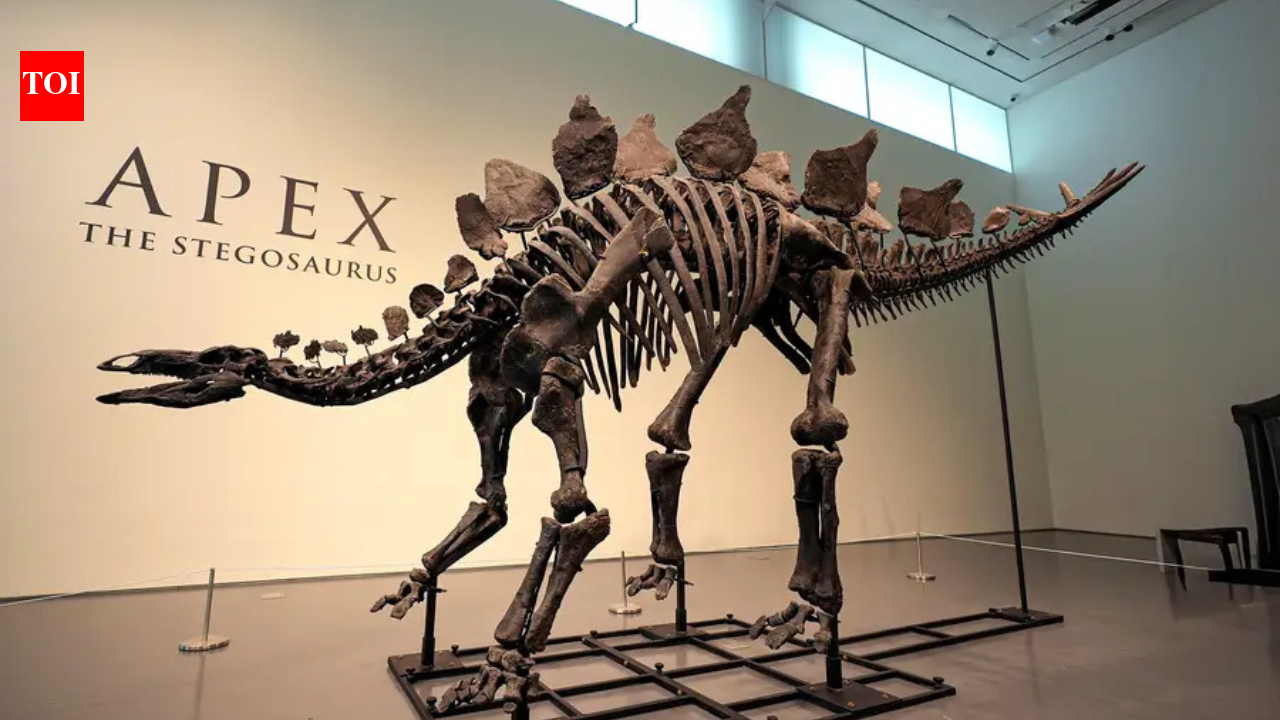
In a blockbuster sale that has captivated the world of paleontology and high-stakes collecting, a rare dinosaur fossil fetched a staggering $44.6 million at auction, setting a new record for prehistoric specimens. The transaction, reported by the Times of India, highlights a growing frenzy among billionaires to acquire these ancient relics, turning what was once the domain of museums into a playground for the ultra-wealthy. The fossil in question, a nearly complete skeleton of a massive theropod dinosaur, was sold anonymously to a private buyer during a private auction in New York last week.
According to details emerging from the sale, the specimen dates back approximately 150 million years to the Late Jurassic period, when dinosaurs like this one roamed vast landscapes across what is now North America. Experts at the auction house described it as one of the most intact examples ever discovered, measuring over 30 feet in length with 80% of its bones preserved. 'This is not just a fossil; it's a window into a lost world,' said Dr. Elena Vasquez, a paleontologist consulted by the auction organizers. 'Its rarity and condition make it priceless for scientific study, yet here it is in the hands of private ownership.'
The buyer, whose identity remains undisclosed, outbid several competitors in a heated session that lasted nearly two hours. Bidding started at $20 million and escalated rapidly, with increments in the millions drawing gasps from the room. Reports indicate that at least three other high-profile collectors, including tech moguls from Silicon Valley, were vying for the prize. This sale surpasses the previous record of $31.8 million set in 2020 for a Tyrannosaurus rex skeleton known as 'Stan,' which was acquired by a group of investors planning a museum exhibit.
Why the rush among billionaires? Sources close to the auction suggest it's a mix of passion, prestige, and investment potential. 'These fossils are like fine art or vintage cars—tangible pieces of history that appreciate over time,' explained Marcus Hale, an art and collectibles advisor based in London. Hale noted that the market for dinosaur fossils has boomed in the last decade, with prices doubling on average due to limited supply and increasing demand from private buyers. The Times of India article points out that long ago, dinosaurs ruled the Earth with their gigantic size and immense strength, dominating land, sea, and sky for millions of years—a legacy now commodified in boardrooms and private vaults.
Critics in the scientific community, however, are raising alarms about the privatization of such treasures. 'When fossils like this end up in private collections, they often disappear from public view and scientific access,' said Dr. Raj Patel, a curator at the Natural History Museum in London. Patel referenced past cases where high-profile sales led to specimens languishing in storage rather than contributing to research. According to unconfirmed reports, the new owner has expressed interest in displaying the fossil in a custom-built facility, but details remain scarce.
The trend isn't new. In 2019, a smaller but exceptionally preserved Apatosaurus skeleton sold for $11.7 million to an anonymous buyer, sparking debates over ethics in paleontology. Billionaires such as Microsoft co-founder Paul Allen, who amassed a vast collection before his death in 2018, and Hollywood producer Peter Jackson, known for his own dinosaur exhibits, have fueled the market. Allen's collection included a rare Stegosaurus that fetched $5.3 million posthumously. These sales underscore a shift: what began as opportunistic finds by ranchers in the American West has evolved into a global auction spectacle.
Legal experts weigh in on the implications. In the United States, where most high-value fossils originate, federal laws like the Paleontological Resources Preservation Act of 2009 regulate public lands, but private property discoveries—like this one from a Montana ranch in the 1990s—can be sold freely. 'It's a gray area that benefits landowners but starves science,' noted attorney Laura Kensington, who specializes in cultural heritage law. Kensington added that international treaties, such as those under UNESCO, aim to protect fossils as shared human heritage, but enforcement is spotty.
From a historical perspective, the allure of dinosaurs traces back to the 19th-century 'Bone Wars' between rival paleontologists Othniel Marsh and Edward Cope, who unearthed thousands of specimens in a race for glory. Today, that rivalry has morphed into financial competition. The Times of India reports that the current sale reflects broader interest in prehistoric giants, with collectors drawn to their symbolic power—icons of dominance and extinction in an era of environmental uncertainty.
Environmentalists see parallels between ancient extinctions and modern climate challenges. 'Dinosaurs didn't cause their own downfall; asteroids and volcanoes did. We're in a similar precarious position now,' observed climate scientist Dr. Mia Chen during a recent panel discussion. While not directly tied to the sale, Chen's comments highlight how these fossils serve as cautionary tales, even as they become luxury items.
Looking at market data, Sotheby's and Christie's auction houses have reported a 40% increase in fossil sales since 2015, with Asian buyers entering the fray alongside American and European tycoons. One such bidder at the recent auction was reportedly a Chinese real estate magnate, though bids fell short. This globalization adds layers to the story, as fossils once excavated in the U.S. now travel the world.
Back in Appleton, local enthusiasts are buzzing. The Appleton Museum of Natural History, which houses a modest dinosaur exhibit, saw a spike in visitors following news of the sale. Director Tom Reilly said, 'It reminds us that these wonders belong to everyone, not just the highest bidder.' Reilly plans a lecture series on the ethics of fossil collecting to engage the community.
As for the fossil itself, preliminary scans suggest it belongs to an Allosaurus species, a fierce predator that hunted in packs. Discovered in 1991 by amateur fossil hunter Jack Horner—famous for his work on Jurassic Park inspirations—the specimen spent years in preparation before hitting the market. Horner, now retired, declined comment but reportedly advised against the sale in private circles.
The $44.6 million price tag includes fees and commissions, with proceeds partly earmarked for the seller's family foundation focused on conservation. Yet questions linger: Will this skeleton ever see the light of day in a public space? Auction officials said negotiations for loans to museums are underway, but no commitments have been made.
Beyond the glamour, the sale prompts reflection on preservation. With climate change accelerating erosion at fossil sites, experts warn that future discoveries may dwindle. 'We're racing against time, just like the billionaires racing to buy,' quipped Dr. Vasquez. Initiatives like the Society of Vertebrate Paleontology's advocacy for ethical sourcing aim to balance commerce and science.
In the end, this record-breaking transaction cements dinosaurs' enduring fascination, bridging 150 million years of history with today's headlines. As billionaires continue their quest for prehistoric giants, the scientific community hopes for partnerships that keep these ancient stories accessible to all. For now, the fossil's fate rests in private hands, a silent testament to Earth's wild past.