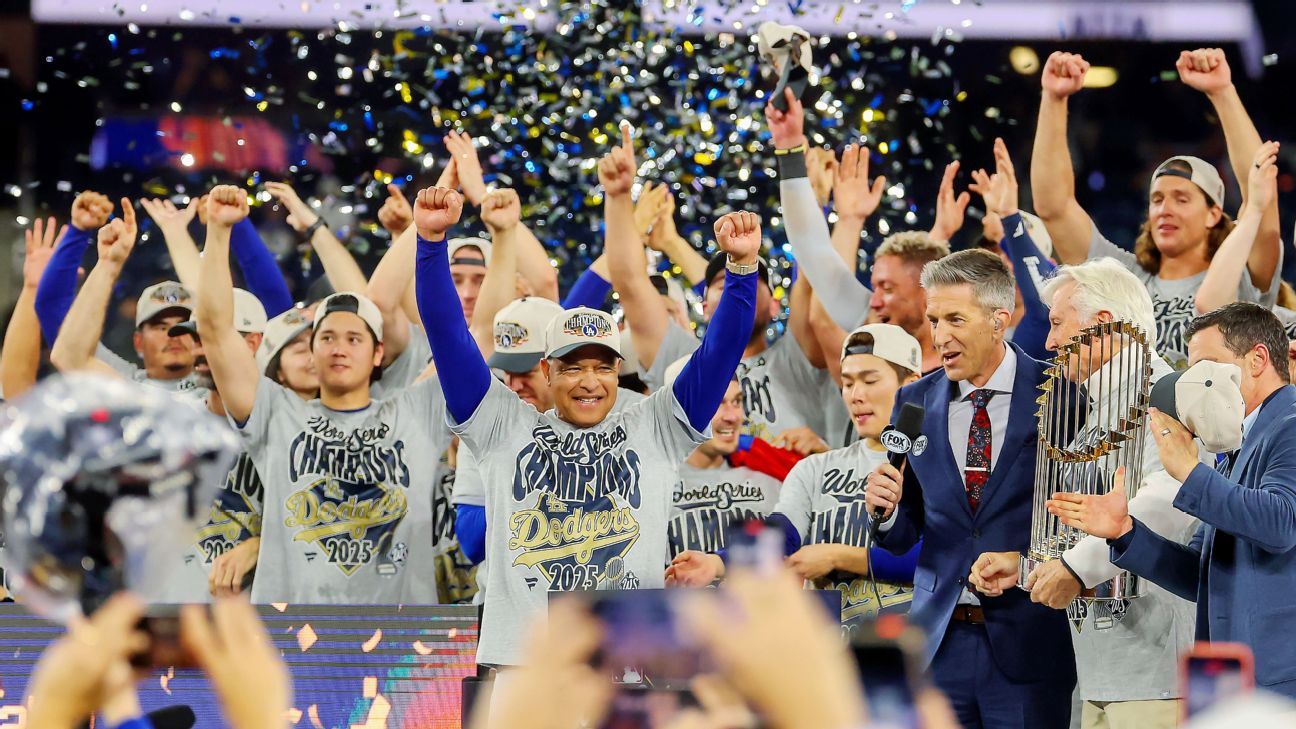
NEW YORK — The Los Angeles Dodgers have set a new benchmark in Major League Baseball spending, shattering records with a staggering $515 million combined payroll and luxury tax total for the 2025 season, according to final figures released by the commissioner's office. This massive outlay propelled the Dodgers to their second consecutive World Series title, underscoring the financial firepower that has become a hallmark of the franchise under owners Mark Walter and Todd Boehly. The Dodgers' 2025 payroll alone reached a record $345.3 million, coupled with a $169.4 million luxury tax, for a total of $514.7 million — a figure that excludes a $6.5 million signing bonus for Japanese pitcher Roki Sasaki on a minor league deal.
Compared to the rest of the league, the Dodgers' spending dwarfed even the most frugal teams. Their total was seven times the $68.7 million payroll of the Miami Marlins, the lowest-spending club in 2025, and exceeded the combined payrolls of the bottom six teams. This marked a significant escalation from the previous high of $430.4 million set by the New York Mets in 2024. Together, the Mets and Dodgers accounted for $948.3 million in spending last year, highlighting the growing chasm between MLB's financial heavyweights and the rest of the pack.
The Dodgers' ascent to the top payroll spot ended a three-year run by the Mets, who had led the league under owner Steve Cohen. Los Angeles' figure received a boost from $8.5 million in earned bonuses by retiring ace Clayton Kershaw, though deferred payments significantly tempered the on-paper costs. Without these deferrals for seven players, the Dodgers' total would have swelled by about $71 million. For instance, two-way star Shohei Ohtani's $70 million salary for 2025 counts as just $28.2 million against the payroll due to $68 million deferred until 2035.
The Mets, finishing second with a $342.1 million payroll and $433.7 million in total spending including tax, have poured resources into contention since Cohen's 2020 purchase. Over the first five seasons of his ownership, the Mets spent $1.44 billion — $1.11 billion in payroll and $320 million in tax — yet have not secured a World Series title. Both teams surpassed the prior record payroll of $333.3 million also set by the 2024 Mets, illustrating how aggressive spending has redefined MLB's competitive landscape.
Looking ahead to 2026, the Dodgers are projected to maintain their lead with a $323.3 million opening-day payroll for their 40-man roster, a $163.7 million luxury tax, and a total of $487.1 million. The Mets, however, enter the season with an even higher starting payroll of $358.4 million and a projected $482.5 million total, including a $124.1 million tax. At the other end, the Cleveland Guardians have the league's lowest opening-day 40-man payroll at $75.5 million, a stark reminder of the disparities baked into baseball's economic structure.
League-wide, total spending based on regular payrolls climbed 3.1% to $5.32 billion in 2025 from $5.16 billion the previous year, marking a 31.3% increase over four seasons under the current collective bargaining agreement that began in 2022. These figures exclude the $50 million annual pre-arbitration bonus pool introduced in that deal, as well as benefits allocations, which are factored into luxury tax calculations. As of MLB's opening-day rosters for 2026, eight teams surpassed the $244 million luxury tax threshold: the Dodgers at $415.2 million, Mets at $379.2 million, New York Yankees at $339.6 million, Toronto Blue Jays at $319.5 million, Philadelphia Phillies at $315.2 million, Boston Red Sox at $263.7 million, San Diego Padres at $260.1 million, and Atlanta Braves at $247.9 million.
The Chicago Cubs started 2026 just $25,000 shy of the threshold, while the Detroit Tigers were $2.5 million below. Payrolls, of course, fluctuate throughout the season with trades and roster adjustments, but the early numbers paint a picture of concentrated wealth at the top. In 2025, the Yankees ranked third in regular payroll at $301.5 million, followed by the Phillies at $291.9 million, AL champion Blue Jays at $253.1 million, Houston Astros at $236.4 million, and Texas Rangers at $229.9 million.
Spending patterns in 2025 revealed a tale of two leagues. The Dodgers increased their payroll by a league-high $74.4 million from the prior year, fueled by key acquisitions and extensions. Other notable jumps included the Tigers ($61.9 million to $165.6 million), Baltimore Orioles ($60.2 million to an unspecified total but with significant growth), Padres ($45.6 million to $217.6 million), Phillies ($42.8 million), and Blue Jays ($34.7 million). Conversely, 15 teams reduced spending, with the Chicago White Sox leading the cuts at $66.1 million down to $87.9 million, followed by the St. Louis Cardinals ($39.3 million to $139.1 million), Marlins ($29.4 million to $68.8 million), and San Francisco Giants ($28 million to $182.9 million).
The Cardinals have continued their austerity into 2026, slashing their opening-day payroll to $102.3 million — a move that includes about $47.4 million in savings from trades involving Nolan Arenado, Sonny Gray, and Willson Contreras, who are no longer with the team. The Yankees, after trimming $9.4 million from 2024 to 2025, have rebounded to $302.8 million this year. Eleven teams crossed the $200 million payroll mark in 2025, tying the record from 2023, while five dipped below $100 million, one more than the previous low.
Playoff success in 2025 loosely correlated with spending, as four of the top five payroll teams — Dodgers, Phillies, Blue Jays, and Astros — advanced, along with lower-ranked clubs like those with ninth, 10th, 12th, 15th, 17th, 22nd, 23rd, and 25th highest payrolls. The Mets, despite their massive investment, missed the postseason. This mix underscores that while money buys talent, it doesn't guarantee results in baseball's unpredictable format.
MLB's methodology for these figures is meticulous: regular payrolls for 2025 incorporate salaries, earned bonuses, prorated signing bonuses, and non-cash compensation for 40-man rosters. Deferred salaries and bonuses are discounted to present value, with adjustments for termination pay, option buyouts, and inter-club cash transactions. The average salary as of August 31, 2025 — the last day before active rosters expanded to 26 players — stood at $4,611,595 according to MLB. The players' association, using a slightly different approach, calculated it at $4,721,393.
Luxury tax payrolls, which form the basis for penalties, include average annual values with benefits and the pre-arbitration bonus pool. The players' union has critiqued the use of tax payments in disparity measures, noting that half of the revenue goes to a commissioner's discretionary fund distributed to revenue-sharing eligible teams, which has bolstered their non-media local revenues. The ratio of the five highest spenders to the five lowest widened to a record 4.7 in 2025, up from 3.6 in 2021, signaling deepening financial divides that could fuel future labor discussions.
As baseball enters another season of high-stakes spending, the Dodgers and Mets remain at the forefront, their aggressive approaches shaping the sport's economic narrative. With projections showing continued dominance by big-market clubs, questions linger about competitive balance under the current CBA, set to expire after 2026. Teams like the Orioles and Padres, riding payroll surges into contention, offer hope that mid-tier spenders can compete, but the overall trend points to an MLB where financial might increasingly dictates championship aspirations.
The commissioner's office figures, compiled annually, provide a snapshot of a league grappling with its wealth distribution. While the Dodgers celebrate their titles, smaller-market teams like the Guardians and Marlins navigate tighter budgets, relying on scouting and development to bridge the gap. As Opening Day 2026 unfolds, all eyes will be on whether this spending disparity yields more predictable outcomes or if underdogs can still upend the giants.