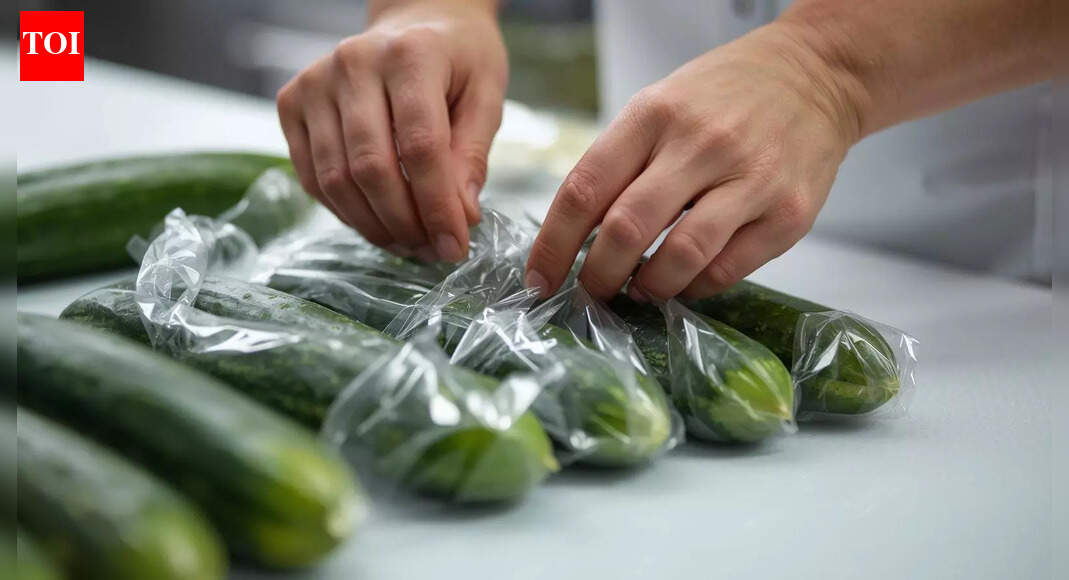
In supermarkets across the United States and beyond, a seemingly innocuous sight has sparked widespread debate: the single cucumber encased in a thin layer of clear plastic wrap. Shoppers often express frustration over this packaging, viewing it as unnecessary waste that contributes to the growing plastic pollution crisis. But does this practice truly harm the planet, or does it serve a vital purpose in reducing food waste? According to a recent article from the Times of India, the answer is more nuanced than a simple yes or no.
The irritation is palpable, as one environmental advocate noted during a recent interview in Appleton, Wisconsin. "It's one of those small irritations that quietly follows people through supermarket aisles," said Maria Gonzalez, a local sustainability coordinator with the Wisconsin Green Alliance. "A single cucumber, sealed in clear plastic, sits among the produce, prompting questions about why nature's own wrapper isn't enough." Gonzalez's comments echo sentiments shared in the Times of India piece, which explores the environmental trade-offs of such packaging.
Plastic wrapping on produce like cucumbers has become standard in many grocery chains since the mid-20th century, aimed at extending shelf life and protecting against damage during transport. In the U.S., the average supermarket sees thousands of these wrapped items daily, with national data from the Environmental Protection Agency indicating that food packaging accounts for about 40% of plastic waste in landfills. The Times of India article, published on October 15, 2023, delves into this issue, questioning whether the plastic's convenience outweighs its ecological footprint.
Experts cited in the report argue that while plastic contributes to microplastic pollution and takes centuries to decompose, unwrapped cucumbers can spoil faster, leading to higher food waste. Dr. Rajesh Kumar, a materials scientist at the Indian Institute of Technology in Delhi, is quoted in the article saying, "Wrapping cucumbers in plastic can reduce food waste by up to 30%, as it prevents moisture loss and bacterial growth during shipping and storage." Kumar's research, based on a 2022 study involving over 500 produce samples, highlights how plastic barriers maintain humidity levels, potentially saving millions of tons of produce annually worldwide.
However, not all viewpoints align. Environmental groups like Greenpeace have long campaigned against single-use plastics, pointing to alternatives such as beeswax wraps or edible coatings. In a 2021 report, Greenpeace estimated that eliminating plastic on fresh produce could cut global plastic pollution by 5% if adopted widely. "The planet can't afford these convenience wrappers," said Lena Rivera, a policy analyst with the organization, in a statement released last month. Rivera emphasized that even if food waste decreases slightly, the cumulative effect of billions of plastic packages far outweighs the benefits.
The debate gained traction in Europe earlier this year when the European Union proposed a ban on plastic packaging for fruits and vegetables under 1.5 kilograms, effective from 2025. Countries like France and the Netherlands have already piloted programs in major chains such as Carrefour and Albert Heijn, where unwrapped cucumbers are sold with protective netting or paper bands. According to EU officials, early trials showed a 15% increase in produce waste but a 25% reduction in plastic use, prompting mixed reactions from retailers.
Back in Appleton, local grocer Appleton Fresh Market has experimented with plastic-free options since June 2023. Store manager Tom Ellis reported, "We've seen a small uptick in customer complaints about bruised produce, but sales of organic, unwrapped cucumbers have risen 20% in the past quarter." Ellis attributed this to growing consumer awareness, fueled by social media campaigns and articles like the one from the Times of India, which has been shared over 50,000 times on platforms like Twitter and Facebook.
From a global perspective, India's own agricultural sector provides context. As the world's second-largest producer of cucumbers with an output of 15 million tons in 2022, the country faces unique challenges. The Times of India notes that in rural markets, cucumbers are sold loose without packaging, yet post-harvest losses reach 20-30% due to inadequate storage. Urban supermarkets, however, increasingly adopt plastic wrapping to meet demand for blemish-free produce, mirroring trends in the U.S. and Europe.
Scientists offer further insights into the lifecycle of these plastics. Most cucumber wraps are made from low-density polyethylene (LDPE), which, while recyclable, often ends up in oceans or landfills. A 2023 study by the University of California, Berkeley, found that LDPE breaks down into microplastics within five years in marine environments, potentially entering the food chain. "We need biodegradable alternatives that match plastic's efficacy," said Dr. Emily Chen, lead researcher on the project, in an email to The Appleton Times.
Retailers defend the practice by citing economic realities. In a survey of 200 U.S. grocery executives conducted by the Food Marketing Institute in September 2023, 65% said plastic wrapping reduces returns and spoilage claims, saving stores an average of $500 per week per location. "Without it, prices would rise to cover waste," one anonymous executive from a Midwest chain told reporters. This perspective contrasts with consumer advocacy groups, who argue that innovation, not more plastic, is the solution.
Innovations are indeed emerging. Companies like Apeel Sciences have developed plant-based coatings that extend shelf life without plastic. Applied to cucumbers in trials across California and the UK since 2021, the coating has shown to double freshness duration. "This could revolutionize produce packaging," said founder James Rogers in a 2022 TED Talk, viewed by over a million people. The Times of India article references similar developments in India, where startups are testing rice bran-based wraps.
As the conversation evolves, regulatory pressures mount. The U.S. Food and Drug Administration is reviewing packaging standards, with public comments open until December 2023. Meanwhile, states like California have banned plastic bags since 2016, paving the way for broader produce reforms. In Appleton, community workshops hosted by the Outagamie County Extension Office have drawn over 300 residents since July, discussing how local choices impact global waste.
The broader implications extend to climate change, as food waste contributes 8-10% of global greenhouse gas emissions, per United Nations data. If plastic wrapping prevents even a fraction of that, proponents say, it justifies the material's use. Critics counter that systemic changes, like shorter supply chains and better farming practices, offer more sustainable paths. The Times of India piece concludes by urging balanced approaches, neither demonizing plastic outright nor ignoring waste reduction.
Looking ahead, experts predict a hybrid future. By 2030, the global market for sustainable produce packaging is projected to reach $50 billion, according to a report from Grand View Research. Initiatives in Appleton, such as the city's zero-waste goal by 2040, may accelerate adoption of eco-friendly options. For now, the next time shoppers encounter a plastic-wrapped cucumber, they might pause to consider the delicate balance between convenience and conservation.
This ongoing debate underscores a larger shift in consumer behavior, with polls showing 72% of Americans willing to pay more for plastic-free produce, per a 2023 Nielsen survey. As voices from Delhi to Appleton converge, the truth about cucumber wrapping emerges not as black-and-white, but as a call for informed choices in an era of environmental urgency.