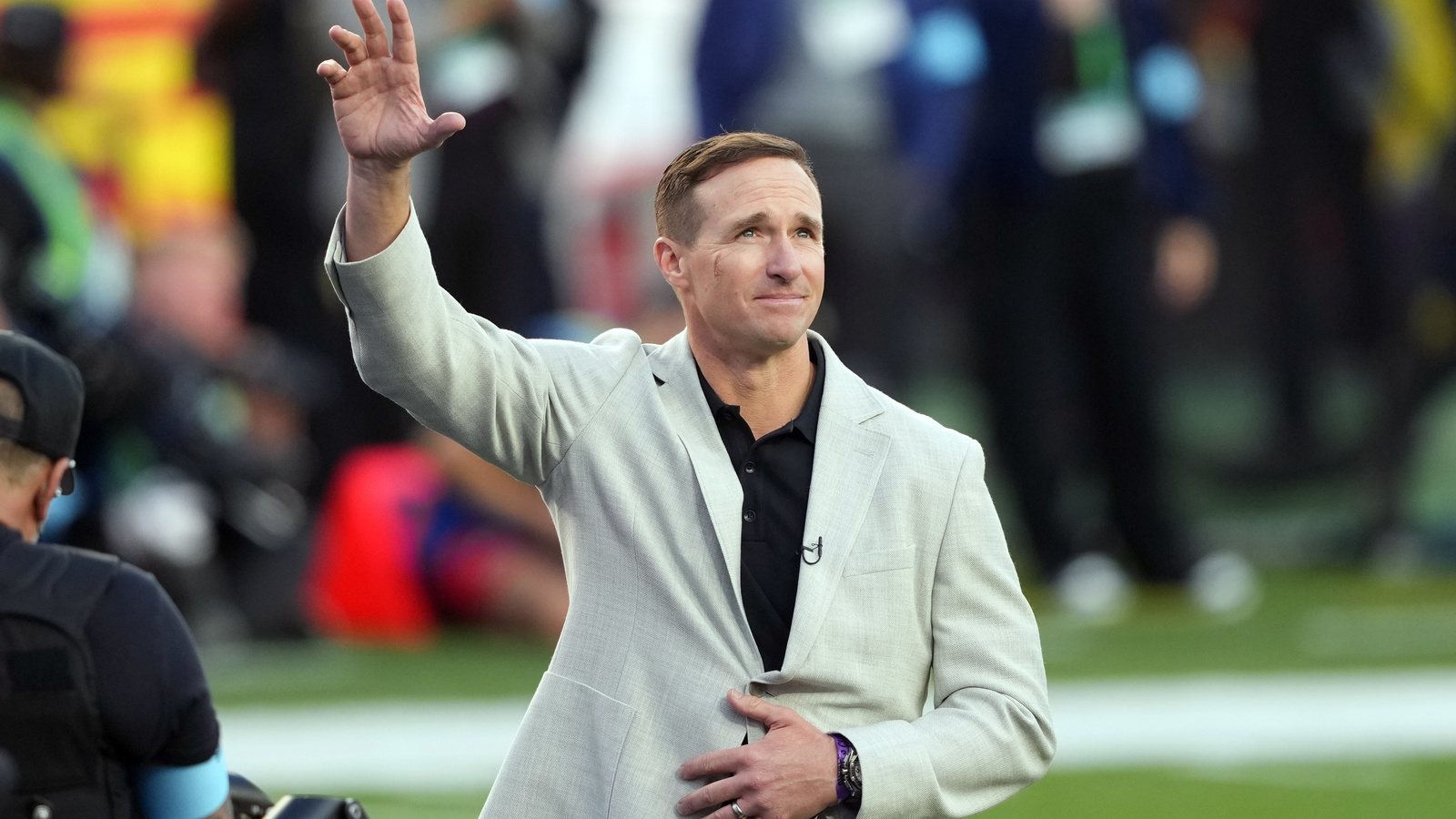
In the bustling atmosphere of Super Bowl weekend, where football legends converge to celebrate the game's pinnacle, Hall of Famer Drew Brees offered his insights on the future inductees of the Pro Football Hall of Fame. Speaking to TMZ Sports amid the festivities in Las Vegas for Super Bowl LVIII on February 11, 2024, Brees, who will enter the Hall as part of the Class of 2026, highlighted several veteran quarterbacks from his era as deserving candidates. The former New Orleans Saints star, known for his record-setting accuracy and leadership in securing the franchise's lone Super Bowl victory in 2010, emphasized that induction is just a matter of time for peers like Eli Manning and Philip Rivers.
Brees, drafted in 2001 out of Purdue University, shared a draft class rich with talent that has already produced multiple Hall of Famers, including himself and Michael Vick. His comments came as the Hall of Fame announced its Class of 2024 earlier that week, inducting seven new members on February 8, 2024, in Canton, Ohio. Among those celebrated were defensive standout Andre Johnson and return specialist Devin Hester, but notable absences, including longtime coach Bill Belichick, sparked discussions about the selection process.
"Certainly [Eli] is one of them. Belichick is one of them. Rivers is one of them," Brees said, according to the TMZ Sports interview. "You have all these guys that at some point, their time is going to come." Brees' endorsement of Manning, the two-time Super Bowl MVP who orchestrated dramatic upsets over Tom Brady's New England Patriots in 2008 and 2012, underscores the quarterback's legacy despite never leading the league in passing statistics. Manning, who retired in 2020 after 16 seasons with the New York Giants, amassed 57,023 passing yards and 366 touchdowns, ranking him among the all-time greats.
Philip Rivers, another 2001 draftee selected fourth overall by the San Diego Chargers, received similar praise from Brees. Rivers, who played 17 NFL seasons primarily with the Chargers before finishing his career with the Indianapolis Colts in 2020, holds the fourth-most passing yards in league history with 63,440 and the fifth-most touchdown passes at 421. Despite never reaching a Super Bowl and playing in an era dominated by Brady and Aaron Rodgers, Rivers' consistency—starting 240 consecutive games, an NFL record for quarterbacks—has made him a strong Hall of Fame contender, though his first year of eligibility comes in 2026.
The conversation naturally turned to Bill Belichick, the architect of six Super Bowl championships as head coach of the Patriots and a polarizing figure whose recent departure from New England in January 2024 has fueled speculation about his Hall of Fame trajectory. Belichick, eligible for induction in 2025, was notably absent from the Class of 2024 ballot entirely, a decision that surprised many in the football world. Brees addressed the snub directly, acknowledging the widespread sentiment without delving into the voters' rationale.
"I think we would all acknowledge that Belichick deserves to be here. We are not the voters, you know, so I think what we are going to do is focus on the class that is here," Brees remarked. The Hall of Fame's selection committee, composed of 50 media members, requires finalists to receive at least 80% of the vote for induction, a threshold that has historically favored players over coaches in recent years. Belichick's resume includes 333 regular-season wins, tying him for second all-time, and his defensive innovations revolutionized the modern game.
Brees' own path to Canton has been a celebrated one, marked by 80,358 career passing yards—the second-most in NFL history behind Brady—and a 68.7% completion rate that set the standard for precision passing. Selected 32nd overall in the 2001 draft after being overlooked due to his height of 6 feet, Brees revitalized the Saints franchise post-Hurricane Katrina, leading them to a 13-3 record in 2009 and a triumphant Super Bowl appearance. His induction ceremony is slated for August 2026 in Canton, Ohio, where he will join luminaries like his Saints predecessor Archie Manning, Eli's father.
Reflecting on the honor, Brees described the experience as "incredible," but quickly pivoted to what truly matters beyond the gridiron. "I would rather my family have it," he said, referring to the iconic gold jacket bestowed upon inductees, a symbol of prestige that now adorns his home. Brees, a father of four and husband to Brittany Brees, has long emphasized philanthropy through his Brees Dream Foundation, which has donated millions to causes in Louisiana and beyond, including youth sports and cancer research.
This perspective aligns with Brees' post-retirement life, where he has transitioned into broadcasting and business ventures while maintaining a strong Christian faith. "Football does not define you. Being in the Hall of Fame does not define you. What defines you is your faith, family, and your spirit," he concluded in the interview. These words resonate in an NFL landscape increasingly focused on player well-being and legacy beyond statistics, especially as the league grapples with concussion protocols and mental health initiatives.
"Football does not define you. Being in the Hall of Fame does not define you. What defines you is your faith, family, and your spirit," Drew Brees told TMZ Sports.
The timing of Brees' comments, just days after the Class of 2024 reveal, highlights ongoing debates about the Hall of Fame's inclusivity. Critics, including some former players, argue that the process favors offensive stars and Super Bowl winners, potentially delaying recognition for defensive coaches like Belichick or workhorse quarterbacks like Rivers. Supporters of the committee point to the rigorous standards, noting that only 382 of over 28,000 eligible players and coaches have been enshrined since 1963.
Looking ahead, the 2025 class could see a crowded quarterback field, with potential nominees including Matt Ryan, who led the Atlanta Falcons to Super Bowl LI in 2017, and possibly Manning if he gains enough senior committee support. Rivers and Eli Manning become eligible in 2026, coinciding with Brees' induction, which could create a poignant reunion of 2001 draft classmates. Belichick's case, meanwhile, may benefit from a cooling-off period post-Patriots, allowing voters to reflect on his dynasty-building without the recency of his 4-13 record in 2023.
Brees' optimism extends to the broader veteran quarterback cohort, a group that includes contemporaries like Brady, already a first-ballot lock, and Rodgers, whose future eligibility in 2027 looms large. The NFL's evolution, from the run-heavy 2000s to today's pass-oriented schemes, has elevated the quarterback position, making Hall debates more competitive. As Brees noted, time often heals the selection process, with many first-year snubs eventually gaining entry—Eli Manning, for instance, might follow the path of his brother Peyton, inducted in 2021 after one year.
In Canton, the Hall of Fame continues to grow, with its bronze bust gallery serving as a testament to football's enduring stars. Brees' remarks during Super Bowl weekend not only celebrate his peers but also remind fans that the game's greatest honors are part of a larger narrative of perseverance and character. As the 2024 inductees prepare for their enshrinement speeches, the anticipation builds for future classes that promise to honor the architects of an era defined by aerial assaults and unbreakable wills.
For Rivers, who retired amid whispers of a potential return that never materialized, a Hall nod would cap a career of near-misses, including four AFC Championship appearances without a Super Bowl berth. Manning's inclusion seems all but assured, given his clutch performances in the biggest moments, though some analysts question if his completion percentage of 60.3% holds him back compared to higher-efficiency passers. Brees' endorsement carries weight, given his own statistical dominance and the respect he commands across the league.
Ultimately, Brees' interview paints a picture of camaraderie among football's elite, where personal accolades take a backseat to shared respect and life beyond the field. As the NFL offseason unfolds, with free agency and the draft on the horizon, these reflections on legacy provide a welcome pause, connecting past achievements to the sport's timeless appeal.