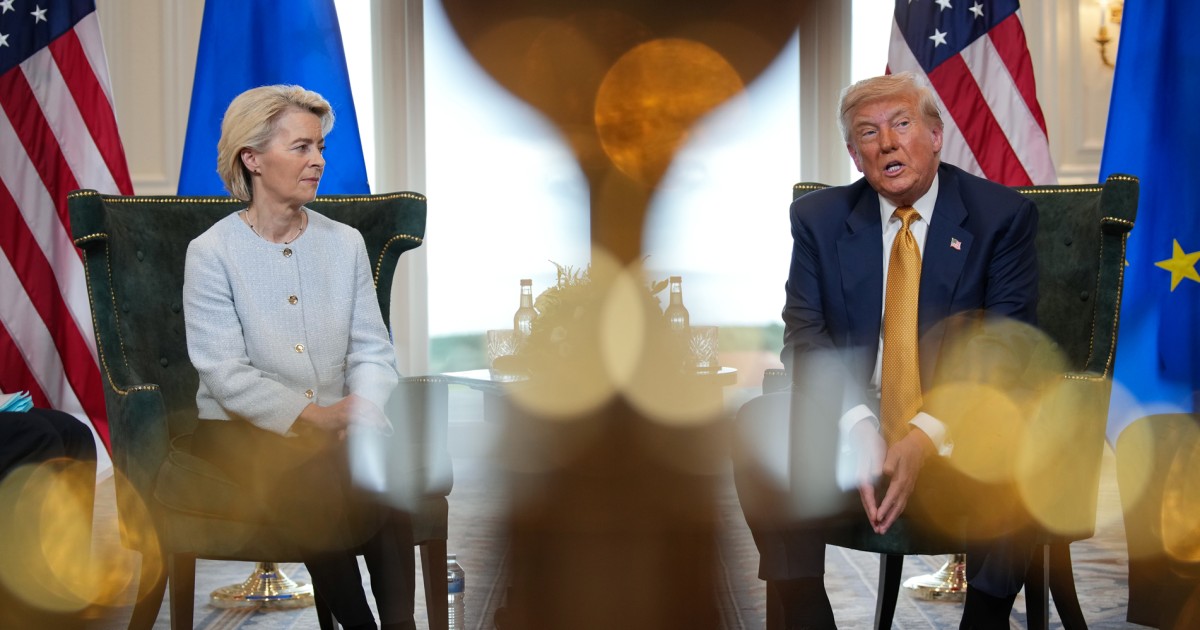
BRUSSELS — The European Parliament has suspended the ratification process for a major trade agreement with the United States, citing deep uncertainty over the Trump administration's commitment to the deal following a recent Supreme Court ruling that invalidated many of President Donald Trump's tariffs. The decision, announced after an emergency meeting in Brussels on Monday, comes amid escalating tensions in transatlantic trade relations, exacerbated by Trump's earlier threats to impose additional tariffs on European countries.
The trade deal, negotiated last July between Trump and European Commission President Ursula von der Leyen, aimed to eliminate barriers in key sectors for American exporters. It would have capped most U.S. tariffs on EU imports at 15 percent and reduced them to zero for items including aircraft and parts, generic drugs, semiconductor equipment, certain farm products, and critical raw materials unavailable domestically in the U.S. The White House described the agreement as a "generational modernization of the transatlantic alliance," while von der Leyen emphasized that it provided "certainty in uncertain times" and offered "stability and predictability, for citizens and businesses on both sides of the Atlantic."
However, progress on the deal has been rocky since its announcement. The European Parliament has been working to implement the EU's obligations, but U.S. actions have repeatedly sowed doubt. Last year, the U.S. expanded its metals tariffs to cover hundreds of additional products, complicating negotiations. Then, in mid-January, Trump threatened to impose extra tariffs on eight European countries unless the U.S. gained control of Greenland, a Danish territory. That move prompted the European Parliament to pause ratification for the first time.
Bernd Lange, chair of the Parliament's international trade committee, sharply criticized the Greenland threats at the time, stating, "By threatening the territorial integrity and sovereignty of an E.U. member state and by using tariffs as a coercive instrument, the U.S. is undermining the stability and predictability of E.U.-U.S. trade relations." The backlash was swift: the United Kingdom, the EU as a whole, and individual member states pushed back forcefully, leading Trump to retract the threats.
Despite the reversal, European lawmakers remained wary. Rather than resuming work immediately, they opted to delay proceedings for several weeks. The latest halt follows the Supreme Court's decision to strike down most of Trump's tariffs, leaving the future of U.S. trade policy in flux. Lawmakers in Brussels now describe the U.S. side of the deal as "so uncertain," with Lange adding, "Nobody knows what will happen ... and it's unclear if there will be additional measures or how the United States will really guarantee" its end of the agreement.
European Union trade spokesman Olof Gill echoed these concerns ahead of Monday's announcement. Speaking in Brussels, Gill said, "The U.S. needs to tell us precisely what is going on," noting that responses from the Trump administration so far have not addressed the bloc's questions adequately. He added, "There is engagement ongoing with the U.S. but there is more required."
The Supreme Court's ruling has broader ramifications beyond the EU deal. Overnight, China announced it was reviewing the decision and seeking more details from Washington. Beijing also urged the U.S. to abandon its tariffs entirely, according to statements from Chinese officials. This comes as U.S.-China trade tensions persist, with the ruling potentially reopening negotiations on their own phase-one agreement from 2020.
Elsewhere, trade negotiators from India have canceled a planned trip to Washington for discussions on a pending bilateral deal, multiple reports indicate. The Indian Commerce Ministry did not respond to requests for comment on the cancellation, but sources suggest the uncertainty from the court ruling played a role. India, a major U.S. trading partner, has been pushing for reduced tariffs on textiles, pharmaceuticals, and agricultural goods in ongoing talks.
The EU-U.S. deal's origins trace back to efforts to reset relations after years of tariff skirmishes during Trump's first term. In 2018, the U.S. imposed 25 percent tariffs on steel and 10 percent on aluminum from the EU, prompting retaliatory measures from Brussels on American products like bourbon, motorcycles, and jeans. A temporary truce in 2021 suspended those tariffs, paving the way for the July agreement. Yet, implementation has lagged, with the European Parliament requiring approval from all 27 member states before ratification.
Critics within the EU argue that the deal favors U.S. interests too heavily, particularly in sectors like digital services and data flows, where American tech giants stand to gain. Environmental groups have also raised concerns about weakened standards for raw materials extraction. On the U.S. side, some lawmakers in Congress have questioned whether the agreement adequately protects domestic industries, especially after the metals tariff expansions.
The timing of the halt is particularly sensitive, as it coincides with preparations for the upcoming G7 summit in Italy, where trade issues are expected to feature prominently. EU leaders, including von der Leyen, have stressed the need for reliable partnerships amid global challenges like the war in Ukraine and supply chain disruptions. The Parliament's decision could delay benefits for exporters on both sides; for instance, zero tariffs on aircraft parts would aid companies like Boeing and Airbus, while lower duties on generic drugs could lower costs for consumers in Europe.
Trump administration officials have not yet commented directly on the EU's latest move. In a statement last week following the Supreme Court ruling, U.S. Trade Representative Katherine Tai described the decision as a "significant step toward fairer trade," but provided no specifics on ongoing deals. White House press secretary Jen Psaki, in a briefing on Friday, reiterated the administration's commitment to transatlantic ties, saying, "We value our partnership with the EU and are working through these challenges collaboratively."
Analysts suggest the pause could last several months, depending on clarity from Washington. "The EU is signaling that it won't proceed without ironclad assurances," said trade expert Maria Gonzalez of the Brussels-based think tank EuroTrade Institute. "This isn't just about tariffs; it's about trust in the U.S. as a predictable partner."
The broader implications extend to global trade dynamics. With the U.S. tariffs now largely dismantled by the court, other nations may seek similar concessions, potentially leading to a cascade of renegotiations. For the EU, the halt underscores its growing assertiveness in trade policy, especially post-Brexit, as it balances relations with the U.S., China, and emerging markets.
Looking ahead, EU lawmakers plan to reconvene in early March to reassess the situation. Gill indicated that further talks with U.S. counterparts are scheduled, but emphasized that "substantive answers" are needed soon. As the transatlantic alliance navigates this latest hurdle, businesses on both sides watch closely, hoping for resolution before economic uncertainties deepen.