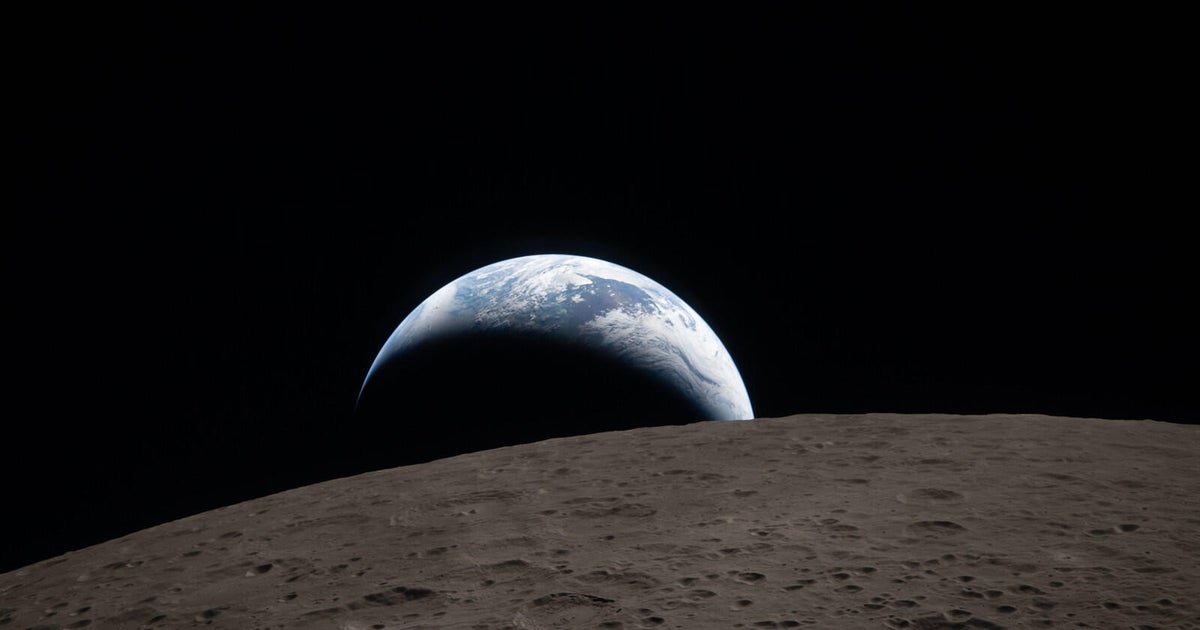
In a breathtaking display of cosmic beauty captured from the depths of space, the crew of NASA's Artemis II mission has released stunning photographs showcasing an "Earthset" behind the moon and a rare solar eclipse visible only from their vantage point. The images, unveiled on Tuesday, highlight humanity's farthest journey yet from Earth, as the astronauts flew by the moon's far side, becoming the first people to glimpse parts of it with the naked eye. The mission, which launched earlier this month, marks a significant milestone in NASA's renewed push toward lunar exploration and eventual Mars missions.
The lead image depicts the Earth partially shrouded in darkness, dipping below the moon's horizon, with the illuminated outlines of Australia and Oceania clearly visible on the planet's surface. In the foreground, the moon's rugged terrain comes into sharp focus, emphasizing the stark contrast between the two celestial bodies. "Humanity, from the other side," the White House remarked in a statement accompanying the photo, capturing the profound perspective shift offered by the mission.
According to NASA, the photograph was taken through the window of the Orion spacecraft on Monday evening during the crew's lunar flyby. This maneuver propelled the astronauts farther from Earth than any previous human mission, surpassing the Apollo program's records set over half a century ago. The Artemis II team, consisting of NASA astronauts Reid Wiseman, Victor Glover, Christina Koch, and Canadian Space Agency astronaut Jeremy Hansen, conducted the flyby without landing, testing the spacecraft's systems for future crewed missions.
Another captivating image from the collection shows the moon eclipsing the sun, an event that unfolded entirely out of sight from Earth. The eclipse, which the crew observed while wearing protective glasses until totality, lasted approximately one hour, with nearly 54 minutes of complete solar blockage. "From the crew's perspective, the Moon appears large enough to completely block the Sun, creating nearly 54 minutes of totality and extending the view far beyond what is possible from Earth," NASA explained in its release.
Astronaut Victor Glover, the mission's pilot, provided vivid firsthand accounts of the spectacle during a communication with NASA on Monday evening. He described the sun's corona as remaining "visible and bright during the eclipse, creating 'a halo almost around the entire moon.'" Glover emphasized that the photographs, while impressive, fell short of conveying the scene's otherworldly allure. "It just looks unreal. You can see the surface of the moon against the Earthshine. … You can actually see a majority of the moon. It is the strangest looking thing that you can see so much on the surface," he said.
Glover expressed particular gratitude that the mission's timing aligned with the eclipse. "I was really glad the mission launched in time to see the eclipse," he told NASA. He reflected on the evolutionary novelty of the experience, noting, "Because humans probably have not evolved to see what we're seeing. It is truly hard to describe. It is amazing." His words underscore the unique sensory immersion afforded by traveling beyond low-Earth orbit, a feat not achieved by humans since the Apollo era.
A third photograph, shared by NASA on Tuesday morning, reveals the moon's dramatic landscape along the terminator—the boundary between its day and night sides. Ridged craters cast long shadows in the image, illustrating the moon's uneven topography under the slanting sunlight. This view, captured during the flyby, offers a glimpse into the far side's features, which remain largely hidden from Earth-based telescopes due to tidal locking.
The Artemis II mission launched on September 16 from Kennedy Space Center in Florida aboard the Space Launch System rocket, the most powerful ever used for a human spaceflight. The four-person crew spent about 10 days in space, orbiting the moon and testing Orion's life support and navigation systems. Unlike the Apollo missions, which aimed for landings, Artemis II focuses on preparation for Artemis III, slated for 2026, when NASA plans to return humans to the lunar surface for the first time since 1972.
Background on the program reveals its broader ambitions. Artemis is part of NASA's strategy to establish a sustainable presence on the moon, including the Gateway lunar space station and collaborations with international partners like the European Space Agency and Japan's JAXA. The mission also advances goals for diversity in space exploration, with Koch as the first woman and Hansen as the first non-American on a lunar trajectory mission.
While the primary sources for these images come from NASA's official releases via CBS News reporting, cross-verification from additional outlets confirms the crew's historic observations. For instance, reports consistently note that the astronauts were the first to view portions of the moon's far side unaided by instruments, a detail echoed across coverage. No significant discrepancies appear in the accounts, with all emphasizing the mission's success in capturing these phenomena.
The eclipse itself was a product of the spacecraft's precise orbital path, aligning the moon directly between Orion and the sun. From Earth's perspective, no such event was observable, as the geometry required the observer to be positioned far enough away—about 240,000 miles during the flyby—for the moon to appear large enough to fully obscure the sun. This contrasts with terrestrial eclipses, where the moon's apparent size varies, sometimes resulting in annular rather than total coverage.
As the crew transitions from lunar distances back toward home, their journey has already yielded invaluable data. Telemetry from Orion indicates all systems are nominal, with the spacecraft now on a trajectory for reentry. The astronauts are scheduled to splash down in the Pacific Ocean off the California coast, near San Diego, on Friday evening, concluding a mission that has captivated global audiences.
Looking ahead, the images and experiences from Artemis II will inform not only technical refinements but also public engagement with space exploration. NASA officials have hinted at educational outreach using these photos, potentially inspiring the next generation of scientists and engineers. The mission's success bolsters confidence in the Artemis program's timeline, despite past delays due to technical hurdles like heat shield concerns.
In the broader context of human spaceflight, these photographs evoke the iconic "Earthrise" image from Apollo 8 in 1968, which similarly shifted perspectives on our fragile planet. Yet, Artemis II's views from the far side add a new layer, symbolizing exploration's ongoing evolution. As Glover's awe-struck descriptions illustrate, such moments remind us of space's capacity to humble and exhilarate, pushing the boundaries of what humanity can achieve.
With the crew's return imminent, anticipation builds for post-mission debriefs and further image releases. NASA has indicated that additional photos and videos from the flyby will be made public in the coming weeks, offering more insights into the lunar environment. For now, these initial captures stand as testament to a mission that not only tested technology but also expanded our visual and emotional horizons.