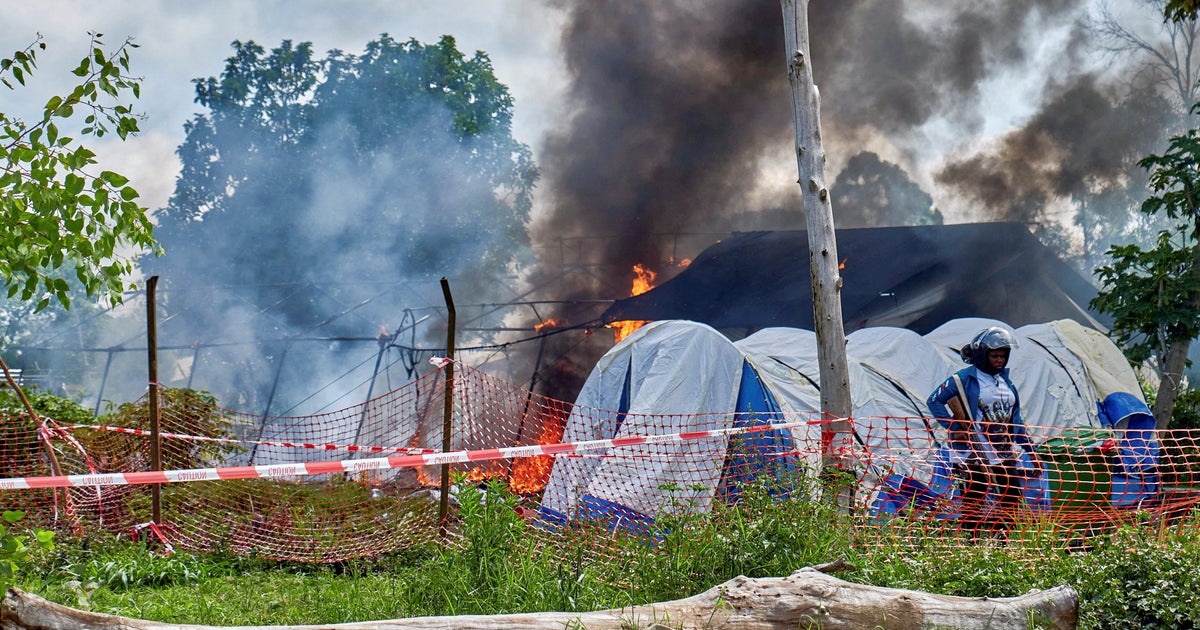
An Ebola treatment center in eastern Congo was set ablaze Thursday by local youths angry over efforts to retrieve the body of a suspected victim, highlighting growing tensions amid a rapidly spreading outbreak that health officials now describe as a national emergency.
The World Health Organization raised its risk assessment for the Democratic Republic of Congo to "very high" at the national level, with Director-General Tedros Adhanom Ghebreyesus telling reporters Friday that the virus "is spreading rapidly." He noted 82 confirmed cases and seven confirmed deaths, though he added that the true scale is likely much larger, with nearly 750 suspected cases and 177 suspected deaths reported so far.
The arson attack occurred in Rwampara, a town at the center of the outbreak in Ituri Province. According to witness Alexis Burata, a local student, young people tried to take the body of a friend who had apparently died of Ebola for a traditional funeral but were blocked by authorities enforcing strict burial protocols. "The police intervened to try to calm the situation, but unfortunately they were unsuccessful," Burata told The Associated Press. "The young people ended up setting fire to the center."
Deputy Senior Commissioner Jean Claude Mukendi, head of public security in Ituri Province, explained that the youths had not understood the regulations. "His family, friends, and other young people wanted to take his body home for a funeral even though the instructions from the authorities during this Ebola virus outbreak are clear," Mukendi said. "All bodies must be buried according to the regulations." An AP journalist on the scene reported that people broke into the facility, set fire to objects inside, and appeared to ignite the body of at least one suspected victim stored there, forcing aid workers to flee in vehicles.
Health workers have struggled to contain the outbreak because of local customs around burials that can spread the highly contagious virus through contact with bodily fluids. The bodies of Ebola victims remain dangerous even after death, prompting authorities to manage burials directly, which has sparked protests from families. Hama Amadou, field coordinator for the humanitarian group ALIMA, said later that calm had returned and teams were resuming work at the damaged center.
The current outbreak involves the Bundibugyo strain of Ebola, for which no vaccine or specific medicine is yet available. Experts estimate it could take six to nine months to develop one. The virus went undetected for weeks after the first known death in late April, as officials initially tested for a different strain more common in past Congo outbreaks. "Patient zero" has not yet been identified, according to the WHO.
Neighboring Uganda has reported two confirmed cases in people who had traveled from Congo, with one death, though the situation there remains stable. The outbreak has been complicated by armed conflict in the region, including a Tuesday attack by ISIS-linked militants that killed at least 17 people in the village of Alima in Ituri Province. There are more than 920,000 internally displaced people in the province, further straining weak health infrastructure.
"We are still in the phase where we are intensifying the investigation, searching for cases," said Jean Kaseya, Director-General of the Africa Centers for Disease Control and Prevention. "I expect the number of cases to increase as surveillance becomes more and more rigorous."
The United States has imposed travel restrictions on anyone who visited Congo, Uganda, or South Sudan in the previous 21 days. Foreign visitors are barred from entry, while U.S. citizens and permanent residents must undergo screening at Washington Dulles International Airport. India and the African Union postponed the India-Africa Forum Summit scheduled for next week in New Delhi due to the evolving health situation.
Congo's national soccer team canceled a three-day World Cup training camp and fan farewell event in Kinshasa this week over concerns about the outbreak. Ariel Kestens, head of the International Federation of Red Cross and Red Crescent Societies delegation in Congo, stressed the need for swift action. "The priority now is to act quickly and work closely with communities, as the coming days are critical," he said.
Early detection remains essential for saving lives, yet surveillance capacity has been hampered by years of international aid cuts and ongoing displacement. The WHO declared the outbreak a public health emergency of international concern earlier this week, though the global risk level remains low.
Health officials continue to search for additional cases while trying to build trust with communities wary of outside interventions. The fire in Rwampara underscores the delicate balance between containing a deadly virus and respecting local traditions in a region already burdened by conflict and limited medical resources.