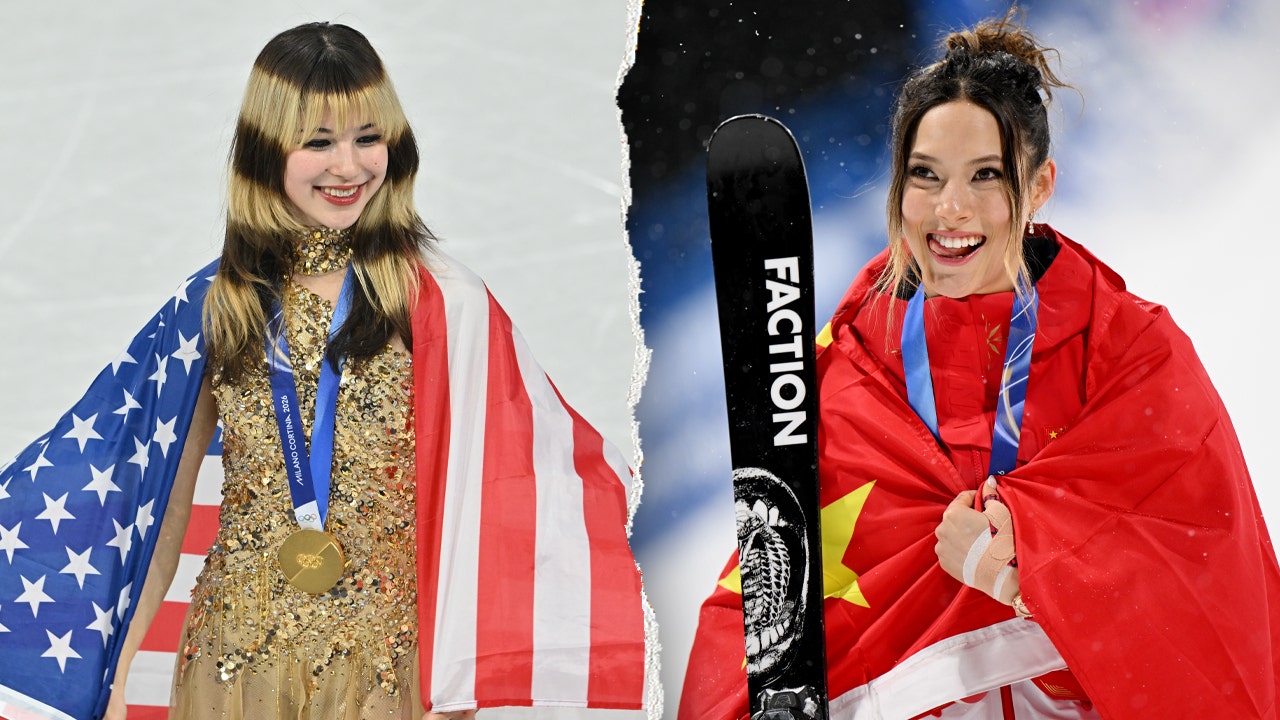
MILAN, Italy — Alysa Liu made history on Thursday at the Milano Ice Skating Arena during the Milan Cortina 2026 Winter Olympics, clinching the gold medal in the women's single skating event and becoming the first American woman to win an individual Olympic medal in figure skating in 20 years. Her victory also marked the first U.S. gold in the discipline in 24 years, capping a triumphant return to the sport after a brief retirement. Liu's performance in the free skate final earned her a total score of 226.79 points, including a season-best 150.20 in the free skate and 76.59 from the short program, as she landed all her jumps flawlessly before erupting in celebration with her team.
As Liu held up her gold medal in a photo shared on Instagram, captioned 'These are for y'all,' alongside the U.S. team gold she helped secure earlier, she received an enthusiastic response from an unexpected source: Eileen Gu, the American-born skier competing for China. Gu, who has been a focal point of Olympic discussions due to her own nationality switch, commented simply, 'YESSSSSS,' on the post, celebrating Liu's achievement amid ongoing comparisons between the two athletes.
Liu's win came after a dramatic performance where she yelled, 'That's what I'm f---ing talking about!' and 'Holy s---!' in exuberant joy upon finishing her routine on February 19, 2026. The 20-year-old from Oakland, California, raised by her father Arthur Liu, has long been seen as a symbol of loyalty to Team USA. Her family reportedly rebuffed overtures from Chinese officials seeking to recruit her, with Arthur Liu described as 'not open to persuasion,' according to reports from The Economist.
In contrast, Gu, also a Chinese American from the Bay Area—raised in San Francisco by her mother Yan Gu—chose to represent China starting in 2019, just months after her debut on the U.S. freestyle ski circuit. The decision came amid a Chinese government initiative launched that year to recruit foreign-born athletes of Chinese heritage, aimed at bolstering the nation's performance in events like the 2022 Beijing Winter Olympics and beyond, as detailed by The China Project. Gu requested a change of nation with the International Ski Federation and made her debut for China in June 2019.
The paths of Liu and Gu have diverged sharply, fueling social media debates throughout these Olympics about identity, loyalty, and geopolitics. Both daughters of Chinese immigrants, the athletes have been pitted against each other in what some online commentators call an 'Olympic proxy war.' Liu's story is often framed as one of unwavering American allegiance, while Gu's switch has drawn criticism from those who view it as a betrayal, especially given her success and the U.S.-China tensions.
At the 2022 Beijing Winter Olympics, Gu shone brightly for China, earning two gold medals and one silver in freeskiing events, which catapulted her to global fame upon returning to California. Liu, competing for the U.S., placed sixth in women's singles figure skating that year before stepping away temporarily in early retirement. She made a comeback in 2024, leading to her dominant showings in Milan Cortina, where she contributed to the U.S. team gold before her individual triumph.
Gu's Olympic campaign in 2026 has been strong but not flawless so far. She secured silver medals in the women's freeski big air event on February 16, 2026, in Livigno, Italy, and another in a related competition. Posing after the big air ceremony, Gu faced questions about her results during a Tuesday interaction with reporters that went viral. When asked if she viewed her medals as 'silvers earned' or 'golds lost,' Gu responded firmly.
'I’m the most decorated female freeskier in history. I think that’s an answer in and of itself,' Gu said. 'How do I say this? Winning a medal at the Olympics is a life-changing experience for every athlete. Doing it five times is exponentially harder because every medal is equally hard for me, but everybody else’s expectations rise, right? The two medals lost situation, to be quite frank with you, I think is kind of a ridiculous perspective to take. I’m showcasing my best skiing. I’m doing things that quite literally have never been done before. So, I think that is more than good enough, but thank you.'
Gu's challenges continued on Thursday when she fell during the halfpipe qualifier, nearly missing the final, but recovered in her second run to advance. The women's halfpipe final, widely considered her strongest event, is now set for Sunday in Milan Cortina, delayed by one day from its original schedule due to intense snowfall in the area. A gold there could add to her medal tally and potentially shift the narrative around her performances this Games.
Beyond the ice and snow, Gu has navigated significant scrutiny over her decision to compete for China, a choice made at age 15 despite her U.S. upbringing. After her Thursday qualifier, she addressed whether she feels like 'a bit of a punching bag for a certain strand of American politics,' according to USA Today.
'I do,' Gu acknowledged. 'So many athletes compete for a different country. ... People only have a problem with me doing it because they kind of lump China into this monolithic entity, and they just hate China. So, it's not really about what they think it's about. And also, because I win. Like, if I wasn't doing well, I think that they probably wouldn't care as much, and that's OK for me. People are entitled to their opinions.'
Defenders of Gu, including fellow Olympians, have spoken out against the criticism she faces. Reports indicate that some U.S. athletes have publicly supported her right to choose her representation, highlighting that nationality switches are common in international sports. Meanwhile, Liu's family history adds another layer; her father Arthur was once targeted by what were described as Chinese spies attempting to influence her allegiance, though Liu has addressed the matter publicly, emphasizing her commitment to the U.S.
The recruitment program that approached both athletes has been a point of contention. According to The China Project, it targeted top talents like Gu and Liu to enhance China's winter sports prowess, particularly ahead of the Beijing Games. Gu's success has made her a star in China, but it has also intensified debates in the U.S. about dual loyalties and the implications of such programs amid broader U.S.-China rivalries.
Liu's gold medal not only personalizes her journey but also boosts American figure skating, which has seen a drought in individual women's medals since Sarah Hughes' gold in 2002. Her Oakland roots and family story resonate widely, with fans praising her as a homegrown talent. Gu, for her part, continues to compete under the weight of expectations, her comments reflecting a mix of defiance and acceptance.
As the Milan Cortina Olympics progress, the stories of Liu and Gu underscore the complex intersections of heritage, nationality, and athletic ambition. With Gu's halfpipe final looming and Liu's victory fresh, their journeys highlight how personal choices can ripple through global sports narratives. Observers will watch closely to see if Gu can claim gold in her final event, potentially evening the medal scoreboard in this tale of two Bay Area stars on opposing sides.