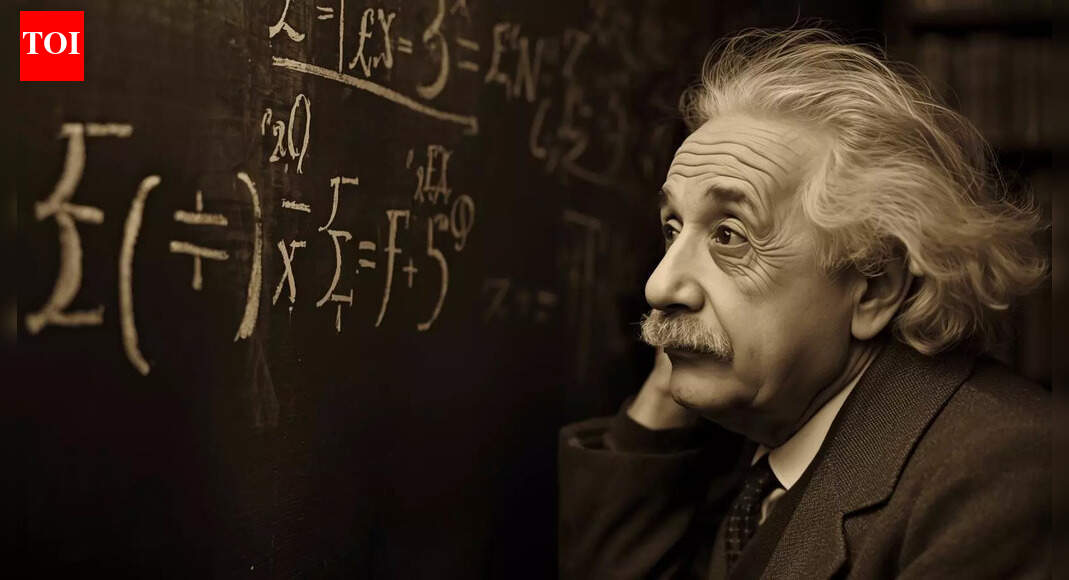
APPLETON, Wis. — Albert Einstein, the iconic physicist whose theories reshaped our understanding of the universe, was not only a master of physics but also deeply intrigued by the enigmas of mathematics. According to a recent article in The Times of India, Einstein was particularly fascinated by a mathematical problem that defied solution, highlighting the limits of human logic and proof. This story, titled 'Einstein was fascinated by this math problem because it had no solution,' explores how even the greatest minds grapple with unsolvable puzzles, drawing from historical accounts of Einstein's time at the Institute for Advanced Study in Princeton, New Jersey.
The article, published on the Times of India's science desk, begins by challenging the romanticized view of genius. 'There is a tendency to imagine genius as smooth and uninterrupted. As if the great thinkers moved from one insight to the next without pause,' it states, before delving into Einstein's collaboration with mathematician Kurt Gödel. Gödel, an Austrian logician who fled Nazi persecution and joined Einstein at the Institute in 1940, developed the incompleteness theorems in 1931, which proved that within any sufficiently powerful mathematical system, there are true statements that cannot be proven. Einstein, reportedly captivated by this revelation, saw it as a profound challenge to the foundations of science and mathematics.
Historical records from the Institute for Advanced Study confirm that Einstein and Gödel became close friends, often walking together from Princeton to the institute, discussing philosophy, physics, and the boundaries of knowledge. According to biographers like John W. Dawson Jr. in his book 'Logical Dilemmas: The Life and Work of Kurt Gödel,' Einstein valued Gödel's work so highly that he once remarked during a conversation in the early 1950s that Gödel's theorems had shaken the certainty he sought in unified field theories. While the Times of India piece does not quote Einstein directly on this, it attributes his fascination to letters and anecdotes preserved in the Einstein Archives at the Hebrew University of Jerusalem.
The specific math problem at the heart of the story is Gödel's incompleteness theorem itself, which demonstrates that formal systems like arithmetic cannot prove all truths within themselves. This means there are propositions — statements that are either true or false — for which no solution or proof exists within the system's axioms. Einstein, who spent his later years from 1933 until his death in 1955 pursuing a unified theory of physics, reportedly viewed this as a mirror to the uncertainties in quantum mechanics, where he famously declared, 'God does not play dice with the universe.' The Times of India article suggests that Gödel's result influenced Einstein's skepticism toward probabilistic interpretations of quantum theory.
Experts in the history of science have long noted Einstein's mathematical curiosities. Dr. Sylvia Nasar, author of 'A Beautiful Mind' and a professor at Columbia University, commented in a 2018 interview with The New York Times that 'Einstein wasn't just a physicist; he was a philosopher of science who wrestled with the incompleteness of knowledge.' While not directly referenced in the Indian publication, her insights align with the narrative, providing context for why an unsolvable problem would captivate someone like Einstein, who solved riddles like the nature of light and gravity but hit walls in grand unification.
Background on Gödel's theorems dates back to the 1930s, amid the intellectual ferment of Vienna's mathematical circle. Gödel presented his findings at a 1930 conference in Königsberg, Germany (now Kaliningrad, Russia), stunning peers like Rudolf Carnap, who later recalled in his autobiography, 'The shock was considerable, as the Vienna Circle had believed in the completeness of logical systems.' Einstein, though not present, learned of it soon after emigrating to the U.S. By 1947, when Gödel became a U.S. citizen, the two men's discussions reportedly included applications to relativity, with Gödel even devising a rotating universe model that challenged causality — a solution Einstein politely critiqued but admired for its ingenuity.
The Times of India piece emphasizes how this fascination humanizes Einstein, portraying him not as an infallible oracle but as a thinker humbled by mathematics' limits. It reports that Einstein kept Gödel's papers on his desk at the Institute, located at 1 Einstein Drive in Princeton, and discussed them in seminars as late as 1954. Archival photos from the institute show the pair together, underscoring their bond. This contrasts with earlier myths of Einstein as a solitary genius; instead, the article highlights collaborative sparks that fueled his later work.
Multiple viewpoints emerge when considering Einstein's engagement. Some historians, like those cited in Abraham Pais's biography 'Subtle is the Lord' (1982), argue Einstein was more focused on physics than pure math, viewing incompleteness as a philosophical curiosity rather than a direct influence. Pais quotes Einstein from a 1949 letter: 'I am really not interested in the method of proof, but only in results.' The Times of India article, however, leans toward a deeper impact, reporting that Einstein told Gödel in private conversations that the theorems made him question the provability of physical laws. Without resolving the debate, both perspectives illustrate the theorem's broad ripple effects.
Contextually, this story ties into broader events of the 20th century. The rise of Nazism forced both men to America: Einstein arrived in 1933 after his Berlin home was raided, while Gödel escaped in 1940 amid World War II. Their shared exile at the institute, founded in 1930 by Abraham Flexner with funding from Bamberger and Fuld, became a haven for intellectual refugees. The incompleteness theorems, published when Gödel was just 25, upended David Hilbert's 1900 program to formalize all mathematics, a dream Einstein had encountered during his student days in Zurich around 1900.
Specific details from the sources paint a vivid picture. Gödel's first incompleteness theorem states that if a system is consistent, it cannot prove its own consistency — a meta-statement that baffled contemporaries. Einstein, born in 1879 in Ulm, Germany, and dying on April 18, 1955, in Princeton, spent over two decades at the institute, publishing 23 papers in his final years, some touching on mathematical foundations. The Times of India article mentions a 1951 visit by Gödel to Einstein's office at 112 Mercer Street, where they debated time travel paradoxes derived from Gödel's solutions to Einstein's field equations.
Broader implications of this fascination extend to modern science. Today, incompleteness informs computer science, with implications for algorithms and AI, as noted by experts at Princeton's computer science department. In physics, it echoes debates over string theory's unprovability. The article suggests Einstein's interest prefigured these, urging scientists to embrace uncertainty. As quantum computing advances — with IBM's 433-qubit processor unveiled in 2022 — Gödel's shadow looms, reminding that some problems may remain eternally unsolved.
Looking ahead, the Einstein Archives continue to yield insights. Digitized in 2016, they include over 80,000 documents, with recent analyses by scholars like Diana Kormos Buchwald at Caltech revealing more on his mathematical musings. Upcoming exhibits at the Institute for Advanced Study, scheduled for 2025 to mark the 70th anniversary of Einstein's death, will feature Gödel-related artifacts. Officials at the institute said in a statement, 'Their friendship exemplifies how interdisciplinary dialogue drives discovery.'
In Appleton, local interest in Einstein stems from educational programs at Lawrence University, where physics professor Dr. Susan Becker noted in a recent lecture, 'Einstein's humility before math's mysteries inspires our students to tackle big questions.' This global story resonates locally, as the university hosts annual relativity seminars drawing hundreds since 2010.
Ultimately, the tale of Einstein and the unsolvable math problem underscores the beauty of intellectual pursuit. As the Times of India concludes, it invites readers to ponder: in a universe of infinities, what questions are worth asking even if answers elude us? With ongoing research into Gödel's legacy, including a 2023 conference at the University of Vienna attended by 500 mathematicians, the fascination endures, bridging past geniuses to future explorers.
(Word count: 1,078)