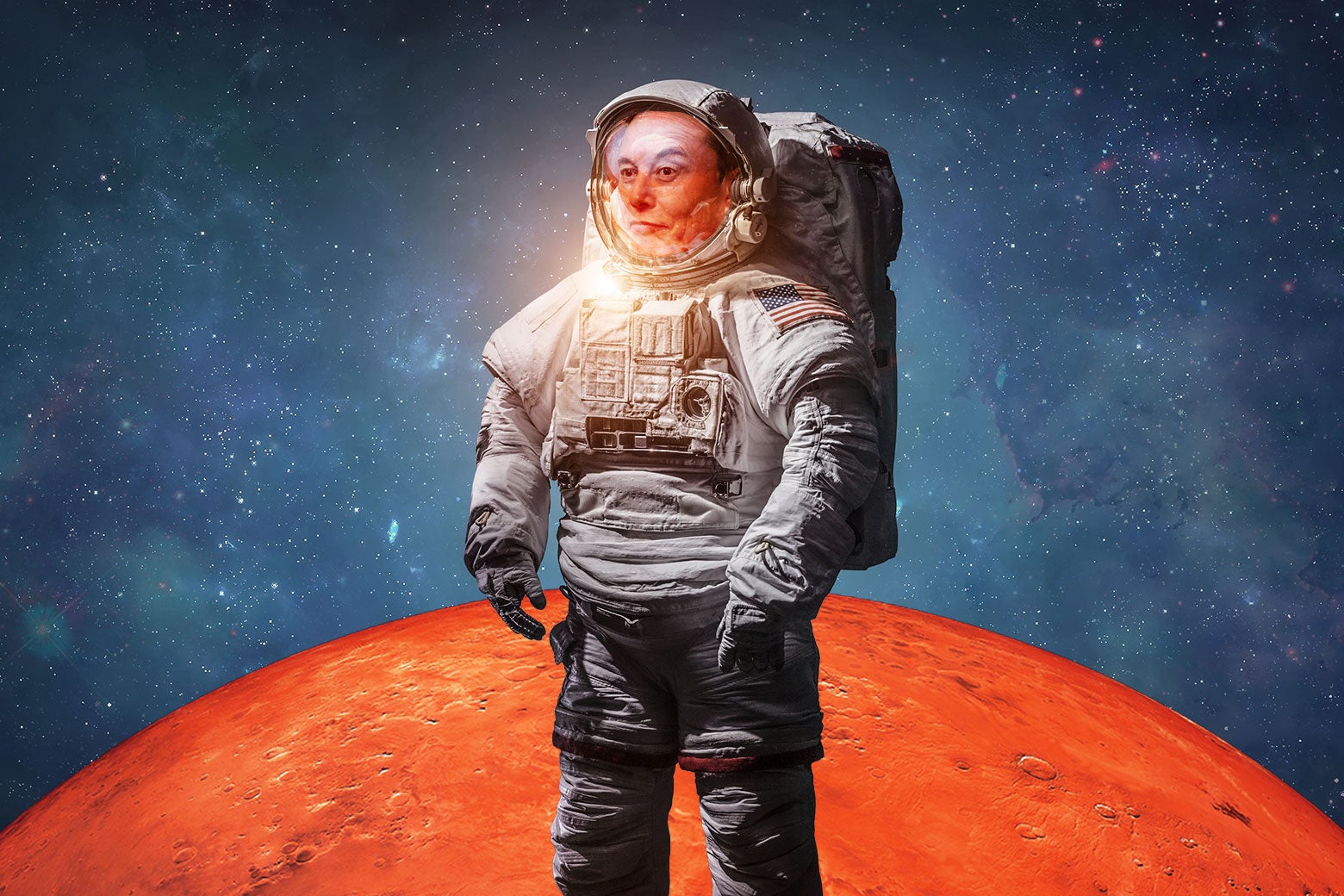
In a recent shift that has caught the attention of space enthusiasts and industry watchers alike, Elon Musk announced that SpaceX is dialing back its immediate ambitions for Mars colonization, turning its gaze instead toward establishing lunar cities. The announcement, made amid ongoing discussions about the feasibility of long-duration space travel, underscores the formidable health challenges that continue to plague human exploration beyond Earth's orbit. According to a detailed analysis published on Slate.com, these obstacles—ranging from psychological strain to severe physiological damage—may render ambitious plans like Mars missions unrealistic in the near term.
Musk's comments come as SpaceX continues to push boundaries with reusable rocket technology and satellite deployments, but the entrepreneur has reportedly expressed cooling enthusiasm for the red planet. 'Elon Musk says his obsession with the red planet is cooling,' the Slate article notes, highlighting a pivot to lunar outposts as a more attainable goal. This redirection aligns with broader NASA strategies, which have long emphasized the moon as a stepping stone for deeper space ventures, including the Artemis program aimed at returning humans to the lunar surface by 2026.
The health risks of space travel have been a persistent concern since the earliest missions. For decades, astronauts have faced the harsh realities of leaving Earth's protective atmosphere, but recent studies have painted an even grimmer picture for extended journeys. A trip to Mars, estimated to take two and a half to three years round-trip, would expose crews to unprecedented durations in microgravity and isolation, far beyond the six-month stints on the International Space Station.
One of the most immediate hurdles is the psychological toll of confinement. Crews would be confined to cramped spacecraft with limited personal space, interacting with the same small group for years. 'A return journey to Mars would be anywhere from two and a half to three years long, and any intrepid adventurers would have to spend that entire time in cramped, unpleasant spaces with a handful of other people,' the Slate report explains. To mitigate this, space psychologists have developed team-building protocols, and experiments like those featured in the podcast series The Habitat simulate long-term isolation to test human resilience.
Despite these efforts, experts acknowledge the risks remain high. Isolation could lead to mental health breakdowns, with historical precedents from Antarctic research stations and submarine crews offering sobering parallels. NASA officials have invested in virtual reality systems to provide mental breaks, allowing astronauts to 'visit' simulated Earth environments, but such measures are seen as temporary aids rather than cures.
Radiation exposure presents another formidable barrier, one that Earth's atmosphere shields us from daily. In space, cosmic rays and solar particles bombard unprotected travelers, increasing cancer risks and causing organ damage. The Slate article cites NASA estimates from 2017, noting that a three-year Mars mission could deliver the equivalent of 3,600 chest X-rays worth of radiation to each astronaut. For comparison, International Space Station residents endure 240 to 480 X-ray equivalents over six months, a dose already linked to elevated health concerns.
Shielding strategies exist in theory, such as surrounding habitats with water barriers or utilizing natural lunar caves for bases, which could block much of the radiation. However, implementing these during transit remains daunting. 'Technically you can shield people from radiation with thick barriers of water, but getting the water or other protective substances into space and constructing the shields has thus far proved prohibitively expensive,' the analysis states. SpaceX and NASA continue to explore advanced materials, but no breakthrough has yet made long-haul protection viable.
Beyond radiation and isolation, microgravity's effects on the body are perhaps the most insidious challenge. Upon entering space, astronauts often experience fluid shifts causing 'puffiness' and nasal congestion, as detailed in a recent scientific paper referenced in the Slate piece. These symptoms, while manageable with medications, signal the broader disruptions gravity's absence inflicts on human physiology.
Kidney function, reliant on gravitational forces for proper filtration, begins to falter quickly. A 2024 study involving human and animal models found that even one month in microgravity can cause permanent alterations to kidney pathways, potentially leading to irreversible damage. Similarly, six months in space accelerates arterial stiffness and endocrine disruptions equivalent to over a decade of aging on Earth, according to research on veteran astronauts.
Countermeasures like daily exercise regimens and pharmaceuticals offer partial relief. Space treadmills help prevent kidney stones, while drugs such as bisphosphonates slow bone density loss, which occurs at about 1 percent per month in weight-bearing bones. 'Exercising for two hours a day can partially ameliorate this issue, but it doesn’t prevent the problem entirely,' the Slate article reports, drawing from a 2019 study. Muscle atrophy, another gravity-dependent affliction, similarly resists full mitigation, with routines maintaining mission fitness but not long-term health.
The consensus among researchers is stark: current solutions are 'stopgap measures designed to keep astronauts relatively healthy for six-month stretches.' For longer durations, such as the 12- to 24-month stays required for Mars or sustained lunar living, the impacts could be catastrophic. 'Every study I could find on the topic unanimously agrees that the ultimate solution to microgravity-induced disease, for example, is for astronauts to come back to Earth,' the analysis quotes from scientific literature.
Our understanding is limited by small sample sizes—fewer than 600 people have ever ventured to space, with the longest stays capping at a year for records like those set by cosmonauts on Mir. Animal studies and bed-rest simulations on Earth provide clues, but they can't fully replicate space's unique stressors. Undiscovered risks, from neurological changes to immune system vulnerabilities, loom large for future missions.
Musk's pivot to lunar cities reflects these realities, potentially leveraging the moon's partial gravity and proximity to Earth for shorter rotations. NASA's Artemis accords, involving international partners, aim for sustainable lunar presence by the late 2020s, with habitats possibly in lava tubes to shield against radiation. SpaceX's Starship, designed for both moon and Mars, could ferry crews, but health protocols would need refinement.
Critics of ambitious space plans argue that focusing on Earth-based challenges, like climate change, might yield greater returns, while proponents see space as essential for humanity's survival. Musk himself has oscillated between bold visions and pragmatic assessments, once tweeting about making life multi-planetary but now emphasizing nearer-term goals. As of March 2026, when the Slate piece was published, no firm timeline for Mars resumption has been set.
Looking ahead, breakthroughs in artificial gravity via rotating spacecraft or genetic therapies could alter the equation, but these remain speculative. For now, the perils of space travel suggest that while short lunar stays—up to six months—might be feasible, extended off-world living carries grave risks. 'From a health perspective, I doubt that any humans will spend more than 12 months living in space—or on the moon—during my lifetime without suffering serious, long-term health consequences,' the Slate author concludes, echoing broader scientific caution. As SpaceX refines its strategies, the dream of the stars persists, tempered by the unyielding demands of human biology.