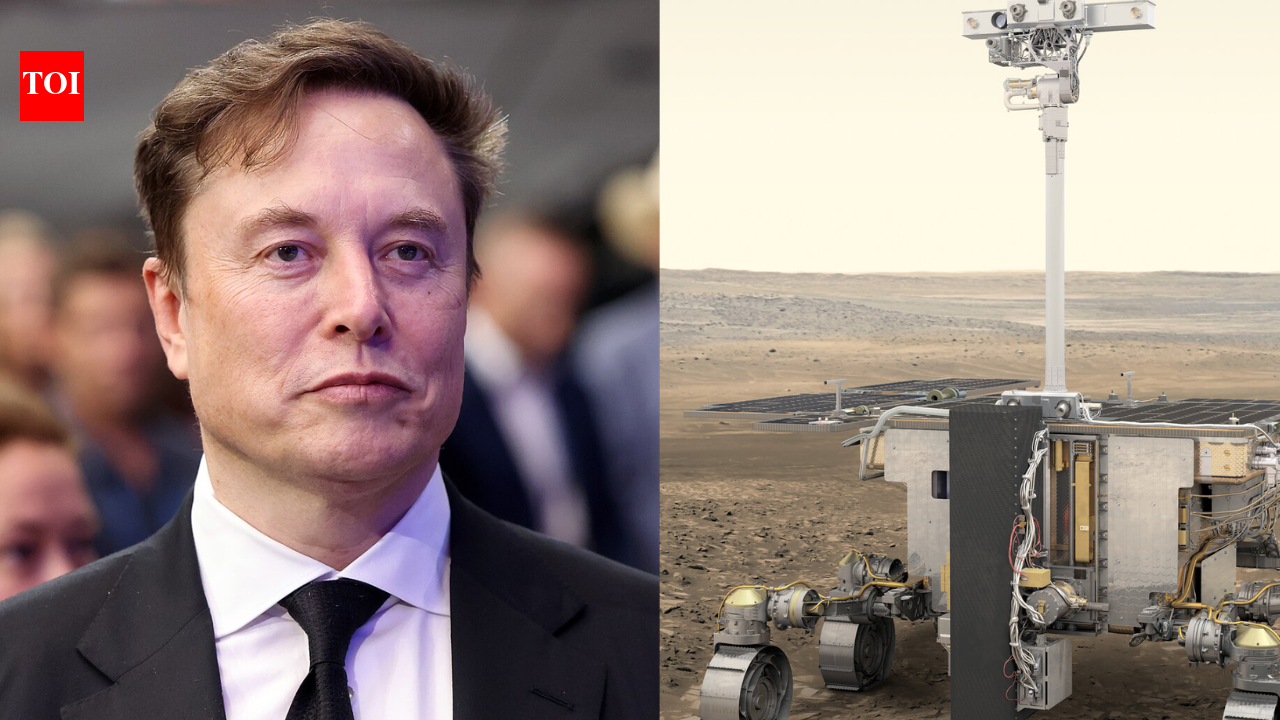
In a significant development for international space exploration, Elon Musk's SpaceX has been tapped to launch the European Space Agency's Rosalind Franklin rover to Mars in 2028, marking a new chapter in the quest to uncover signs of ancient life on the Red Planet. The announcement, reported by the Times of India, underscores the growing collaboration between private space ventures and global space agencies amid delays that have plagued the mission for years.
The Rosalind Franklin rover, named after the British chemist who played a pivotal role in discovering the structure of DNA, is designed to drill up to two meters beneath the Martian surface to search for organic molecules that could indicate past microbial life. According to the Times of India, SpaceX's involvement comes as a boost to the project, which has faced multiple setbacks, including geopolitical tensions and technical hurdles. The launch is scheduled aboard a SpaceX Falcon Heavy rocket from the Kennedy Space Center in Florida, though exact dates within 2028 remain to be finalized.
ESA officials have long emphasized the rover's advanced capabilities, including its panoramic instruments for surface analysis and a subsurface drill that can collect samples without contamination from Earth's environment. "The Rosalind Franklin rover represents a cornerstone of our ExoMars program, aiming to answer fundamental questions about Mars' habitability," an ESA spokesperson said in a statement released earlier this year, highlighting the mission's scientific ambitions.
SpaceX's role in the launch was confirmed through negotiations that began after Russia's Roscosmos withdrew from the project in 2022 due to the ongoing conflict in Ukraine. Previously, the rover was set to hitch a ride on a Russian Proton rocket, but sanctions and strained relations led ESA to seek alternative partners. SpaceX, with its proven track record of reliable heavy-lift launches, emerged as a natural choice. "We're excited to partner with ESA on this groundbreaking mission," Elon Musk tweeted in response to the news, adding that the Falcon Heavy's payload capacity makes it ideal for delivering the 310-kilogram rover to Mars.
The mission's timeline has been anything but smooth. Originally planned for launch in 2018 as part of the ExoMars 2020 campaign, delays pushed it back repeatedly. A 2022 launch window was missed due to the Russia-Ukraine war, and further postponements arose from the need to requalify the rover's parachute system and other components for compatibility with the new launcher. According to ESA reports, the 2028 target now aligns with NASA's Perseverance rover sample return plans, potentially opening doors for future sample-sharing between missions.
Experts in planetary science view the Rosalind Franklin mission as complementary to ongoing U.S.-led efforts. NASA's Perseverance rover, which landed in Jezero Crater in 2021, is collecting rock and soil samples for a future return to Earth, while the Rosalind Franklin will focus on in-situ analysis at a yet-to-be-determined landing site in Mars' Oxia Planum region, selected for its ancient clay deposits that could preserve biosignatures.
"This rover's drill will allow us to access layers of Mars that no other mission has reached, providing unprecedented data on the planet's geological and biological history," said Prof. Mark Sims, former lead of the Beagle 2 lander project, in an interview with the BBC. Sims noted that the mission's Pasteur payload, equipped with instruments like the ISEM spectrometer and the MicrOmega infrared microscope, will enable detailed chemical mapping of samples.
From a technical standpoint, the collaboration with SpaceX introduces efficiencies that ESA couldn't achieve alone. The Falcon Heavy, which successfully launched NASA's Psyche mission to an asteroid in 2023, can carry the rover plus a descent module and entry, descent, and landing systems developed by Airbus. The total mission cost is estimated at around €1.5 billion, with ESA covering the bulk and SpaceX providing launch services for a reported $100 million—far less than the original Russian deal.
Critics, however, point to potential risks in relying on a private company like SpaceX, which has faced scrutiny over its rapid development pace and occasional launch failures. "While SpaceX has revolutionized access to space, integrating their systems with ESA's hardware requires meticulous testing to avoid mission-ending issues," warned Dr. Sarah Jane Smith, a space policy analyst at the Royal Aeronautical Society. She referenced past incidents, like the 2015 Falcon 9 explosion, though SpaceX has since achieved over 300 successful missions.
Broader context reveals a shifting landscape in space exploration, where public-private partnerships are becoming the norm. NASA's Artemis program relies on SpaceX's Starship for lunar landings, and the company is eyeing Mars colonization through its own Starship vehicles. Musk has repeatedly stated his vision of making humanity multi-planetary, with Mars as the ultimate destination. The Rosalind Franklin launch fits into this narrative, potentially paving the way for more joint ventures.
Environmental and ethical considerations also surround the mission. Drilling into Mars raises questions about planetary protection protocols to prevent forward contamination that could compromise future life-detection efforts. ESA adheres strictly to COSPAR guidelines, ensuring the rover is sterilized to levels that reduce microbial hitchhikers to less than one per 10,000 cubic meters.
As preparations ramp up, teams at ESA's ESTEC facility in the Netherlands are conducting final assembly and testing of the rover. The Rosalind Franklin, standing about 3 meters long and 1.5 meters tall, will communicate via the Mars Express orbiter and NASA's Deep Space Network. Arrival on Mars is projected for mid-2030, after a seven-month journey covering roughly 500 million kilometers.
Looking ahead, the mission's success could influence international space policy. If Rosalind Franklin detects organic compounds suggestive of life, it would bolster arguments for increased funding in astrobiology. Conversely, null results would refine models of Mars' uninhabitable past. "Regardless of the outcome, this mission will advance our understanding of planetary evolution," ESA Director General Josef Aschbacher remarked during a recent briefing.
In the U.S., where Appleton, Wisconsin, hosts a growing aerospace community tied to NASA's work, local experts are watching closely. "Missions like this inspire the next generation of scientists right here in the Midwest," said Dr. Elena Rodriguez, a planetary geologist at the University of Wisconsin. She highlighted how data from Rosalind Franklin could inform educational programs and even local tech innovations in robotics.
Ultimately, the SpaceX-ESA partnership signals a maturing era of space exploration, where delays give way to determination. As the 2028 launch approaches, the world anticipates fresh insights from Mars, reminding us of the enduring human drive to explore the unknown.