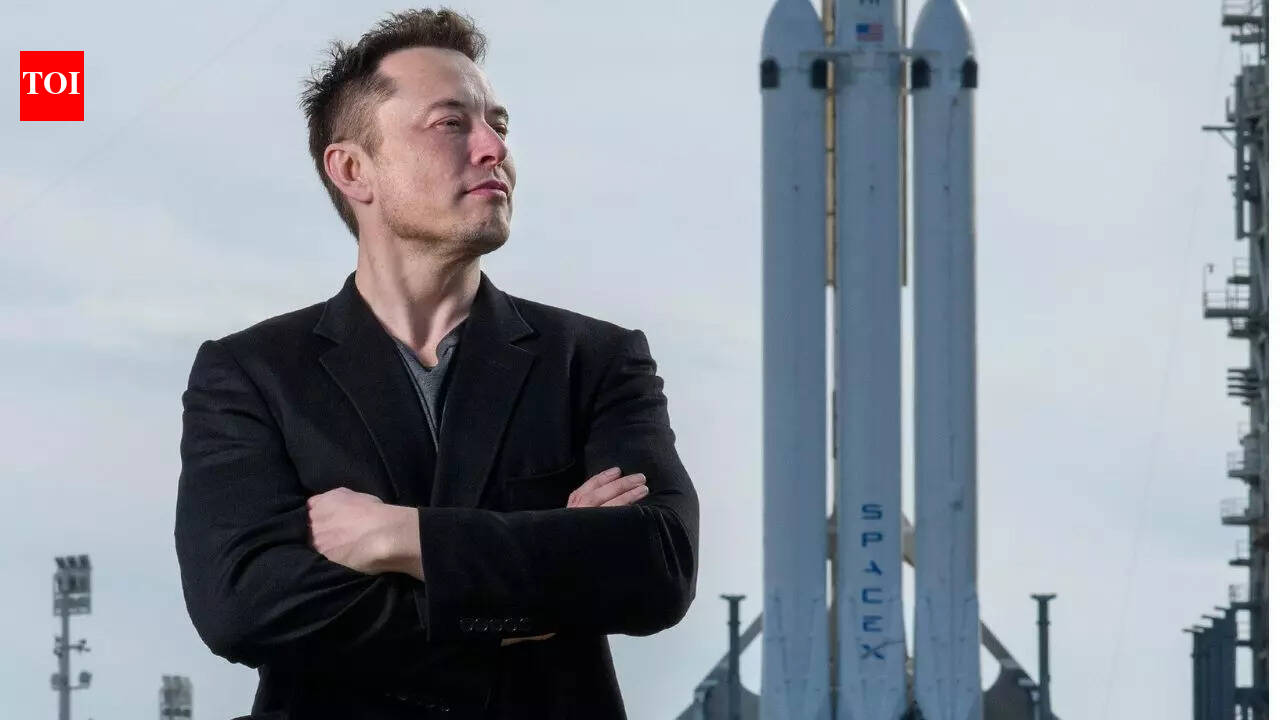
APPLETON, Wis. — Elon Musk, the CEO of SpaceX, has made a bold prediction about the future of space launches, stating that his company could be sending up its massive Starship rocket as frequently as once every hour within the next three years. The announcement, shared during a recent update on the company's progress, underscores SpaceX's ambitious vision to revolutionize access to space and pave the way for human settlement on other planets.
Musk's comments came amid ongoing development of the Starship, a fully reusable spacecraft designed to carry crew and cargo to the Moon, Mars, and beyond. According to reports from the Times of India, Musk highlighted the potential for rapid reusability, saying the Starship could achieve launch cadences that dwarf current industry standards. 'SpaceX chief executive Elon Musk has said the company’s next-generation Starship rocket could launch as often as once every hour within three years,' the outlet reported, citing Musk's remarks.
The Starship program has been a cornerstone of SpaceX's efforts since its inception in 2012, evolving from earlier concepts like the Interplanetary Transport System. The vehicle consists of a Super Heavy booster and an upper-stage Starship, both powered by Raptor engines that use methane and oxygen for fuel. Standing at nearly 400 feet tall when stacked, it's the largest and most powerful rocket ever built, with a payload capacity of up to 150 metric tons to low Earth orbit in its reusable configuration.
Recent milestones have brought SpaceX closer to operationalizing Starship. In April 2023, the first integrated flight test from the company's Starbase facility in Boca Chica, Texas, ended in an explosion shortly after liftoff, but it provided valuable data. A subsequent test in November 2023 saw the vehicle reach space, though it disintegrated during reentry. Musk has described these as 'rapid unscheduled disassemblies,' a tongue-in-cheek term for failures that the company uses to iterate quickly.
Building on those tests, SpaceX conducted a successful soft landing of the Super Heavy booster in the Gulf of Mexico during a flight in 2024, marking a step toward full reusability. Officials at SpaceX have emphasized that achieving high launch rates depends on refining recovery and turnaround times. 'We're aiming for aircraft-like operations,' Musk said in past interviews, comparing Starship's goals to commercial aviation.
The promise of hourly launches would represent a seismic shift in the space industry, where current leaders like SpaceX's Falcon 9 achieve about 100 missions annually. For context, NASA's Space Shuttle program, retired in 2011, averaged around eight flights per year. Experts note that such frequency could enable massive projects, including satellite constellations for global internet coverage via Starlink and fuel depots in orbit for deep-space missions.
However, challenges remain significant. Regulatory hurdles from the Federal Aviation Administration (FAA) have delayed tests, with environmental concerns in Texas leading to lawsuits from local groups. In one instance, the FAA grounded Starship after the 2023 explosion due to debris impacting nearby areas, including Padre Island National Seashore. SpaceX has worked to address these, installing water deluge systems to mitigate launch effects.
Musk's timeline aligns with SpaceX's contracts under NASA's Artemis program, where Starship is slated to serve as the Human Landing System for lunar missions starting in 2026. According to NASA officials, the agency has invested over $2.9 billion in the project, with a crewed lunar landing targeted for no earlier than 2027. 'Starship's reusability is key to making lunar exploration sustainable,' said NASA Administrator Bill Nelson in a 2023 statement.
Beyond government partnerships, private sector interest is growing. SpaceX has secured deals with companies like Blue Origin and international players for Starship rideshares. Musk has also teased applications for point-to-point Earth travel, suggesting suborbital flights could connect cities like New York to Shanghai in under an hour, though this remains speculative.
Critics, including some aerospace analysts, question the feasibility of Musk's three-year horizon. Dr. Laura Forczyk, founder of Astralytical, a space consulting firm, told Reuters in a recent interview that while SpaceX's track record with Falcon 9 is impressive—over 300 successful launches since 2010—scaling to hourly Starship flights would require unprecedented infrastructure. 'It's ambitious, but SpaceX has surprised us before,' Forczyk said.
On the other hand, supporters point to the company's vertical integration, from in-house engine production to automated manufacturing at its Hawthorne, California, headquarters. SpaceX employs over 13,000 people and has raised billions in funding, including a $1.7 billion infusion from investors in 2023. Musk, who founded the company in 2002 with the goal of making humanity multi-planetary, often frames these predictions as motivational targets.
The broader implications of frequent Starship launches extend to Mars colonization, a long-standing Musk priority. He envisions fleets of Starships transporting one million people to the Red Planet by 2050, establishing a self-sustaining city. Recent uncrewed missions are planned for 2026, with cargo variants carrying habitats and supplies. According to SpaceX updates, the company is testing life support systems and radiation shielding essential for such voyages.
Environmental considerations are also in focus. While Starship's methane fuel burns cleaner than traditional kerosene rockets, the high launch rate could strain launch site ecosystems. SpaceX has committed to carbon offset programs and wildlife monitoring at Starbase. In a 2024 environmental impact statement, the company projected up to 25 launches per year initially, ramping up as technology matures.
Looking ahead, the next Starship flight test is slated for late 2024 from Boca Chica, aiming for a booster catch using mechanical arms on the launch tower—a feat never accomplished at this scale. Success here could accelerate development toward Musk's vision. As SpaceX pushes boundaries, the space community watches closely, balancing excitement with the realities of engineering complex systems.
In Appleton and across the Midwest, where manufacturing innovation drives local economies, Musk's announcements resonate. Companies like NASA contractors in Wisconsin contribute components to space programs, highlighting how national ambitions fuel regional growth. Whether hourly launches become reality, Starship's progress signals a new era in exploration, one launch at a time.