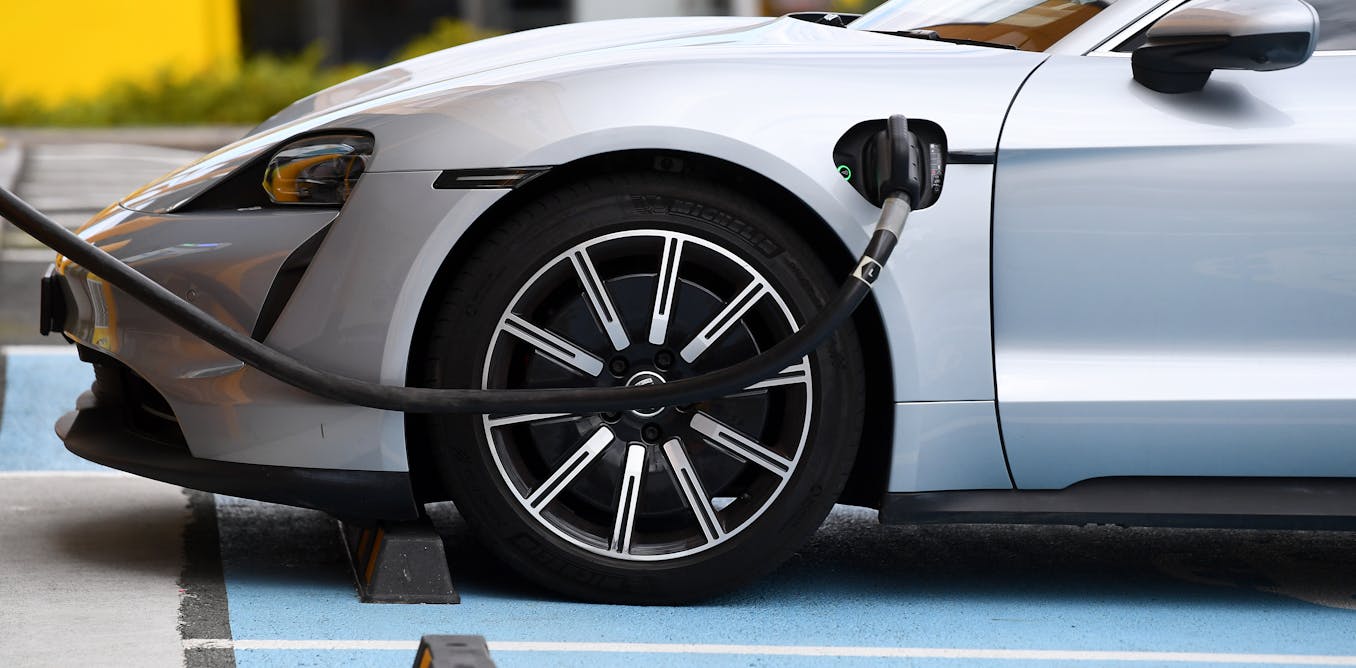
REGIONAL AUSTRALIA — As electric vehicles gain popularity in Australia's bustling cities, vast stretches of the country's regional and rural areas remain underserved by charging infrastructure, creating what experts call "charging deserts" that hinder the broader adoption of clean transport.
According to a new interactive EV charging monitor developed by researchers, including Hussein Dia, a professor of transport technology and sustainability at Swinburne University of Technology, the nation's public charging network is heavily skewed toward urban centers, leaving many regional towns without convenient access to chargers.
Dia, who receives funding from various government bodies such as the Australian Research Council and the Department of Infrastructure, Transport, Regional Development, Communications, Sport and the Arts, highlighted the disparity in a recent article published on The Conversation. "If you live in a big city, finding a charger for your electric vehicle (EV) isn’t hard," Dia wrote. "But drive a few hours in any direction and the story changes."
The monitor, which refreshes daily using data from the Open Charge Map database, plots every public charger across Australia and overlays it with population data. It reveals that only about a third of the country's towns have a charger within 20 kilometers, and more than two-thirds lack one within 5 kilometers.
Nationally, Australia boasts around 1,250 public charging sites with nearly 3,800 charge ports. More than half are fast chargers capable of delivering above 50 kilowatts, about a third are medium-speed, and the rest are slower options often found at destinations. However, Dia noted that "most of the fast sites are concentrated in cities and along the eastern seaboard, leaving vast inland gaps."
When viewed per capita, the access is even more limited, with only about one to two chargers for every 10,000 people across the country. This becomes particularly evident on long-distance routes, such as the highway between Melbourne and Darwin, where stretches hundreds of kilometers long have no fast chargers at all.
"These are the real ‘charging deserts’ – areas where geography, cost and low traffic volumes still make investment difficult to justify," Dia explained in his analysis.
Even where chargers do exist in regional areas, reliability can be an issue. The data from Open Charge Map is voluntary, leading to inconsistencies. Some operators update statuses frequently, while others do not, and the system does not track uptime—the actual availability of chargers. Dia pointed out that "each charger’s ‘status’ can tell us whether it’s listed as operational, partial, or down, but it doesn’t reveal uptime – how often a charger is available and working."
In contrast, international standards are more stringent. In the United Kingdom, rapid public charging networks must maintain at least 99% uptime with transparent performance reporting. The United States funds chargers every 50 miles, or about 80 kilometers, on key corridors. Europe requires sites every 60 kilometers along major highways, and New Zealand aims for coverage every 75 kilometers on more than 97% of state highways, plus chargers in most towns with over 2,000 residents.
Australia lacks such national requirements for uptime reporting. While a 98% reliability target applies to federally funded chargers, the rest of the network relies on voluntary and inconsistent reporting. Dia advocated for change, stating, "The next step is to make reliability a shared measure – not just a promise from individual companies, but a national benchmark drivers can trust."
From a population perspective, the coverage appears robust: about 88% of Australians live within 5 kilometers of a charger, 93% within 10 kilometers, and 97% within 20 kilometers. But Dia emphasized the distinction: "On paper, coverage looks good. But look at it from the town’s point of view, and the picture flips: most places still lack a charger, even if most people don’t."
This gap affects the roughly 90% of Australia's urban centers with fewer than 10,000 residents—small regional towns and rural communities that cover much of the nation's geography but house a smaller portion of the population. For EV owners in these areas, the nearest charger often requires a significant detour, discouraging long trips and slowing the transition to electric vehicles.
Efforts are underway to address these issues. State programs like Queensland’s Electric Super Highway and New South Wales’ regional charging rollout are expanding infrastructure. Dia suggested a national backbone with fast-charging sites every 150 to 200 kilometers along priority corridors, eventually tightening to every 100 kilometers. He also called for consistent standards on uptime, open access, and data reporting.
Regional support through co-funding from state or federal grants could help, especially in towns reliant on tourism. "A single fast charger in a country town can unlock a chain of benefits for local businesses as passers-by ‘fill up on the way’," Dia wrote.
The broader implications extend to Australia's environmental goals and the push for sustainable transport. With EV adoption rising—sales reached record highs in 2023, according to industry reports—the uneven charging network risks leaving regional Australians behind in the shift away from fossil fuels. Experts like Dia argue that bridging these deserts is essential not just for equity but for building driver confidence nationwide.
Looking ahead, the focus should shift to strategic installations that maximize impact. "The next frontier isn’t just installing more chargers – it’s installing them where they’ll make the biggest difference to confidence and coverage," Dia concluded. As governments and private operators respond, the hope is that Australia's EV infrastructure will evolve into a truly national network, capable of supporting clean transport from coast to outback.