TITUSVILLE, Fla. — As NASA gears up for the Artemis II mission, the first crewed voyage toward the moon in over 50 years, a wave of excitement has swept across Florida's Space Coast. Visitors from across the country are converging on the area, staking out prime viewing spots with determination rivaling the rocket's own power. The launch, set for Wednesday at 6:24 p.m. ET from the Kennedy Space Center, promises to draw hundreds of thousands to the shores of Brevard County, where the Indian River offers unobstructed views of the 322-foot-tall Space Launch System rocket and its Orion capsule.
Pat Dimond and her childhood friend Kathy Walker made the trip from Colorado, arriving early Saturday to claim front-row seats at the end of a pier in Space View Park, directly across the water from the launch pad. With more than 30 hours remaining before liftoff, the pair was already prepared to camp out, securing their folding chairs to the dock with a cable lock to ward off any challengers. 'We're not moving,' Dimond said, her voice carrying a mix of resolve and anticipation as she scanned the horizon where the rocket stood silhouetted against the sky.
Not far away, Robert Pittman, a 50-year-old from Dallas, was considering more rugged measures to secure his vantage point. He planned to sleep in the back of his pickup truck, telescope at the ready, to ensure he wouldn't miss the historic ascent. 'I've waited my whole life for something like this,' Pittman remarked, adjusting his gear amid the growing buzz of fellow enthusiasts.
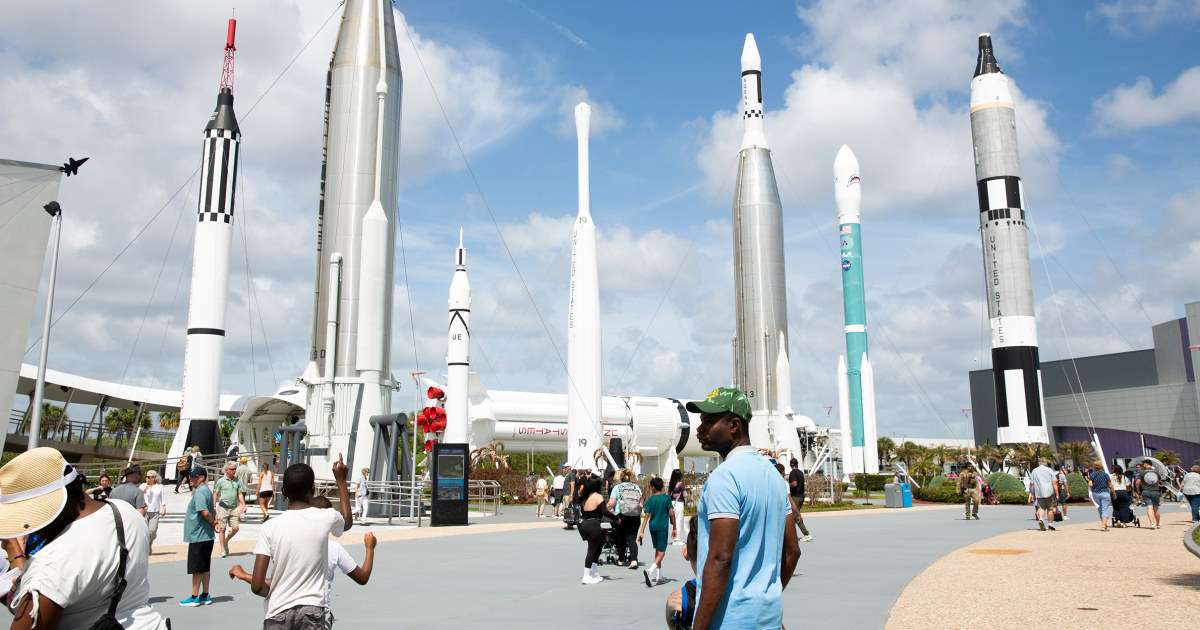
Families, too, have turned the event into a memorable outing. Aaron and Jessica Bialke drove 25 hours from Minnesota with their three young sons—11-year-old twins Kade and Jace, and 10-year-old Gage—for what they called a 'once-in-a-lifetime opportunity.' The family extended their winter getaway upon learning of the launch timing, spending Saturday at the Kennedy Space Center Visitor Complex on Merritt Island, where the boys eagerly explored exhibits on NASA's history and the dawn of commercial spaceflight. 'We've been trying stuff out and pressing a lot of buttons,' Kade said, his eyes wide as he described the interactive displays featuring rockets and space capsules.
The Artemis II crew—NASA astronauts Reid Wiseman, Christina Koch, and Victor Glover, alongside Canadian astronaut Jeremy Hansen—will embark on a 10-day journey, orbiting Earth before looping around the moon without landing. This marks NASA's return to human spaceflight beyond low-Earth orbit since Apollo 17 in 1972, fueling widespread interest. Although the mission is a test flight with no lunar touchdown, its significance cannot be overstated, especially following the uncrewed Artemis I launch in 2022 that drew sizable crowds but paled in comparison to the current fervor.
Peter Cranis, executive director of the Space Coast Office of Tourism, anticipates an even larger influx this time. 'In 2022 for Artemis I, we estimated between 200,000 to 250,000 people were from out of town,' Cranis said. 'It’s very likely that we’ll exceed that.' From Titusville in the north to Cocoa Beach and Melbourne in the south, the region—nicknamed the Space Coast for its proximity to NASA's operations—is bracing for the deluge of spectators along its coastal stretches.
For some, the draw is deeply nostalgic. Todd Seymour, 61, traveled from Columbus, Ohio, with his twin brother, driven by vivid memories of childhood. 'I remember sitting in front of the black-and-white TV when we were wee little lads, watching Apollo 11,' he said. 'To not have ever seen a launch before in person, that’s kind of a bucket list thing for us.' Seymour's story echoes a sentiment shared by many who grew up idolizing the Apollo era and now seek to witness its revival firsthand.
Dimond's journey carries an even more personal weight. Her husband, a lifelong space enthusiast who passed away three years ago from Covid-19, dreamed of seeing a launch but never did. A devotee since Project Mercury, he attended the first adult space camp and knew every detail of NASA's endeavors. To honor him, Dimond wore his wedding ring on a chain around her neck and carried a keepsake ring bearing his fingerprints. As she gazed across the Indian River from the pier, she touched the ring gently. 'He had been a space guy since the beginning of [Project] Mercury. He went to space camp the first year that they let adults go. He knew everything about every launch and he always wanted to see a launch,' she recounted. 'He would be so amazed by this.'
While visitors focus on the spectacle, local preparations underscore the event's scale. NASA ground crews have begun fueling the massive rocket, which will propel the Orion capsule skyward for the first time with humans aboard. Earlier delays this year only heightened the anticipation, transforming what could have been routine into a celebrated milestone.
The economic ripple effects are already evident. Beachfront hotels sold out weeks or months in advance, and businesses are capitalizing on the theme. An Ace Hardware store in Titusville displayed a photo of the astronaut crew on its sign, promoting launch-viewing supplies. In Cocoa Beach, shops offered Artemis II merchandise, including a Hawaiian shirt emblazoned with mission motifs.
At Playalinda Brewing Co., owners brewed up enthusiasm with a special pale ale. The Artemis IIPA, a double IPA, features retro labels depicting the Space Launch System and Orion, complete with an 'Easter egg' showing the moon's phase from NASA's original February launch window. Released on Feb. 3 ahead of the initial target date, the beer sold out in days, prompting a larger batch that vanished just as quickly. 'It was the fastest thing we’ve sold out at this brewery,' said Ronnie Chabot, one of the company's four owner-operators.
Brewmaster Donald Atwell selected hops with cosmic flair—varieties named Galaxy and Comet—to craft the beer. All four owners, Brevard County natives and lifelong space fans, view the mission as a revival for the area. 'Seeing when the space shuttle program got shut down, and what it did to our local economy, and how much of a strain it put on, I think what excites us the most is to see this resurgence,' Chabot explained. 'It will be exciting times here on the Space Coast for next five years.'
Chabot hinted at future brews tied to the Artemis program. 'If Artemis III goes up, who knows? Maybe there will be a Triple IPA,' he said, eyeing the next mission slated for next year, which could include the first woman and person of color on the lunar surface.
Beyond the brews and souvenirs, the influx poses logistical challenges, particularly traffic along the coastal roads. The Bialke family, for instance, planned to head to Titusville for a less crowded viewing spot, mindful of the expected throngs. Yet, officials and locals alike see the event as a boon, revitalizing a region once hit hard by the end of the shuttle program.
As the countdown progresses, the Space Coast pulses with a blend of reverence and revelry. For visitors like Dimond, it's a tribute to lost dreams; for families like the Bialkes, an adventure to inspire the next generation; and for the community, a harbinger of sustained prosperity. With NASA pushing boundaries once more, eyes worldwide will turn to Florida, where history lifts off anew.