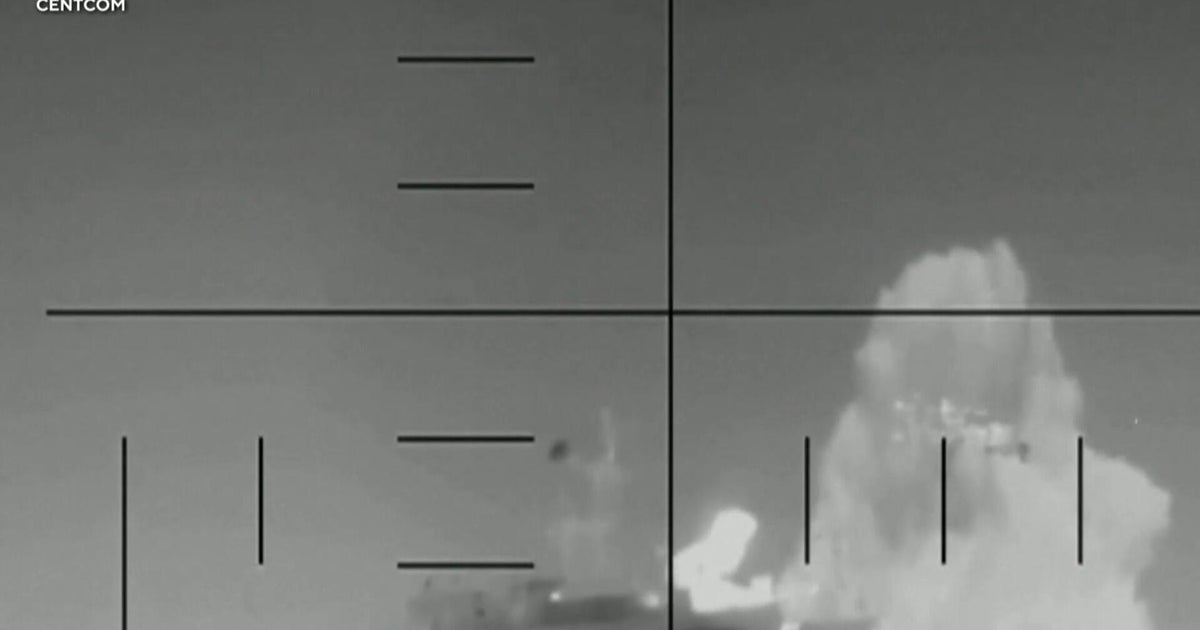
TEHRAN, Iran — Tensions in the Middle East reached a boiling point on Wednesday as new military strikes escalated the ongoing conflict between the United States and Iran, prompting urgent evacuation efforts for American citizens in the region. A dramatic video circulating on social media and reported by major news outlets appeared to show a U.S. submarine launching a torpedo that struck an Iranian warship in the Strait of Hormuz, marking a significant intensification of hostilities that have simmered for years.
According to CBS News, the footage, which surfaced late Tuesday evening, captures the moment of impact, with a plume of smoke rising from the vessel amid the choppy waters of the strategic waterway. The Iranian warship, identified by military analysts as part of the Islamic Revolutionary Guard Corps Navy, was reportedly patrolling near the strait when it was targeted. Iranian state media swiftly condemned the attack as an "act of aggression," while U.S. officials have remained tight-lipped, citing operational security.
The incident comes amid a broader escalation that began last month when Iranian-backed militias launched rocket attacks on U.S. bases in Iraq, killing three American service members. In response, the U.S. conducted airstrikes on militia positions, drawing sharp rebukes from Tehran. "This is a dangerous crossing of the red line," Iranian Foreign Minister Hossein Amir-Abdollahian said in a statement released early Wednesday. "The United States must bear the consequences of its provocative actions."
American citizens in Iran and neighboring countries, numbering around 5,000 according to State Department estimates, have been scrambling to leave amid fears of further reprisals. Evacuation flights organized by the U.S. Embassy in Tehran departed from Imam Khomeini International Airport carrying over 200 Americans on Wednesday morning. "We were told to pack only essentials and head to the airport immediately," recounted Sarah Jenkins, a 34-year-old teacher from California who was among those evacuated. "The streets were chaotic, with sirens blaring and people rushing in every direction."
The U.S. State Department issued a Level 4 travel advisory for Iran on Tuesday night, urging all Americans to depart immediately. "The security situation is fluid and deteriorating rapidly," a department spokesperson said in a briefing from Washington. Similar advisories were extended to Iraq, Syria, and Lebanon, where anti-American protests have erupted in solidarity with Iran. In Baghdad, demonstrators gathered outside the U.S. Embassy, chanting slogans and burning American flags, as reported by eyewitnesses.
Military experts suggest the torpedoing could be part of a larger U.S. strategy to deter Iranian naval movements in the strait, through which 20 percent of the world's oil supply passes. The waterway has been a flashpoint since 2019, when Iran seized a British oil tanker and the U.S. downed an Iranian drone. "This strike sends a clear message: the U.S. will not tolerate threats to freedom of navigation," said retired Admiral James Stavridis, a former NATO commander, in an interview with CBS News. "But it risks pulling us into a wider war."
Iranian officials, meanwhile, vowed retaliation. Supreme Leader Ayatollah Ali Khamenei addressed the nation in a televised speech Wednesday afternoon, declaring, "The Islamic Republic will defend its sovereignty with all its might. The aggressors will face a decisive response." Reports from the Iranian news agency IRNA indicated that additional naval assets were being deployed to the Persian Gulf, raising concerns about potential blockades.
The conflict's roots trace back to the 1979 Iranian Revolution, which severed diplomatic ties between Washington and Tehran. Tensions flared anew in 2018 when President Donald Trump withdrew from the 2015 nuclear deal, imposing crippling sanctions. Under President Joe Biden, efforts to revive the agreement stalled amid Iran's advancing uranium enrichment program, now at 60 percent purity—close to weapons-grade levels, according to the International Atomic Energy Agency.
Recent provocations include Iran's support for Houthi rebels in Yemen, who have targeted Saudi oil facilities, and Hezbollah in Lebanon, which has clashed with Israel. The U.S. has accused Iran of orchestrating cyberattacks on American infrastructure, including a 2022 hack on a major pipeline company. "Iran's proxy network is destabilizing the entire region," U.S. National Security Advisor Jake Sullivan stated during a White House press conference. "We are acting to protect our interests and those of our allies."
As evacuations continue, humanitarian concerns are mounting. The United Nations High Commissioner for Refugees reported that over 10,000 people, including expatriates and locals, have fled border areas in Iraq and Syria. Aid organizations like the Red Crescent are distributing supplies in Tehran, where power outages and fuel shortages have begun to affect daily life. "Families are terrified," said Dr. Fatima Alavi, a physician at a Tehran hospital. "We're seeing stress-related illnesses spike, and medical supplies are running low."
International reactions have been swift and divided. Israel, a staunch U.S. ally, praised the strike as "necessary to curb Iranian aggression," with Prime Minister Benjamin Netanyahu tweeting, "Iran's navy poses an existential threat; bold action is required." In contrast, Russia and China, both with ties to Iran, condemned the U.S. move. Russian Foreign Minister Sergey Lavrov called it "a violation of international law," while Beijing urged all parties to exercise restraint to safeguard global energy markets.
Oil prices surged 5 percent on Wednesday, reaching $85 per barrel on the New York Mercantile Exchange, as traders feared disruptions in the Strait of Hormuz. Analysts warn that a full closure could send prices above $100, exacerbating inflation worldwide. "The economic ripple effects could be severe," noted energy expert Amy Myers Jaffe from New York University. "Consumers in the U.S. might see gas prices jump 50 cents a gallon overnight."
Back in Washington, lawmakers from both parties expressed alarm. Senate Majority Leader Chuck Schumer, a Democrat, called for briefings on the escalating situation, saying, "Congress must be kept fully informed to prevent this from spiraling out of control." On the Republican side, Senator Lindsey Graham urged stronger measures: "Half-measures won't deter Iran; we need to show resolve."
As the sun set over the Persian Gulf, U.S. naval forces remained on high alert, with the aircraft carrier USS Abraham Lincoln positioned nearby. Pentagon officials confirmed that no American casualties were reported in the strike, but intelligence suggests Iran may target U.S. assets in the coming days. Diplomatic channels, though strained, remain open, with backchannel talks reportedly underway through Swiss intermediaries.
The path forward remains uncertain, with the potential for de-escalation hanging by a thread. Evacuations are expected to continue through the weekend, while world leaders monitor the crisis closely. For Americans like Jenkins, now en route to Europe, the ordeal underscores the fragility of peace in the region. "I never thought I'd have to flee like this," she said. "But safety comes first."