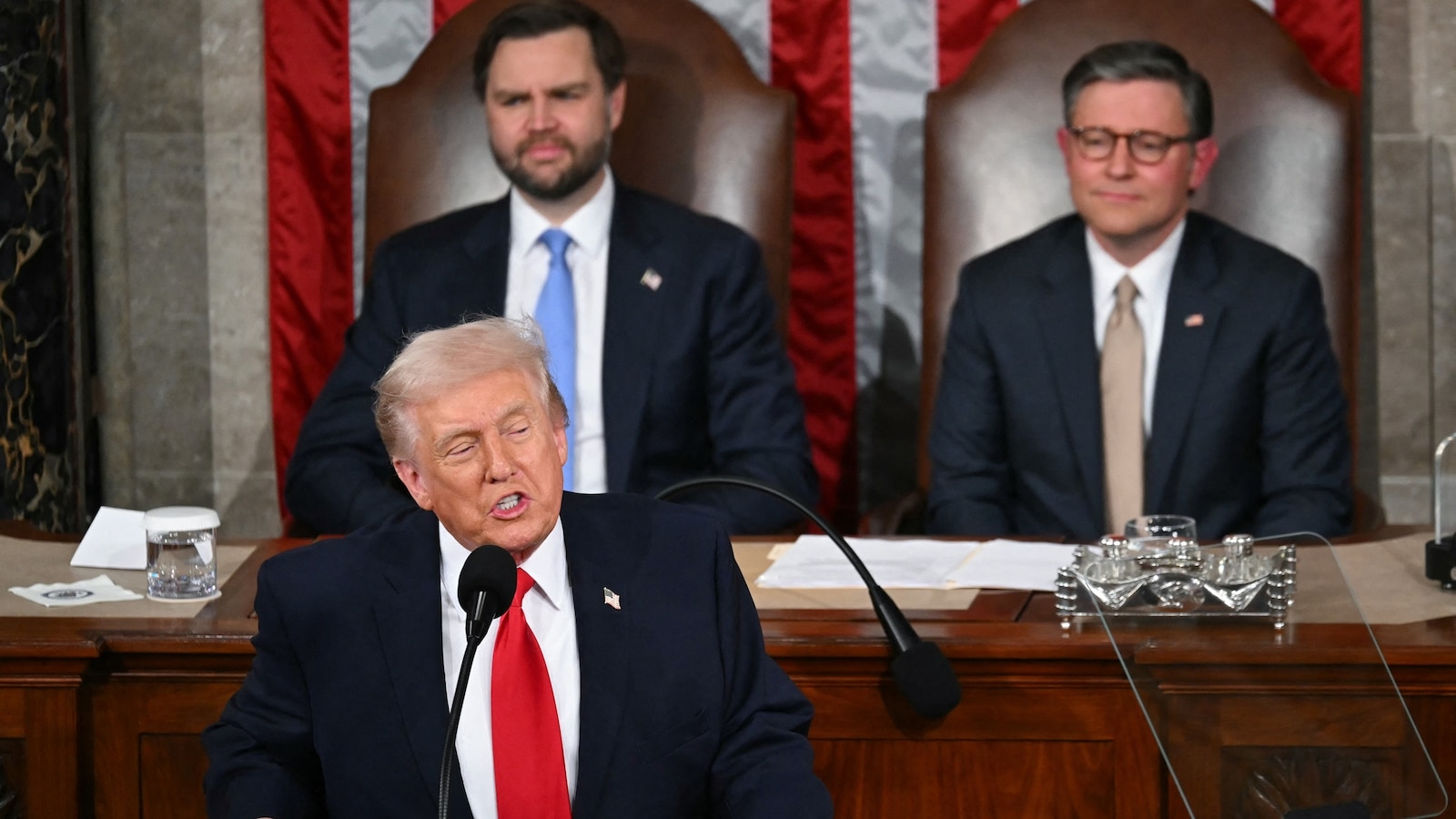
WASHINGTON — President Donald Trump delivered his first State of the Union address of his second term on Tuesday night, outlining ambitious policy goals amid a backdrop of economic challenges, border security debates and international tensions. Speaking before a joint session of Congress at the U.S. Capitol, Trump highlighted achievements in immigration enforcement, inflation control and global investments, while proposing sweeping changes to health care and election integrity. The address comes just over a year into his term, with an ABC News/Washington Post/Ipsos poll released Sunday showing his overall disapproval rating at 60%, the highest of his second term.
As midterm elections approach in November, where control of Congress hangs in the balance, Trump used the platform to tout efforts to boost affordability and the economy. He referenced recent Supreme Court rulings striking down steep global tariffs, an overhaul of domestic immigration policies and escalating tensions with Iran. All eyes were on the president as he made his case for executive actions that have defined the current political landscape.
Throughout the speech, Trump made several bold claims about his administration's accomplishments. One standout assertion was on immigration: "In the past nine months, zero illegal aliens have been admitted to the United States." According to data from U.S. Customs and Border Protection, this statement is false, though illegal crossings have dropped dramatically. In 2024, the final full year of President Joe Biden's term, there were over 1.5 million encounters with migrants attempting to cross the southern border illegally. By contrast, in 2025, Trump's first full year back in office, that figure plummeted to just under 28,000. The trend has continued into 2026, but numbers have never reached zero, and undetected crossings remain a possibility, as noted by ABC News reporters Luke Barr and Justin Fishel.
Trump also addressed economic progress, claiming, "My administration has driven core inflation down to the lowest level in more than five years." This is a mixed picture. Inflation stood at 3% when Trump took office and has since fallen to 2.4%, with the most recent report showing positive developments. However, this hasn't translated to lower prices across the board for everyday goods. Tariffs imposed by the administration have raised costs for items like fresh produce, beef and coffee—ground coffee prices, for instance, are up 34% in the past year. Energy prices have also increased by 6.3% from January 2025 to January 2026, partly due to demand from data centers powering AI technology, according to Bureau of Labor Statistics data analyzed by ABC News' Zunaira Zaki.
On the investment front, Trump boasted, "In 12 months, I secured commitments for more than $18 trillion pouring in from all over the globe." This claim lacks clear evidence. The White House website reports $9.6 trillion in domestic and foreign investments since Trump returned to office, including both materialized and committed funds, as confirmed by a White House official. However, questions about the source of the $18 trillion figure went unanswered by the administration. Moreover, the $9.6 trillion total appears inflated; for example, a listed $1.2 trillion "foreign investment" from Qatar stems from an agreement to "generate an economic exchange worth at least $1.2 trillion," not a direct investment, per a White House fact sheet from the deal's announcement.
"It is unclear where the $18 trillion number is coming from. It is a huge number. US GDP is $31 trillion," Zunaira Zaki reported, highlighting the discrepancy.
Health care emerged as a major theme, with Trump touting reductions in prescription drug prices. He said, "I took prescription drugs, a very big part of health care, from the highest price in the entire world to the lowest." This requires more context. The administration has secured lower cash prices for certain medications through initiatives like the TrumpRX website, which offers manufacturer discounts, and direct negotiations. Notable reductions include weight-loss drugs like Wegovy and Zepbound, primarily benefiting uninsured patients or those paying out-of-pocket. Ben Jolley, senior fellow for health care at the American Economic Liberties Project, pointed out that these discounts were influenced by market competition and political pressure as new products entered the space.
Yet, overall drug prices in the U.S. remain among the world's highest, and many insured patients continue to face high out-of-pocket costs. Some significant price cuts predate Trump's return; for instance, Bristol Myers Squibb slashed the price of the blood thinner Eliquis by more than 50% at the start of the year, while Eli Lilly and partners reduced the diabetes drug Jardiance by 66%. Jolley attributed these to Medicare drug price negotiations enacted prior to the current term, as detailed by ABC News' Liz Neporent.
Trump proposed a major shift in health care funding during the address, stating, "I want to stop all payments to big insurance companies and instead give that money directly to the people so they can buy their own health care." This idea is part of "The Great Healthcare Plan," unveiled last month as a potential replacement for the Affordable Care Act (ACA), amid expiring tax breaks and premium hikes of up to 100% for some. The plan aims to redirect subsidies to consumers and leverage a "most favored nation" drug pricing initiative.
However, details are sparse. A White House video message and one-page fact sheet provided little on funding amounts, distribution methods or total costs. Health policy experts previously told ABC News that the plan's impact is uncertain and may overlap with existing ACA provisions. Notably, while the first Trump administration halted direct federal payments to insurers for cost-sharing reductions, the new proposal appears to reinstate such reimbursements, according to ABC News' Mary Kekatos.
Immigration enforcement drew sharp rhetoric from Trump, who said, "In many cases, drug lords, murderers all over our country. They're blocking the removal of these people out of our country," referring to illegal immigrants and sanctuary cities. Department of Homeland Security data paints a different picture for detainees. As of February 7, 68,289 people were in immigration detention, down from a record high of over 70,000 weeks earlier, according to immigrant advocacy groups. Of those, only 26% were convicted criminals, another 26% had pending charges, and 47%—or 32,364 individuals—were classified as "other immigration violators" with no criminal record. In total, 73% of detainees had no convictions, per ICE figures analyzed by ABC News' Armando Garcia and Jack Date.
Election integrity was another focal point, with Trump declaring, "The cheating is rampant in our elections, it's rampant." He has repeatedly alleged that undocumented immigrants improperly influence federal elections. Yet, state voting data indicate such cases are exceedingly rare. Audits in Georgia, with 8.2 million registered voters, found 20 noncitizens registered and nine who cast ballots ahead of the 2024 election. In Iowa, among 2.3 million voters, 87 instances involved self-reported noncitizens voting. Research from the non-partisan Center for Election Innovation & Research attributes most fraud allegations to misunderstandings or fabrications of voter data, with actual fraud being rare and quickly prosecuted.
Peter Charalambous of ABC News noted that these findings underscore the infrequency of noncitizen voting in federal elections.
The address unfolds against a tense political environment, with Democrats criticizing Trump's economic claims amid persistent affordability issues and Republicans praising his border security focus. As the midterm campaign intensifies, Trump's proposals on health care and subsidies could become flashpoints, especially with ACA marketplaces facing uncertainty. Analysts suggest the speech aims to rally his base while addressing voter concerns on costs, though fact-checks reveal nuances in his portrayals of progress.
Looking ahead, the White House has not responded to inquiries on several claims, and ongoing developments—like the Nancy Guthrie case, where a sheriff's office said more than one suspect is not ruled out, or blizzard warnings with snow totals topping 2 feet and winds up to 80 mph—compete for public attention. Trump's agenda, including potential reversals on TSA PreCheck suspensions tied to past shutdowns, will likely shape congressional debates in the coming months. For now, the State of the Union serves as a snapshot of a divided nation grappling with policy realities versus rhetoric.