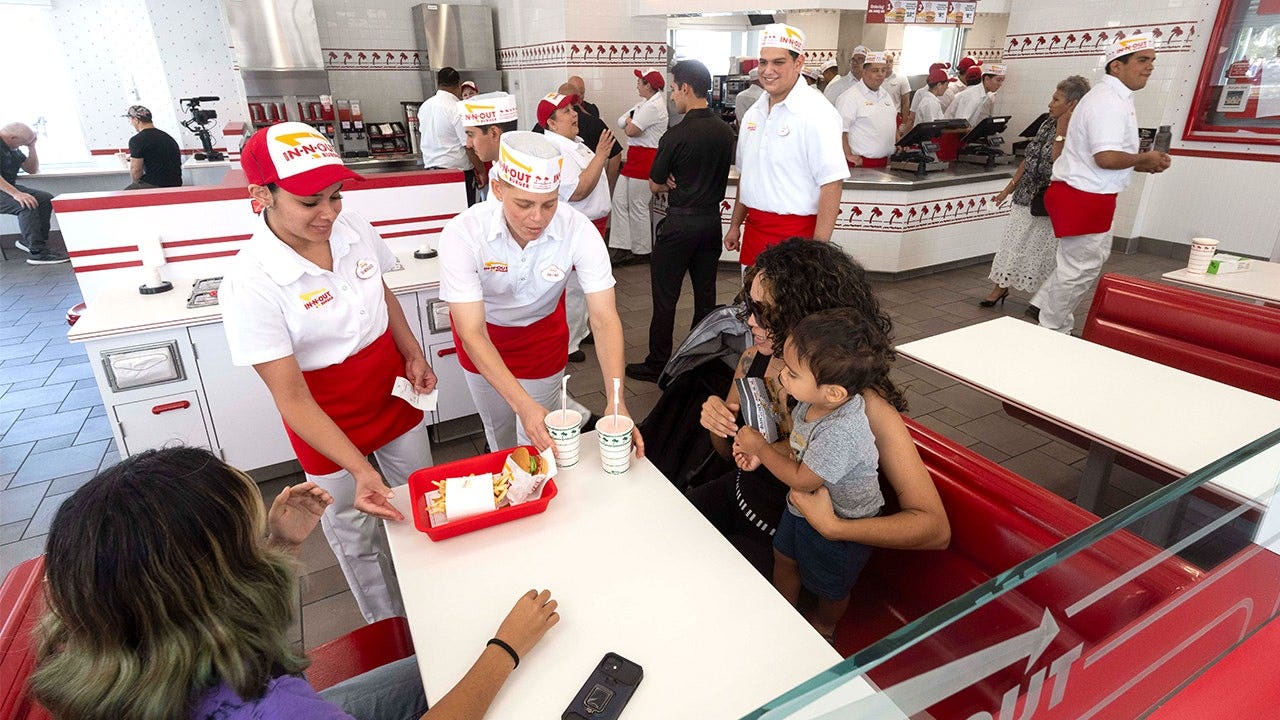
In a fast-food industry increasingly dominated by apps, delivery services, and self-service kiosks, In-N-Out Burger is charting a different course by recommitting to its roots in in-person service. The California-based chain, known for its fresh ingredients and simple menu, has explicitly rejected trends like third-party delivery partnerships and advanced tech integrations that many competitors have embraced. According to a recent report from Fox News, In-N-Out executives emphasized that maintaining direct, face-to-face interactions with customers remains central to the company's identity, even as the sector races toward digital transformation.
This stance comes at a time when major players like McDonald's and Uber Eats are expanding delivery options to capture more market share. In-N-Out, founded in 1948 by Harry and Esther Snyder in Baldwin Park, California, has built a loyal following across the western United States with its no-frills approach—double-double burgers, animal-style fries, and a secret menu that keeps enthusiasts coming back. The chain operates more than 380 locations in six states, but unlike rivals, it has no plans for nationwide expansion via delivery apps, citing concerns over quality control and customer experience.
"In-N-Out is standing by its in-person service model," the Fox News article states, highlighting the company's decision to forgo the conveniences that have become standard in the industry. Lynsi Snyder, the reclusive heiress and president of In-N-Out, has long championed the brand's traditional values. In past interviews, she has spoken about the importance of fresh, never-frozen beef and hand-cut potatoes, but recent developments underscore a broader resistance to tech-driven shortcuts. Industry analysts note that while delivery boomed during the COVID-19 pandemic, with U.S. food delivery sales reaching $26.5 billion in 2020 according to Statista, In-N-Out's choice could appeal to customers weary of impersonal transactions.
Meanwhile, in the broader world of food innovation, medical researchers are turning to nature for solutions to one of chemotherapy's harshest side effects: loss of taste. Doctors are exploring how a tiny red berry, often called the "miracle fruit," can help some chemo patients rediscover flavor and the joy of eating. The berry, scientifically known as Synsepalum dulcificum and native to West Africa, contains a protein called miraculin that temporarily alters taste buds, making sour foods taste sweet. According to preliminary studies reported by Fox News, patients undergoing treatment at facilities like the MD Anderson Cancer Center in Houston have reported improved appetite and quality of life after consuming the fruit.
One oncologist involved in the research, Dr. Emily Chen, told reporters, "It's a simple, non-invasive way to bring back the pleasure of meals for patients who often face metallic or bland tastes during treatment." While not a cure-all, the berry's potential has sparked interest in clinical trials, with early results from a 2022 pilot study at the University of California, San Francisco, showing that 70 percent of participants experienced enhanced flavor perception for up to an hour after eating it. This development aligns with growing efforts to address chemotherapy-induced dysgeusia, which affects up to 70 percent of patients, per the American Cancer Society.
Shifting from medical breakthroughs to culinary farewells, a "Star Trek" legend's final meal pick has captured fans' attention with its blend of global flavors and a surprising, sophisticated twist. George Takei, the iconic actor who portrayed Sulu in the original series, recently shared his hypothetical last supper in an interview, opting for sushi, dim sum, and a dash of molecular gastronomy-inspired elements. "I've always believed in exploring new worlds, even on the plate," Takei said, according to entertainment outlets covering the story. At 86, Takei's reflections come amid a wave of nostalgia for the franchise, which celebrated its 55th anniversary in 2021.
On the ranch-to-table front, a cowboy chef's blunt message about a common dinnertime habit is resonating with families nationwide. Kent Rollins, a self-taught cook from Wyoming known for his open-fire recipes and viral YouTube videos, has called out the scourge of smartphone use at the table. "Put the dang phone down and taste your food," Rollins advised in a recent Fox News feature, emphasizing how distractions diminish the communal joy of meals. His philosophy, rooted in his life on the frontier, echoes a broader cultural pushback against digital overload, with studies from the Journal of the Academy of Nutrition and Dietetics linking phone-free dinners to better family bonds and healthier eating habits.
Even corporate leaders aren't immune to food's viral spotlight. McDonald's CEO Chris Kempczinski's latest taste test went viral—but not for the reasons he expected. During a company event in Chicago last month, Kempczinski sampled a new prototype burger, only for a clip of his underwhelmed reaction to spread across TikTok, amassing over 5 million views. "It was supposed to be a fun internal demo," a McDonald's spokesperson said, downplaying the mishap. The incident highlights the unpredictable nature of social media in the $300 billion fast-food market, where one grimace can overshadow months of R&D.
Beverage trends are also bubbling up, with egg coffee—a sweet, frothy concoction blending eggs, sugar, and strong brew—gaining traction online, particularly on platforms like Instagram. Originating from Vietnam, where it's known as cà phê trứng, the drink has seen a surge in U.S. cafes from Seattle to New York. However, doctors warn of a hidden risk: potential salmonella contamination from raw eggs. "While delicious, it's important to use pasteurized eggs to avoid foodborne illness," cautioned Dr. Sarah Patel, a gastroenterologist at Johns Hopkins Medicine, in comments echoed by the Fox News report. Health officials report that egg-related outbreaks, though rare, affected over 1,000 people in the U.S. in 2022, per CDC data.
Heart health gets a fruity boost from simple pairings, as new research suggests combining certain fruits can improve key markers in weeks. A study published in the Journal of Nutrition found that eating apples with berries daily lowered LDL cholesterol by 10 percent in participants over 40, thanks to synergistic antioxidants. "It's an easy addition to any diet," said lead researcher Dr. Michael Rodriguez from Harvard T.H. Chan School of Public Health. This comes amid rising cardiovascular concerns, with the American Heart Association noting that 48 percent of U.S. adults have some form of heart disease.
Ice cream lovers are witnessing a quiet revolution, where classic flavors like vanilla and chocolate still dominate—accounting for 60 percent of sales, according to the International Dairy Foods Association—but bold innovations are reshaping cravings. From spicy mango-habanero swirls in Austin to matcha-sea salt in Los Angeles, artisanal shops are experimenting. Nielsen data shows premium ice cream sales up 15 percent year-over-year, driven by Gen Z's preference for unique, Instagram-worthy scoops.
Not all food news is appetizing; a bizarre shoplifting incident in a Los Angeles supermarket turned chaotic when a suspect triggered a tense escalator showdown, ending with steaks scattered everywhere. Security footage from the Ralphs store on Sunset Boulevard, captured on October 15, shows the man, described as mid-30s with a backpack, attempting to flee with $200 worth of prime cuts. "Standards in shoplifting seem to be getting higher now," quipped a store manager in the viral video, which has over 2 million views on social media. Police reported the suspect slipped away, but the event underscores rising retail theft, with the National Retail Federation estimating $112 billion in annual losses nationwide.
In-N-Out's commitment to tradition amid these diverse trends signals a potential backlash against the hyper-connected food landscape. As consumers grapple with post-pandemic habits, the chain's model could inspire others to prioritize human elements over algorithms. Industry watchers predict that while tech will continue to evolve—with projections of $50 billion in delivery revenue by 2025 from Grand View Research—niche players like In-N-Out may thrive by staying true to their origins. For now, the burger chain's double-down on in-person service offers a refreshing reminder of fast food's personal touch.
Looking ahead, In-N-Out plans to open new locations in Tennessee and Colorado next year, expanding its footprint without compromising core principles. Meanwhile, ongoing research into miracle fruits and heart-healthy hacks promises to influence everyday eating. As food intersects with health, culture, and crime in unexpected ways, these stories illustrate the ever-evolving plate of American life.