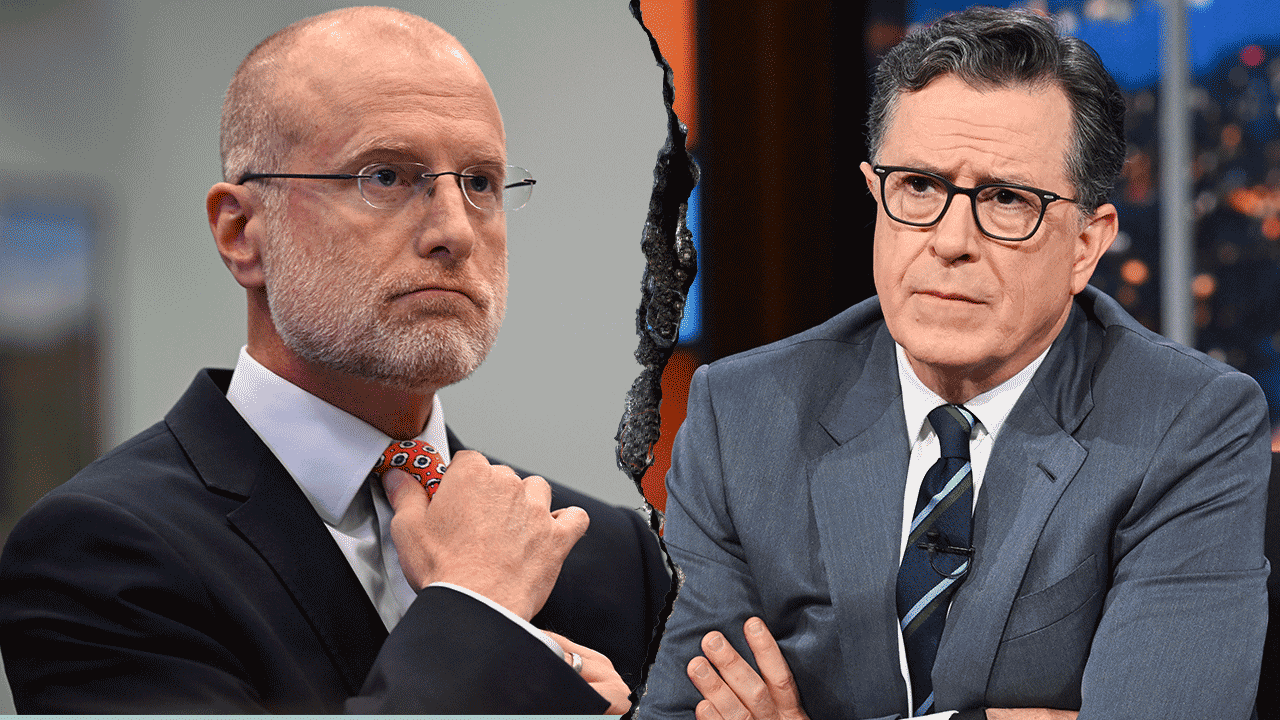
WASHINGTON — Federal Communications Commission Chairman Brendan Carr pushed back against accusations of censorship leveled by late-night host Stephen Colbert, describing the comedian's claims as a manufactured controversy designed to boost a political candidate's profile. The dispute centers on Colbert's allegation that CBS prevented him from airing an interview with Texas Democratic state Rep. James Talarico on "The Late Show," citing fears of scrutiny under the FCC's equal-time rule. Carr, speaking on Fox News' "The Ingraham Angle" on Wednesday, called the situation "Democrat-on-Democrat violence" and a "hoax," insisting that CBS had only provided standard legal guidance rather than imposing a ban.
Colbert first raised the issue with his audience on Monday, July 21, 2025, during a segment on his CBS program. He claimed that network executives had blocked the Talarico interview out of concern over potential FCC enforcement of the equal-time provision, which requires broadcasters using public airwaves to offer comparable airtime to opposing political candidates. "This was Democrat-on-Democrat violence," Carr told host Laura Ingraham, emphasizing that CBS had explicitly informed Colbert he could proceed with the interview but might need to provide equal opportunities to other candidates. "They just said, you may have to comply with equal time… But instead of doing that, they claimed that they were victims."
The equal-time rule, a longstanding federal regulation dating back to the 1950s, aims to prevent broadcasters from favoring one political candidate over another in elections. It applies specifically to appearances by candidates on broadcast television and radio, mandating that if one candidate receives airtime, rivals from major parties must be given equivalent access unless the appearance is part of a bona fide news interview. Carr defended the policy during his Fox News appearance, stating, "The equal-time rule at its core is about stopping legacy media from picking winners and losers in elections. It's so that the American people can decide."
Colbert, however, framed the episode as part of a broader effort by the incoming Trump administration to stifle criticism. Addressing Carr indirectly in his monologue, the host said, "Sir, you're the chairman of the FCC, so FCC you." He continued, "Let's just call this what it is — Donald Trump's administration wants to silence anyone who says anything bad about Trump on TV, because all Trump does is watch TV." Colbert's remarks came amid heightened scrutiny of late-night programming, which has increasingly leaned into political satire, often targeting Republican figures.
CBS swiftly responded to Colbert's on-air accusations the following day, Tuesday, issuing a statement that contradicted the host's narrative. "The Late Show was not prohibited by CBS from broadcasting the interview with Rep. James Talarico," the network said. The statement elaborated that legal advisors had simply informed the production team about the implications of airing the segment, noting it could trigger equal-time obligations for two other Democratic candidates in the Texas U.S. Senate race, including Rep. Jasmine Crockett of Texas. "The show was provided legal guidance that the broadcast could trigger the FCC equal-time rule for two other candidates, including Rep. Jasmine Crockett [D-Texas], and presented options for how the equal time for other candidates could be fulfilled," CBS added.
During his Wednesday interview, Carr dismissed the uproar as a publicity stunt benefiting Talarico, who is vying for the Democratic nomination in Texas's Senate race. "This was all about a political candidate trying to get attention and clicks, and the news media ran with it like lemmings," Carr said. "They just ate it up." He suggested the controversy might even stem from internal Democratic preferences in the primary, though he stopped short of speculating further. "Perhaps Colbert and other establishment Democrats want to put the thumb on the scale in this Democrat primary for one candidate over the other — I don't know, you'll have to ask them — but we're going to enforce the law and hold broadcasters accountable," the FCC chair vowed.
The incident highlights ongoing tensions between regulators and the entertainment industry, particularly as the FCC under Carr's leadership has signaled intentions to address perceived biases in network television. Republicans have long complained about limited access to late-night talk shows, which are predominantly hosted by liberal-leaning figures like Colbert, Jimmy Fallon, and Jimmy Kimmel. A recent Fox News analysis noted that Republicans have been "virtually shut out" of these Democrat-dominated programs, prompting calls for FCC reforms to ensure fairer treatment during election cycles.
Talarico, a rising star in Texas Democratic politics, represents a progressive voice in the state legislature, known for his advocacy on education and gun control issues. His potential Senate bid comes at a time when Texas Democrats are seeking to challenge Republican incumbent Sen. Ted Cruz in 2024, though the primary field remains fluid. The interview in question was recorded but never aired, according to Colbert's account, leaving questions about its content unanswered. Fox News Digital reached out to "The Late Show" for additional comment but did not immediately receive a response.
Colbert doubled down on his criticism during a subsequent episode on February 17, 2026, where he held up a printed copy of CBS's statement and dismissed it as "crap." The host's defiance underscores the combative style that has defined his tenure since taking over "The Late Show" from David Letterman in 2015. Under Colbert, the program has drawn both praise for its sharp political commentary and backlash for its partisan tone, especially in the polarized media landscape.
Carr's rebuttal arrives as the FCC prepares for potential shifts under a second Trump administration, with the president-elect having appointed Carr to the chairmanship. The agency has faced criticism from both sides of the aisle: conservatives argue it has been too lax on enforcing fairness rules, while progressives worry about increased government oversight of content. Carr reiterated his commitment to impartial enforcement, saying the FCC would continue to administer existing laws without favoritism.
This episode is not isolated; similar debates over the equal-time rule have surfaced in past election seasons. For instance, during the 2020 cycle, broadcasters navigated complex obligations when hosting candidate interviews amid the COVID-19 pandemic. Legal experts note that while the rule promotes equity, it can create logistical challenges for shows like Colbert's, which blend entertainment with news-like segments. The FCC has historically waived requirements for certain formats, but political appearances by candidates often fall under strict scrutiny.
As the Texas Senate primary heats up, the controversy could draw more attention to Talarico's campaign, ironically achieving the visibility Colbert sought. Meanwhile, CBS's clarification has not fully quelled the debate, with some media watchers questioning why the network's legal guidance was interpreted as a outright prohibition. Colbert's team has not elaborated beyond the host's monologues, leaving room for speculation about internal dynamics at the network.
Broader implications extend to the future of broadcast regulation in an era of streaming dominance. While the equal-time rule applies only to over-the-air television, pressure is mounting to adapt it for digital platforms. Carr's comments suggest the FCC may prioritize traditional media accountability, potentially influencing how networks handle political content in the lead-up to the 2026 midterms and beyond.
Officials at the FCC did not provide further details on any ongoing investigations related to the incident, but Carr's public stance indicates a firm enforcement posture. As broadcasters weigh compliance costs against creative freedoms, incidents like this one serve as reminders of the delicate balance between regulation and expression in American media. For now, the dust from Colbert's claims appears to be settling, but the underlying questions about media fairness persist.
In Appleton, Wisconsin, where local broadcasters also navigate federal rules, this national story resonates with discussions on equitable coverage during elections. The Appleton Times will continue monitoring developments at the FCC and in Texas politics.