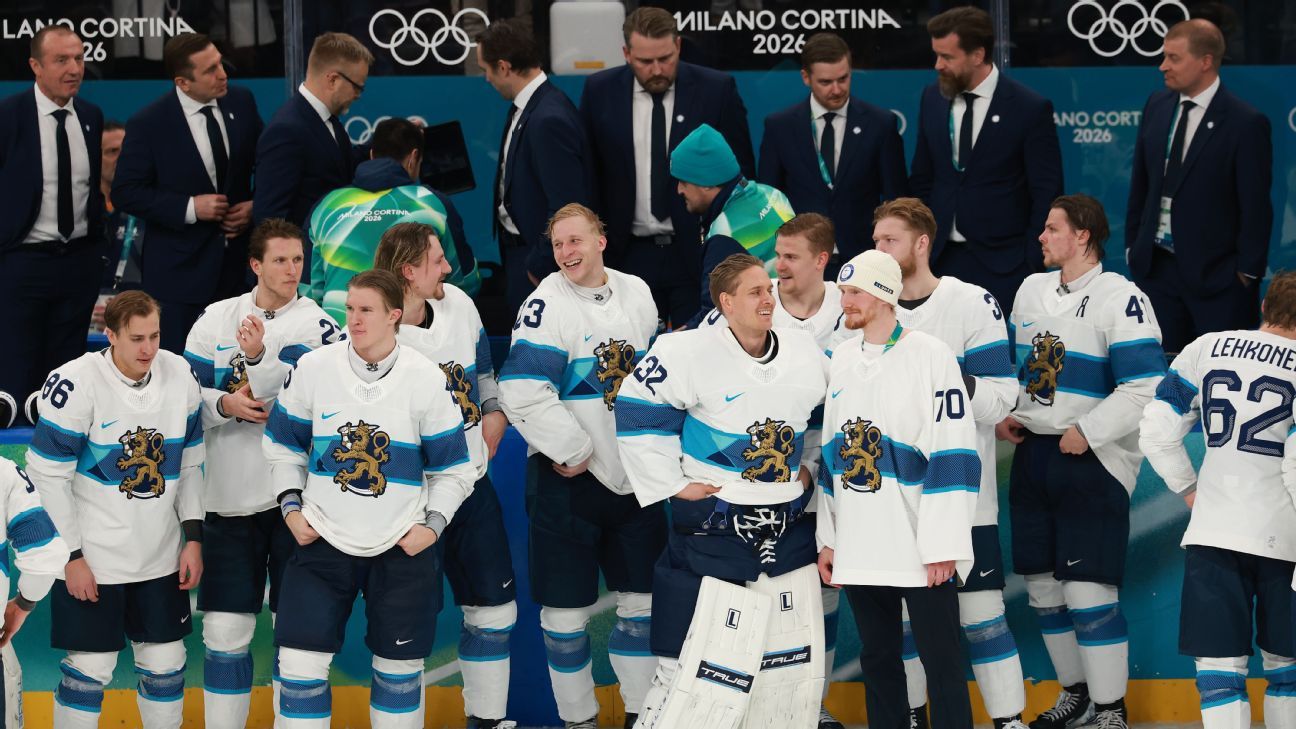
MILAN, Italy — Finland claimed the bronze medal in men's hockey at the Winter Olympics here on Saturday night, defeating Slovakia 6-1 in a decisive performance that marked their third consecutive third-place finish in the tournament when NHL players are allowed to participate.
The victory extends Finland's strong tradition in Olympic hockey, following bronze medals in Sochi in 2014 and Vancouver in 2010, as well as a silver in Turin in 2006. Erik Haula led the way for the Finns with two goals, while Joel Armia contributed a goal and two assists in the lopsided win. Other key scorers included Roope Hintz and Kaapo Kakko, who connected just 42 seconds apart in the third period to break the game open after Slovakia had narrowed the gap.
The match, played at the Mediolanum Forum in Milan, saw Finland surge ahead early, building a 2-0 lead in the first period. Slovakia responded with a goal to make it 2-1 heading into the final frame, but the Finns erupted for four goals in the third, including two empty-net tallies to seal the rout. According to reports from the International Ice Hockey Federation, the game drew a lively crowd of over 12,000 spectators, who cheered as Finland lifted the bronze medals on the podium shortly after the final buzzer.
This bronze comes after a heartbreaking semifinal loss to Canada on Wednesday, where Finland squandered a two-goal advantage in a 3-2 defeat. Nathan MacKinnon's dramatic goal with just 35.2 seconds remaining propelled Canada to the gold-medal game against Sweden. Finnish head coach Jalonen, speaking post-semifinal, acknowledged the setback but emphasized resilience, though specific comments from Saturday's game were not immediately available.
Finland's path to the bronze-medal game was not without challenges. The team arrived in Milan without their captain and star center Aleksander Barkov, who underwent surgery in September to repair torn ligaments in his right knee, an injury sustained during Florida Panthers training camp. Despite the absence of Barkov, a two-time Selke Trophy winner and one of the NHL's top defensive forwards, Finland navigated the tournament with depth and determination, relying on contributions from players like Haula of the New Jersey Devils and Armia of the Montreal Canadiens.
Slovakia, meanwhile, entered the game as underdogs but with momentum from an improbable run through the preliminary rounds and quarterfinals. Four years after securing bronze in Beijing, the Slovaks aimed to repeat that feat but fell short against a more experienced Finnish squad. Their semifinal loss to the United States on Thursday ended hopes of a deeper run, though they showed flashes of the grit that carried them to this stage.
The game itself unfolded with Finland dictating the pace from the opening faceoff. Haula opened the scoring at 7:42 of the first period, capitalizing on a power-play opportunity after a Slovakia penalty. Armia added to the lead later in the frame, assisted by a precise pass from Hintz, setting the tone for Finland's offensive dominance. Goaltender Ukko-Pekka Luukkonen made 28 saves in net for the Finns, earning praise for his steady performance despite the lopsided scoreline.
In the second period, Slovakia mounted a comeback effort, with their lone goal coming from Juraj Slafkovsky at 14:19, cutting the deficit to one. The young Montreal Canadiens forward, who led Slovakia in scoring throughout the tournament, showed his promise but couldn't spark a full rally. Finnish defenders, led by Miro Heiskanen of the Dallas Stars, clamped down effectively, limiting high-danger chances for the Slovaks.
The third period proved decisive, as Finland's experience shone through. Hintz restored the two-goal lead at 4:15, followed swiftly by Kakko's tally at 4:57, both goals coming on even-strength plays that highlighted Finland's speed and puck control. With Slovakia pulling their goaltender late in regulation, Haula and another Finn — reportedly Teuvo Teravainen — added empty-net goals to finalize the 6-1 score. The outburst turned what could have been a close contest into a statement win for the bronze.
Looking back at the tournament, Finland finished the round-robin phase with a strong 3-0-0 record, including victories over Norway, Denmark, and host Italy. Their quarterfinal win over Czechia advanced them to the semis, where the loss to Canada tested their mettle. NHL participation, reinstated after a 16-year Olympic hiatus since Nagano 1998, brought elite talent to Milan, elevating the competition level across the board.
Slovakia's journey was marked by upsets, including a stunning overtime victory against Latvia in the quarterfinals. Goaltender Samuel Hlavaj, a 20-year-old prospect, stood tall in several games but faced overwhelming pressure from Finland's attack. The loss ends a tournament where Slovakia scored 18 goals while allowing 15, per IIHF statistics, underscoring their competitive but ultimately limited run.
Beyond the ice, the Milan Olympics have highlighted hockey's global appeal, with NHL players like MacKinnon, Connor McDavid, and Auston Matthews drawing massive viewership. Finland's success without Barkov speaks to the depth in international hockey, where teams like Sweden and Canada boast star-studded rosters. The bronze medal adds to Finland's Olympic haul, bringing their total to five in men's hockey since 1920.
As the tournament concludes, attention turns to Sunday's gold-medal final between Canada and Sweden at the same venue. Finland's players, many returning to NHL duties soon after, can reflect on a resilient campaign. For Slovakia, the focus shifts to building on this experience for future competitions, including the 2026 World Championships.
In the broader context of Olympic hockey, this result reinforces Europe's stronghold in the sport, with five of the top six teams hailing from the continent. The IIHF noted that attendance across Milan venues exceeded 500,000 for hockey events, a testament to the passion for the game in Italy and beyond. Finland's coaching staff, led by Jalonen, who guided the team to gold in 2022 without NHLers, continues to instill a winning culture.
With the medals awarded, the focus now pivots to the future of the sport. Discussions about NHL Olympic participation beyond 2026 remain ongoing, but for now, Finland celebrates another podium finish, proving that even without their full arsenal, they remain a force in international play.