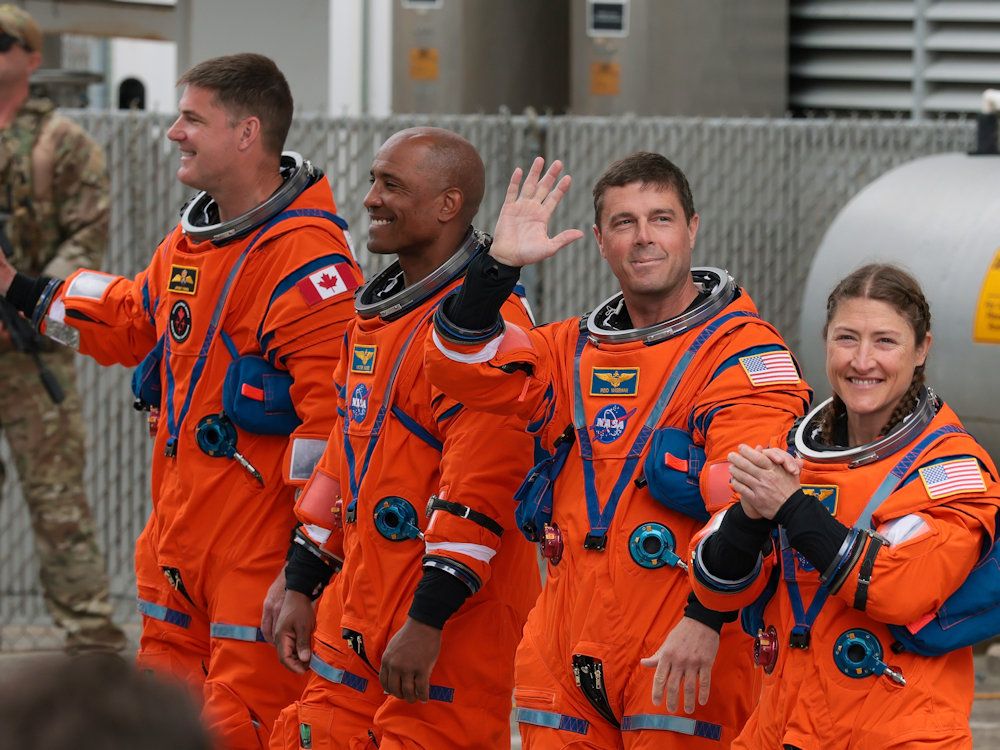
OTTAWA — As the world eyes NASA's upcoming Artemis II mission, set to launch later this year aboard a SpaceX rocket, one of the four astronauts aboard will be Canadian Col. Jeremy Hansen, marking a historic first for his country. Selected as an astronaut in 2009 at age 33, Hansen has waited more than a decade for his chance to venture beyond low-Earth orbit, a journey that traces its roots back to a 2017 directive from then-U.S. President Donald Trump prioritizing a return to the Moon.
The Artemis program, NASA's ambitious effort to land humans on the lunar surface again after more than 50 years, began with Trump's Space Policy Directive-1, issued on December 11, 2017. The memorandum instructed NASA to "lead an innovative and sustainable program of exploration with commercial and international partners to enable human expansion across the solar system and to bring back to Earth new knowledge and opportunities." According to NASA's own summary at the time, "President Donald Trump is sending astronauts back to the Moon," with a focus on establishing a permanent American presence and advancing U.S. leadership in space.
For Hansen, the path to Artemis II was anything but certain. When he joined the Canadian Space Agency's astronaut corps alongside David Saint-Jacques, the future of human spaceflight looked dim. The U.S. space shuttle program, which had carried the only two Canadians to space before them—Marc Garneau, Roberta Bondar, Steve MacLean, Dave Williams, and Chris Hadfield—was nearing retirement in 2011 with no immediate successor. The International Space Station, built with a projected 15-year lifespan, was showing signs of wear, and SpaceX was still a fledgling company struggling with early rocket failures. Elon Musk, SpaceX's founder, later described that era as the "worst" period of his life due to the company's teething problems.
Hansen, a former Royal Canadian Air Force pilot with a master's degree in space science from the Royal Military College of Canada, trained rigorously but flew no missions. He served as capsule communicator, or CAPCOM, for other crews, led training courses, and fulfilled public duties like school visits on behalf of the Canadian government. Retiring around age 48 was the norm for astronauts, and with most missions limited to the ISS via Russian Soyuz rockets, Hansen's prospects seemed slim. Saint-Jacques, his classmate, got a six-month ISS stint starting in December 2018, but Hansen often told schoolchildren, "I’m waiting for my ride," when asked about his spaceflight dreams.
The tide turned with Trump's lunar push. No initial mention was made of international partners in the 2017 directive or its rollout, which featured moon rocks and Apollo-era astronauts. But Canada, eager to maintain its role in space exploration, positioned itself early. The Canadian Space Agency has a history of committing to NASA initiatives, even risky ones, as outlined in its policy framework: "ensuring that Canada is a sought-after partner in the international space exploration missions that serve Canada’s national interests." In 2014, for example, Canada pledged components for NASA's Resource Prospector Mission, a robotic lunar rover project that was later canceled—but those talks laid groundwork for Canadian involvement in deep-space flights.
Canada's breakthrough came in late 2020 with the Gateway Treaty, a pact securing a strong role for the country in the Lunar Gateway, a planned orbital outpost around the Moon. In exchange for providing the Canadarm3 robotic arm for the station, Canada earned seats for two astronauts on lunar missions, including Hansen on Artemis II—the first crewed Artemis flight, a lunar flyby scheduled for no earlier than September 2025 from Kennedy Space Center in Florida. The Canadian Space Agency celebrated the deal on Twitter: "We’re proud to have signed a historic space treaty with NASA that secures a strong role for Canada in the Lunar Gateway and confirms two flights to the Moon for our astronauts. We can definitely say that we are over the Moon (you knew that was coming!)!"
The Canadarm3, the third in a line of iconic Canadian robotic manipulators—following the original Canadarm for the space shuttle and Canadarm2 for the ISS—represents a significant investment. Preliminary design costs reached $268.9 million, and in June 2024, MDA Ltd., a Canadian aerospace firm, won the final build contract for $999.8 million. With Artemis II's total price tag estimated at about $4 billion, Canada's contribution equates to roughly a quarter of the mission's cost for one seat. The arm is designed to service spacecraft, capture samples, and support external activities on the Gateway, building on Canada's legacy of space robotics that has been integral to NASA operations since the 1980s.
The agreement was inked amid political turbulence in the U.S. Trump had lost the November 2020 election and was contesting the results, drawing little media attention to the deal. It was one of the final acts of NASA Administrator Jim Bridenstine, a Trump appointee, who resigned in January 2021 for Bill Nelson, chosen by President Joe Biden. Bridenstine praised Canada's commitment, stating, "Canada was the first international partner to commit to advancing the Gateway in early 2019, they signed the Artemis Accords in October, and now we’re excited to formalize this partnership for lunar exploration." The Artemis Accords, a set of principles for lunar cooperation signed by 48 countries including Canada, further solidified the alliance.
Artemis II itself will test the Orion spacecraft's systems in a 10-day mission circling the Moon without landing, carrying Hansen alongside NASA commander Reid Wiseman, pilot Victor Glover, and mission specialist Christina Koch. Launching from Florida on a Space Launch System rocket developed by NASA and contractors like Boeing and Lockheed Martin, the crew will travel about 1.3 million kilometers round-trip. Hansen, now 47, will become the first Canadian to leave Earth's orbit, surpassing Chris Hadfield's 2013 ISS command.
Yet, a recent twist complicates the story. Just last week, as Artemis II preparations advanced, NASA announced it is reevaluating the Lunar Gateway's role, potentially scrapping the orbital station in favor of a direct ground-based base on the Moon's surface. According to reports, this shift prioritizes faster lunar landings under the Artemis program's evolving architecture, influenced by budget constraints and new priorities from the Biden administration. The change leaves the Canadarm3's future uncertain—designed specifically for the Gateway, it may now lack a destination, raising questions about the billion-dollar investment.
Canadian officials have not publicly commented on the potential pivot, but space analysts note it underscores the fluid nature of international partnerships. The Canadian Space Agency has emphasized the treaty's broader benefits, including technology development and scientific gains. "The Gateway will enable sustainable human exploration of the Moon and serve as a launchpad for missions to Mars," the agency stated in 2020 announcements, though NASA's latest updates suggest a more terrestrial focus for initial outposts.
This development echoes past uncertainties in space collaboration. The Resource Prospector cancellation in 2018 didn't derail Canada's NASA ties, and the ISS partnership has endured geopolitical strains, including U.S.-Russia tensions. For Hansen, however, the mission remains on track. Training at NASA's Johnson Space Center in Houston, he has described the opportunity as a culmination of years of preparation. "It's an honor to represent Canada on this historic flight," Hansen said in a recent interview, reflecting on the journey from uncertainty to lunar orbit.
The Artemis program's international dimension highlights shifting global space dynamics. While Trump's directive emphasized American leadership, the inclusion of partners like Canada, Europe, Japan, and the United Arab Emirates via the Gateway and Accords fosters multilateral exploration. Canada's contribution, valued at over $2.4 billion total for Gateway elements including the arm, ensures its seat at the table— even if the table's design changes. As Artemis II approaches, it symbolizes not just technological triumph but diplomatic maneuvering in the new space race, with China and private firms like SpaceX vying for lunar footholds.
Looking ahead, NASA plans Artemis III for a 2026 lunar landing, potentially involving more international crew. For Canada, the focus may shift to adapting Canadarm3 for surface operations or other roles. Officials in Ottawa, through the Canadian Space Agency, continue to tout the program's alignment with national interests in STEM education, innovation, and Arctic-relevant technologies like remote robotics. Hansen's flight, regardless of Gateway's fate, cements Canada's place in deep space, proving that persistence—and a well-timed treaty—can launch a nation to the Moon.
In the broader context of U.S.-Canada relations, the deal arrives as trade talks loom. Analysts predict potential 'hostility' in negotiations less than three months away, but space cooperation remains a bright spot. As Hansen prepares for his ride, the stars align for a cross-border success story amid earthly challenges.