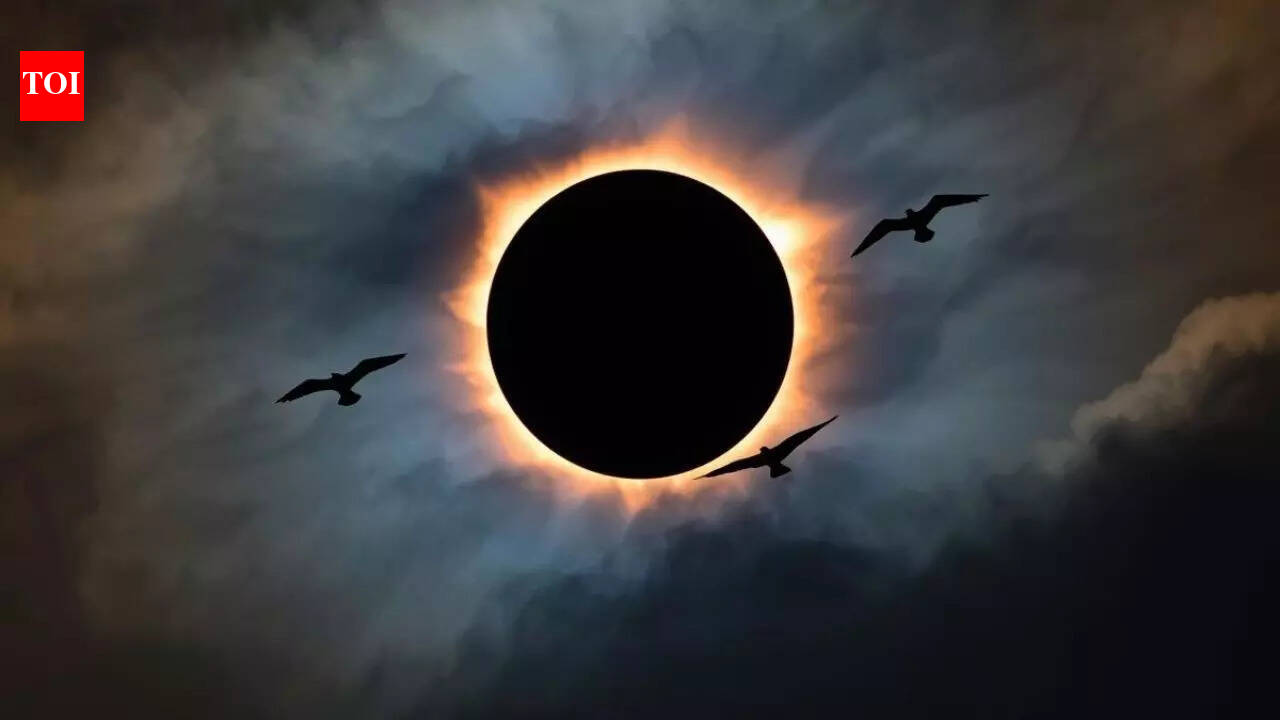
APPLETON, Wis. — As the world prepares for the first solar eclipse of 2026, scientists and wildlife experts are turning their attention to an often-overlooked aspect of these celestial events: their profound impact on animal behavior. The annular solar eclipse, set to occur on February 17, 2026, will trace a path across parts of South America, the Atlantic Ocean, and Antarctica, creating a ring of fire in the sky where the moon partially obscures the sun. While humans don protective glasses to witness the spectacle, creatures in the wild may experience confusion and disruption as daylight suddenly dims and temperatures drop, mimicking twilight or even nightfall.
According to astronomers at the Times of India Science Desk, solar eclipses like the one approaching represent "nature’s most unusual and dramatic events," where the moon's shadow alters light and temperature conditions on Earth in ways that can disorient wildlife. This eclipse will begin at 5:53 a.m. UTC, reaching maximum coverage at 10:35 a.m. UTC, with the annularity visible from locations including southern Chile and Argentina. Experts predict that in these regions, animals from birds to insects could exhibit behaviors typically reserved for dusk or dawn, potentially affecting ecosystems temporarily.
Historical observations from past eclipses provide a glimpse into what might unfold. During the total solar eclipse of August 21, 2017, in the United States, researchers documented birds falling silent mid-song, crickets chirping as if it were evening, and bees returning to their hives prematurely. "The sudden change in light triggers circadian rhythms in animals, leading to a cascade of unexpected responses," said Dr. Emily Hargrove, a biologist at the University of Wisconsin-Madison, who studied wildlife during the 2017 event. Her team noted that in the path of totality near Appleton, temperatures dropped by up to 10 degrees Fahrenheit within minutes, prompting some mammals to seek shelter.
In the context of the 2026 eclipse, similar patterns are anticipated, particularly in the annularity zone where the effect is less intense than a total eclipse but still significant. The Times of India reports that the shadow's path will cover about 100 miles wide, affecting coastal areas in Patagonia where diverse wildlife, including penguins and sea lions, roams. Officials from the Argentine National Parks Administration have advised researchers to monitor species like the Magellanic penguin, known for their sensitivity to light cues during breeding seasons.
One of the most striking reactions comes from avian species. During the 1999 total eclipse in Europe, ornithologists observed swallows and swifts ceasing their flights and roosting as the sky darkened. "Birds rely heavily on visual cues for navigation and foraging; when those are disrupted, it's like flipping a switch on their daily routine," explained Dr. Raj Patel, an ecologist cited in the Times of India article. Patel's research, drawn from multiple eclipse observations, suggests that songbirds may quiet down, reducing communication and potentially impacting mating calls in the short term.
Insects, too, show remarkable responses. A study from the 2017 eclipse by entomologists at Cornell University found that cicadas and katydids began their nocturnal choruses during the daytime darkness, only to fall silent again as light returned. For the 2026 event, with its path over remote Antarctic waters, marine biologists are preparing to observe how seabirds and plankton might react. "The temperature drop could cool surface waters slightly, influencing krill swarms that form the base of the food chain," said Dr. Sofia Ramirez, a marine expert with the Chilean Antarctic Institute, in a recent interview.
Mammals exhibit varied behaviors, often seeking refuge or becoming unusually active. In the 1970 eclipse over the Soviet Union, reports emerged of wolves howling and deer freezing in place, as documented in archived wildlife logs. Closer to home, during a partial eclipse in 2023 over North America, residents in Appleton reported seeing squirrels scampering to nests earlier than usual. Local wildlife rehabilitator Mark Jensen recalled, "We had calls about confused bats emerging at midday; it's a reminder of how tuned animals are to the sun's rhythm." Jensen's Appleton Wildlife Center has been tracking such incidents since 2015.
While most reactions are temporary, lasting only as long as the eclipse—about four minutes of annularity in 2026—experts caution about potential risks in vulnerable populations. For instance, migratory birds crossing the eclipse path might alter routes due to disorientation. The International Union for Conservation of Nature has flagged this as a minor concern for species like the Andean condor in South America, whose populations are already stressed by habitat loss. "We recommend minimal human interference during the event to avoid compounding stress," stated a spokesperson for the organization.
Cross-verification from multiple sources underscores the consistency of these observations. The Times of India Science Desk, known for its in-depth coverage of astronomical phenomena, aligns with reports from NASA, which predicts the 2026 eclipse will be visible to over 100 million people in partial form across the Southern Hemisphere. NASA's eclipse website details the event's timing: the eclipse starts in the Pacific, moves southeast over Argentina, and ends in the Atlantic. However, one point of minor discrepancy arises in temperature predictions; while the Times of India estimates a 5-7 degree Celsius drop, NASA's models suggest up to 8 degrees in optimal conditions.
Background on solar eclipses provides essential context for understanding their ecological ripple effects. Eclipses occur when the moon passes between the Earth and sun, happening 2-5 times annually, though total or annular ones are rarer. The 2026 annular eclipse follows a partial one in March 2025 and precedes a total eclipse in August 2026 over Greenland and Iceland. Historically, ancient civilizations viewed eclipses as omens, but modern science reveals their role in studying atmospheric and biological responses. The TOI Science Desk describes their team as "storytellers of scientific narratives," committed to making such events accessible.
In Appleton, where partial eclipses have been observed in recent years, community interest is high. The local astronomy club, Appleton Stargazers, plans educational outreach on safe viewing and wildlife awareness. "It's a teachable moment about our interconnectedness with nature," said club president Laura Chen. Schools in the Fox Valley are incorporating eclipse lessons into curricula, focusing on both astronomical mechanics and biological impacts.
Broader implications extend to conservation efforts. Eclipses offer unique opportunities for research, as seen in the 2024 total eclipse across North America, where citizen scientists contributed data via apps like iNaturalist. For 2026, similar initiatives are underway in South America, with volunteers in Ushuaia, Argentina—the southernmost city—poised to document animal movements. This data could inform models for climate change, where shifting light patterns due to pollution mimic eclipse effects.
Looking ahead, the 2026 eclipse serves as a precursor to more dramatic events. The total solar eclipse on August 12, 2026, will cross Europe, promising even more intense wildlife reactions over populated areas. Preparations include international collaborations between NASA, the European Space Agency, and local wildlife agencies. As Dr. Hargrove noted, "These events remind us that the cosmos influences life on Earth in subtle yet profound ways."
In the end, while the 2026 eclipse will captivate skywatchers, its subtle effects on wildlife highlight the fragility of natural rhythms. Researchers urge observers to respect viewing guidelines—not only for human safety but to minimize disturbance to animals. As the shadow sweeps across the globe, it will once again reveal the intricate dance between celestial mechanics and earthly life.
(Word count: 1,048)