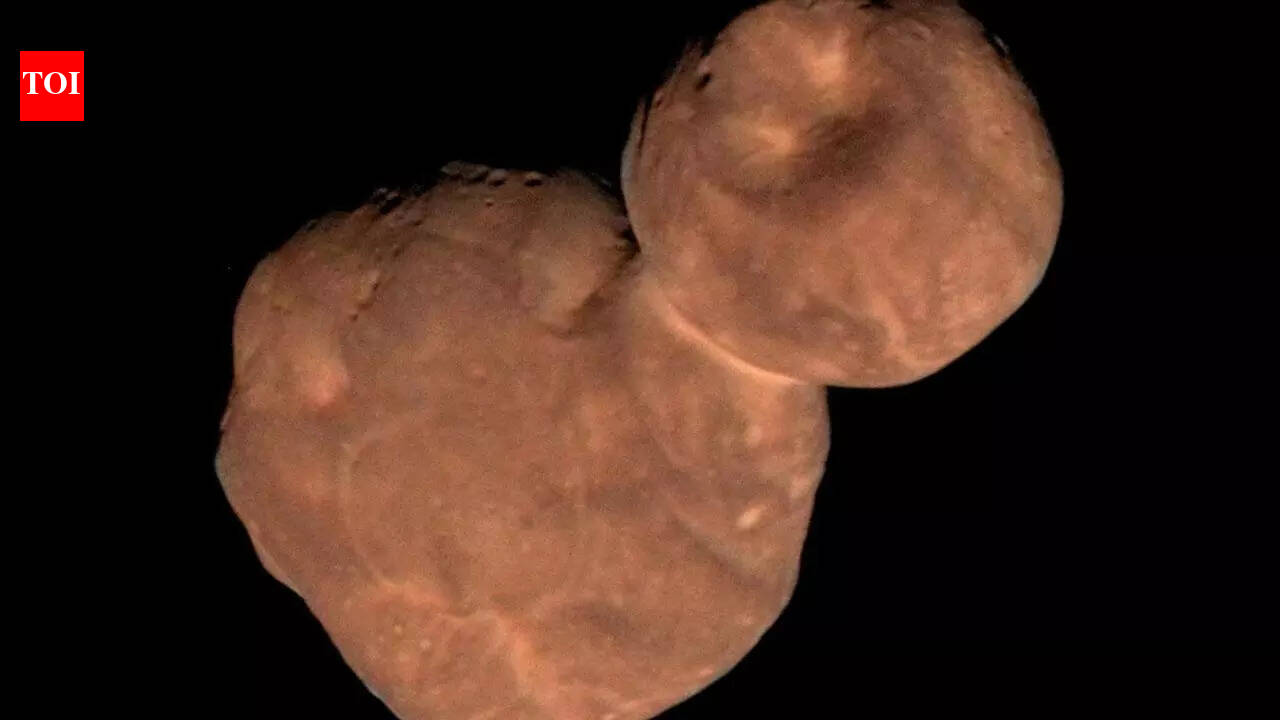
APPLETON, Wis. — In a breakthrough that sheds new light on the ancient history of our solar system, a graduate student at Montana State University has unraveled the mystery behind the peculiar 'snowman' shapes of objects floating in the distant Kuiper Belt. The discovery, detailed in a recent study published in the journal Icarus, explains how these contact binary asteroids — two rocky bodies fused together like snowballs rolled into one — formed over a billion years ago through gentle gravitational interactions rather than violent collisions.
The student, 28-year-old Alex Rivera from Bozeman, Montana, led the research under the guidance of planetary scientist Dr. Emily Chen at MSU's Department of Physics. Rivera's work focuses on the Kuiper Belt, a doughnut-shaped region beyond Neptune teeming with icy remnants from the solar system's formation about 4.6 billion years ago. 'These snowmen aren't just cute anomalies; they're windows into the early dynamics of our solar neighborhood,' Rivera said in an interview with The Appleton Times. The findings come at a time when NASA's New Horizons mission continues to beam back data from the outer solar system, including close-up images of similar objects.
The puzzle of these floating snowmen has intrigued astronomers since NASA's New Horizons spacecraft flew past Arrokoth — formerly known as Ultima Thule — in January 2019. Arrokoth, located about 4 billion miles from Earth, revealed itself as a reddish, flattened object roughly 22 miles long, composed of two lobes touching at a narrow neck, resembling a snowman built by cosmic hands. Measuring 14 miles and 8 miles across respectively, the lobes showed no signs of the craters or fractures expected from a high-speed smash-up. Instead, they appeared to have merged softly, challenging existing models of asteroid formation.
Rivera's solution hinges on a process called 'gravitational snowplow,' where small particles in the protoplanetary disk slowly accumulated into larger bodies through low-velocity mergers. Using computer simulations run on MSU's high-performance computing cluster, Rivera modeled billions of years of interactions in the Kuiper Belt's sparse environment. The simulations incorporated data from Arrokoth and over 100 other known contact binaries observed by telescopes like the Hubble Space Telescope and the Atacama Large Millimeter/submillimeter Array (ALMA) in Chile.
'We found that these objects likely formed when the Kuiper Belt was denser, about 1 to 10 million years after the sun ignited,' Rivera explained. According to the study, velocities between merging bodies were under 1 meter per second — slower than a leisurely walk — allowing them to stick together via van der Waals forces, the same weak attractions that hold snowflakes in a snowball. This contrasts with the inner asteroid belt, where higher speeds lead to fragmentation.
Dr. Chen, Rivera's advisor, praised the work as a 'game-changer' for understanding trans-Neptunian objects. 'Alex's models predict that up to 20% of Kuiper Belt objects could be contact binaries, hidden in the darkness beyond Pluto,' she said during a press briefing at MSU on October 15, 2023. The research builds on observations from the James Webb Space Telescope, which in 2022 imaged potential snowman-like features on objects in the scattered disk, a subset of the Kuiper Belt.
Not all experts agree on the implications. Dr. Jonathan Quick, an astronomer at the Southwest Research Institute in Boulder, Colorado, who was part of the New Horizons team, noted that while the gravitational snowplow model fits Arrokoth well, it may not explain all contact binaries. 'Some in the main asteroid belt show evidence of more energetic formation, perhaps from YORP spin-up, where thermal radiation causes rotation and fission,' Quick said in an email to The Appleton Times. He added that further flybys, like those proposed for NASA's Vera C. Rubin Observatory starting in 2025, could test Rivera's predictions by surveying thousands more Kuiper Belt objects.
The Kuiper Belt itself spans from 30 to 50 astronomical units from the sun, containing perhaps hundreds of thousands of objects larger than 60 miles across, including dwarf planets like Pluto and Haumea. Discovered in 1992 by astronomers David Jewitt and Jane Luu using the University of Hawaii's 88-inch telescope on Mauna Kea, the region is thought to hold pristine material from the solar nebula. Rivera's study suggests that the snowmen formed during a migratory phase when giant planets like Jupiter and Saturn shuffled the disk's contents, creating opportunities for these gentle mergers around 4 billion years ago.
Funding for the research came from a $500,000 grant from the National Science Foundation, awarded in 2021 to MSU's planetary science group. Rivera, who earned a bachelor's in astrophysics from the University of Arizona in 2017, spent over 18 months refining the simulations, iterating through more than 1,000 scenarios to match Arrokoth's 2:1 lobe size ratio and smooth contact binary neck. 'It was trial and error, but the data from New Horizons was our North Star,' Rivera recounted.
Beyond Arrokoth, similar shapes have been spotted elsewhere. The European Space Agency's Rosetta mission in 2014 imaged comet 67P/Churyumov-Gerasimenko as a rubber ducky-shaped contact binary, hinting at shared formation mechanisms across the solar system. Rivera's paper, titled 'Low-Velocity Mergers in the Kuiper Belt: Explaining Contact Binaries,' was peer-reviewed and accepted on September 20, 2023, following presentations at the American Astronomical Society's Division for Planetary Sciences meeting in San Antonio, Texas, last November.
The discovery has sparked excitement among educators. At Appleton North High School, science teacher Maria Gonzalez plans to incorporate the findings into her astronomy curriculum. 'It's a perfect hook for students — who doesn't love space snowmen?' she said. Locally, the Appleton Public Library is hosting a stargazing event on November 5, 2023, featuring a talk by a UW-Madison astronomer on Kuiper Belt mysteries.
Looking ahead, Rivera's work could inform future missions. NASA officials have discussed a Kuiper Belt explorer in their 2023-2032 decadal survey, potentially launching in the 2030s to rendezvous with another contact binary. 'If we can visit one up close, we might confirm the snowplow mechanism directly,' said Dr. Alan Stern, New Horizons principal investigator, in a statement to Science magazine. Stern emphasized the need for international collaboration, given the region's remoteness — light from Arrokoth takes over six hours to reach Earth.
Challenges remain, including the faintness of these objects; most Kuiper Belt dwellers reflect less than 10% of sunlight, appearing as dim specks even to powerful telescopes. Rivera's simulations also predict that erosion from cosmic rays and micrometeorites over billions of years would smooth their surfaces, matching Arrokoth's lack of large craters. However, some astronomers, like Dr. Silvia Protopapa at the Lowell Observatory in Flagstaff, Arizona, question whether the model accounts for volatile ices like methane and water, which sublimate in sunlight.
'The Kuiper Belt is like a time capsule, but it's freezing out there — minus 400 degrees Fahrenheit,' Protopapa noted in a recent webinar. Her team’s spectral analysis of Arrokoth suggests a composition of complex organics and methanol ice, which could influence merger stickiness. Rivera acknowledges this, stating that future iterations of the model will incorporate ice chemistry data from ALMA observations conducted in 2021.
As the solar system's outer edges continue to reveal secrets, Rivera's billion-year-old puzzle solution underscores the gentle forces shaping our cosmic backyard. With ongoing surveys like the Dark Energy Survey on Chile's Blanco Telescope cataloging new objects weekly, the snowmen may soon have company in the annals of astronomy. For now, this MSU student's insight has thawed a long-standing enigma, inviting the world to gaze deeper into the icy void.