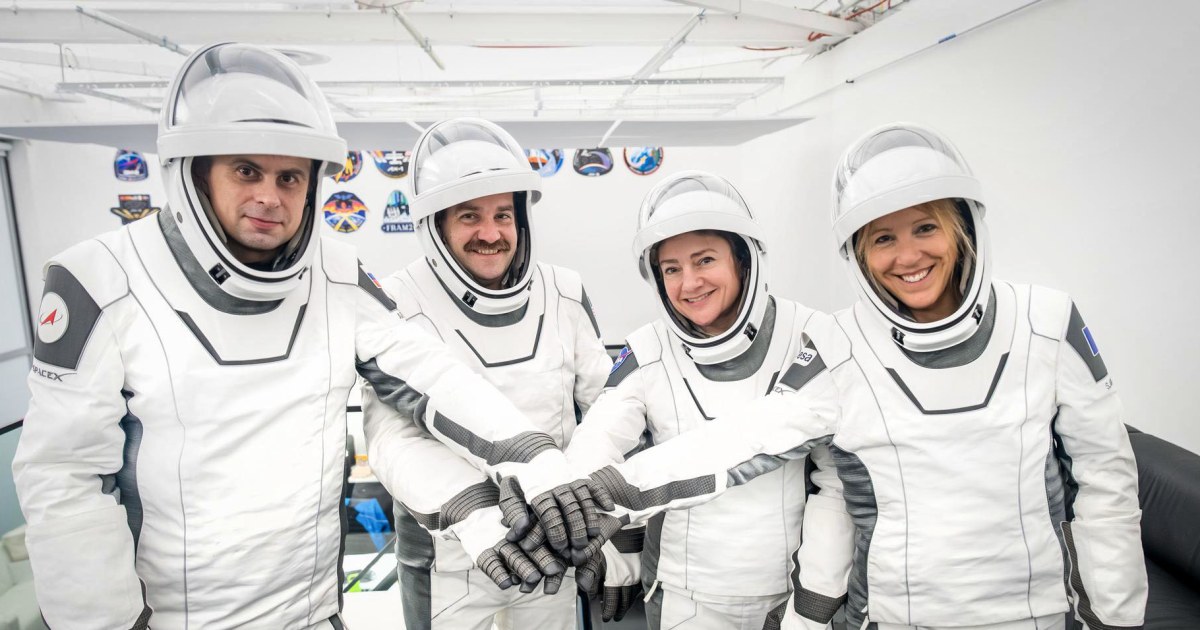
CAPE CANAVERAL, Fla. — Four astronauts rocketed toward the International Space Station early Friday morning, marking a key step in restoring full staffing to the orbiting laboratory after an unexpected early departure by the previous crew.
The launch of NASA's Crew-12 mission aboard a SpaceX Falcon 9 rocket lifted off at 5:15 a.m. ET from Cape Canaveral Space Force Station, carrying NASA astronauts Jessica Meir and Jack Hathaway, European Space Agency astronaut Sophie Adenot, and Russian cosmonaut Andrey Fedyaev. Their Dragon capsule is scheduled to dock with the space station around 3:15 p.m. ET on Saturday, bringing the outpost back to its standard seven-person occupancy.
The mission comes on the heels of the Crew-11 team's premature return to Earth on Jan. 14, prompted by a medical issue affecting one of its members. NASA has not disclosed the identity of the astronaut involved or the specifics of the incident, citing privacy concerns. As a result, the space station has been operating with a skeleton crew of just three: NASA astronaut Chris Williams and two Russian cosmonauts.
According to NASA officials, the reduced staffing has not led to any major operational problems during the interim period. In a briefing earlier this week, Dina Contella, deputy manager of NASA's International Space Station Program at the Johnson Space Center, emphasized the agency's deliberate approach to the launch timeline. “We’re looking forward to some extra helping hands, but we’ll launch when we’re ready,” Contella said.
The Crew-12 astronauts were originally slated to overlap with their predecessors for a smoother handover, but the early departure necessitated adjustments. High winds along the rocket's flight path earlier in the week forced NASA to scrub the launch twice, delaying it by two days. The agency closely monitors weather conditions during ascent, as they could impact emergency abort scenarios where the Dragon capsule would separate from the rocket and splash down along the East Coast.
Adding to the pre-launch scrutiny was a recent anomaly with a Falcon 9 rocket during an uncrewed Starlink satellite deployment mission on Feb. 2. That incident, which involved a mishap during flight, prompted SpaceX to pause operations while it and the Federal Aviation Administration conducted an investigation. Several days later, the FAA cleared SpaceX to resume launches, and a follow-up mission successfully deployed additional Starlink satellites with the rocket performing nominally.
NASA reviewed SpaceX's findings from the February event before approving the Crew-12 liftoff, ensuring the utmost safety for the human-rated mission. This marks the second spaceflight for Meir and Fedyaev, while Hathaway and Adenot are embarking on their first journeys beyond Earth.
Meir, a veteran of the station, previously spent 205 days aboard starting in July 2019. During that expedition, she teamed up with fellow NASA astronaut Christina Koch for the agency's first all-female spacewalk, a milestone in the history of space exploration. Koch, who was part of the Crew-11 team that returned early, is now assigned to NASA's Artemis II mission, slated for a potential launch as early as March 6. That flight will send four astronauts on a lunar orbit trajectory, paving the way for future crewed landings on the moon.
Fedyaev, the Russian cosmonaut, also brings prior orbital experience from a 2022 mission. Hathaway, a NASA astronaut selected in 2013, has prepared extensively for this debut, including simulations and training at various international facilities. Adenot, a French helicopter pilot and engineer selected by the ESA in 2022, represents the growing international collaboration on the space station program.
Once docked, the Crew-12 members will join Williams and the two Russian cosmonauts—whose identities were not specified in recent updates—for a comprehensive handover. The new arrivals are expected to stay aboard the station for approximately eight months, conducting a wide array of scientific research.
Among the experiments planned are investigations into food production in microgravity, studies on how weightlessness impacts blood flow in the human body, and medical research targeting pneumonia-causing bacteria. NASA describes these efforts as crucial for advancing technologies needed for future missions to the moon and Mars, while also yielding benefits for life on Earth, such as improved medical treatments and sustainable agriculture techniques.
The International Space Station, a partnership between NASA, Roscosmos, the European Space Agency, Japan, and Canada, has been continuously occupied since 2000. It serves as a unique platform for long-duration spaceflight research, helping to mitigate risks for deeper space exploration. The early return of Crew-11 highlighted the challenges of maintaining operations with fewer personnel, but officials noted that routine maintenance and experiments continued without interruption.
SpaceX's role in crewed missions has expanded significantly since the company's first NASA astronaut launch in 2020, reducing U.S. reliance on Russian Soyuz spacecraft. The Falcon 9 and Dragon system have now flown dozens of successful missions, though the February anomaly underscored the ongoing need for rigorous safety protocols in commercial spaceflight.
Looking ahead, the Crew-12 mission will contribute to NASA's broader Artemis program goals, including establishing a sustainable human presence on the moon by the end of the decade. As Meir and her crewmates prepare to settle in, they join a legacy of international cooperation in space, even amid geopolitical tensions on Earth.
The successful launch caps a week of anticipation for space enthusiasts and agency personnel alike. With the station poised to return to full strength, researchers can resume collaborative work that pushes the boundaries of human achievement in orbit.