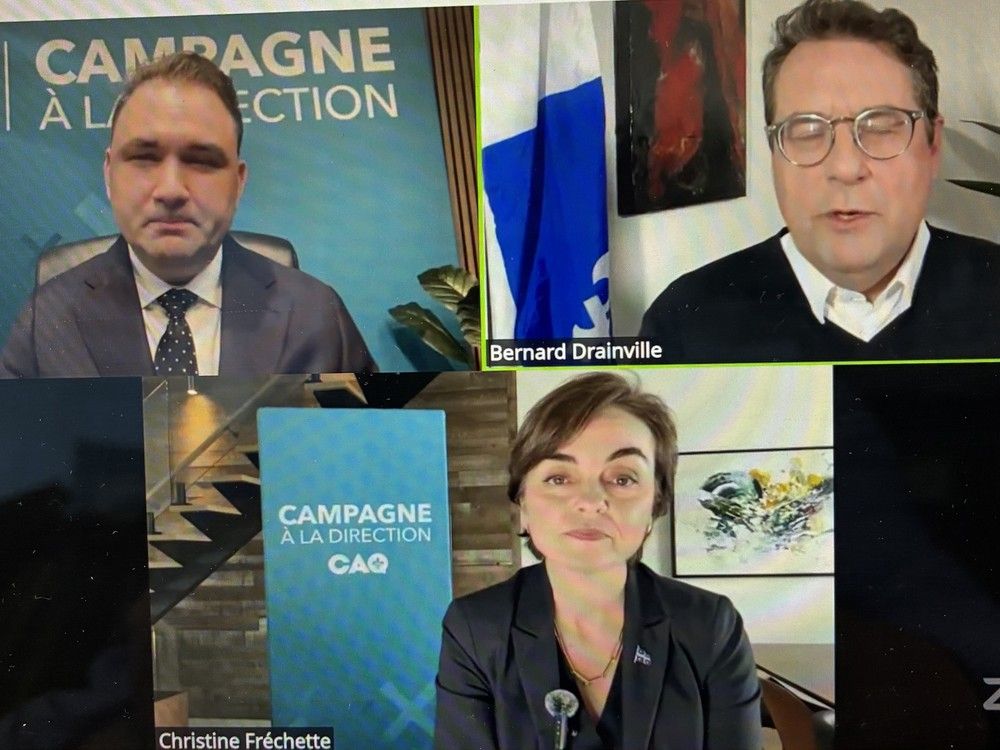
QUEBEC CITY — In a virtual forum hosted by the youth wing of Quebec's ruling Coalition Avenir Québec party, leadership contenders Christine Fréchette and Bernard Drainville firmly defended the province's strict secularism laws, vowing not to dilute them despite reports of job losses among school staff in Montreal.
The event, organized by the Commission de la Relève de la Coalition Avenir Québec, marked the first direct encounter between the two candidates in the ongoing leadership race. Fréchette, the former super minister of the economy, and Drainville, the ex-environment minister, fielded questions from young party members on a range of issues, from housing affordability to the party's future direction. The hour-long session, moderated by political analyst Dimitri Soudas — who once served as communications director for former Canadian Prime Minister Stephen Harper — remained notably civil, concluding with the candidates addressing each other by first names.
At the center of the discussion was Bill 94, the secularism legislation adopted by the CAQ government in October 2025. The bill expanded Quebec's ban on religious symbols in the workplace, previously limited to teachers and principals, to encompass all school employees who interact with students, including janitors and library volunteers. A grandfather clause had initially allowed existing staff to retain their symbols, but this protection was retroactively revoked when the bill was tabled, leading to immediate enforcement.
According to Radio-Canada reports, dozens of Montreal school staff have been fired or have resigned since the law's implementation, citing their refusal to remove religious symbols such as hijabs or turbans. When asked by the youth wing if these job losses amid Quebec's labor shortages warranted softening the law's application, both candidates stood resolute.
“I maintain the idea and the fact that people who do not respect this rule, unfortunately, will not be able to continue their professional activities,” Fréchette said. She emphasized that laicity — Quebec's term for state secularism — forms a core part of the province's values. “It’s important that this (law) be respected. Laicity is part of Quebec’s values, which must continue, and the application of Law 94 is part of it. I will maintain my position because the information (on the rules) was given a year ago and acquired rights are respected.”
Drainville, who as education minister had presented Bill 94 to the National Assembly, echoed her stance, framing the departures as personal choices rather than forced dismissals. “We voted for laws,” he said. “Now it’s important to ensure they are respected. You saw this week. Some women went public saying they were fired because they refused to withdraw their religious symbols. I say it’s a personal decision they took. They were not fired. They chose to lose their jobs.”
Pressed on whether the worker shortages might prompt a reconsideration, Drainville was unequivocal. “I have never backed away from anything under pressure,” he replied, underscoring his commitment to the policy even at the potential cost of essential labor in the education sector.
The candidates' positions align with the CAQ's broader platform of nationalism and economic development, which Fréchette described as the party's “essential DNA.” The leadership race itself stems from Premier François Legault's January announcement that he would step down, triggering a contest among party members to select his successor. With an estimated 15,000 CAQ members, including about 900 under age 30, the vote is scheduled for April 12, and the winner will automatically become Quebec's next premier.
Beyond secularism, the forum delved into youth-specific concerns. Relève president William Denis inquired how the candidates would assist young Quebecers in buying their first home. Fréchette proposed refunding the welcome tax — a municipal transfer duty — for first-time buyers, while Drainville outlined support for down payments to ease entry into the housing market.
Denis also sought commitments on youth representation in government, asking if either would appoint someone under 30 to the cabinet. Both Fréchette and Drainville affirmed they would, signaling an intent to incorporate younger voices into decision-making.
Looking ahead to the October general election, the candidates offered differing visions for the ballot box question. Fréchette framed it as a choice between nationalism and economic focus, arguing that the CAQ uniquely embodies both. “Do we want a nationalist government or an economic government?” she posed. “I think we need both at the same time. The only party which incarnates this is the CAQ.”
Drainville, meanwhile, highlighted stability amid external uncertainties, particularly from U.S. political developments. “I think it takes someone who has already faced storms, who can stay calm when things heat up and I have shown I can on a number of issues,” he said, positioning himself as a steady hand for the province.
The CAQ's current standing adds urgency to the race. Recent polls indicate the party is trailing in popularity, prompting divergent strategies from the candidates. Fréchette advocated for unity and fidelity to the party's pragmatic, nationalist roots. “I am committed to sticking to the DNA of the CAQ,” she stated, urging members to remain faithful amid challenges.
In contrast, Drainville called for renewal. “We have to shake things up,” he countered. “We can’t continue like before. We lost the confidence of many Quebecers and we need to shake things up.” This philosophical divide underscores the internal dynamics as the party seeks to regain momentum.
A recent poll by Pallas-Data-Qc125-L’Actualité revealed stark differences in candidate favorability among CAQ members. Fréchette enjoyed a 51 percent favorable rating, with only 24 percent viewing her unfavorably. Drainville, however, faced headwinds, with 24 percent favorable and 55 percent unfavorable opinions.
Fréchette has led the race to date, bolstered by her economic portfolio experience. She is set to appear Sunday on Radio-Canada's popular talk show Tout le monde en parle, continuing her campaign push. Two formal debates are planned: one on March 21 in Quebec City and another on March 28 in Laval.
Denis, speaking in an interview after the event, emphasized the youth wing's neutrality. “The members of the Relève have the right to vote and can do so as they wish,” he said. “The Relève commission as an entity will not take a position.” This hands-off approach allows individual young members to influence the outcome without organizational endorsement.
The forum's focus on secularism reflects ongoing debates in Quebec society, where Bill 94 builds on earlier laws like Bill 21, adopted in 2019, which barred public sector workers in positions of authority from wearing religious symbols. Critics, including human rights groups, have challenged these measures in court, arguing they discriminate against religious minorities, particularly Muslim women. Supporters, including the CAQ, maintain they protect the neutrality of the state and Quebec's cultural identity.
Quebec's labor market, strained by an aging population and post-pandemic recovery, has seen shortages in education and healthcare. The potential loss of workers due to secularism laws has fueled discussions about balancing values with practical needs, though neither candidate showed willingness to compromise.
As the April 12 vote approaches, the leadership race will shape not only the CAQ's internal cohesion but also its prospects in the fall election. With Fréchette's frontrunner status and Drainville's push for change, the party's direction — and Quebec's approach to secularism — hangs in the balance.