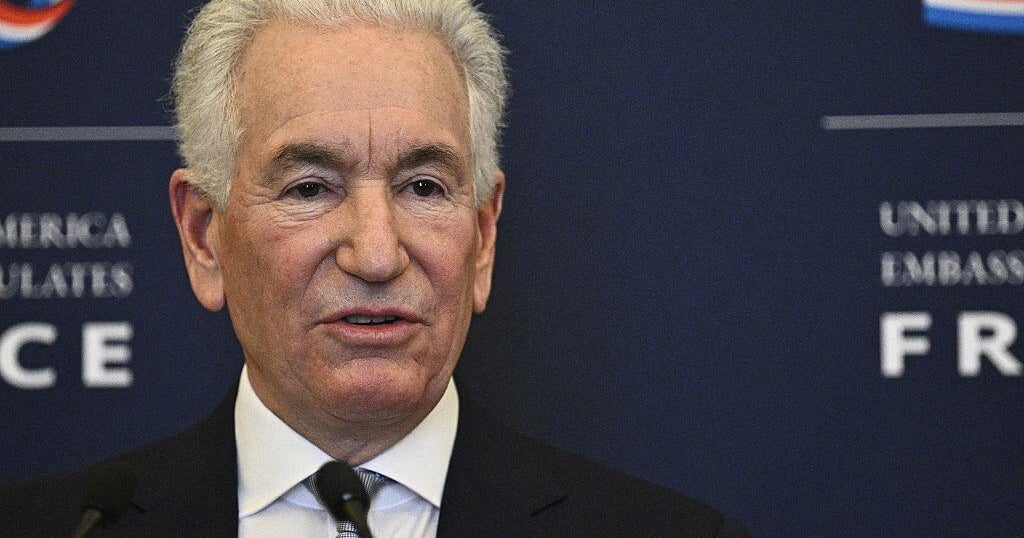
PARIS — France's foreign minister announced on Sunday that the country will summon U.S. Ambassador Charles Kushner to address pointed comments from the Trump administration regarding the death of a far-right activist in Lyon, escalating tensions between the two allies amid broader diplomatic frictions.
The decision comes in response to a statement issued by the U.S. State Department's Counterterrorism Bureau, which highlighted the killing of Quentin Deranque, a 28-year-old far-right activist who succumbed to brain injuries last week after a brutal beating. According to the State Department, "reports, corroborated by the French Minister of the Interior, that Quentin Deranque was killed by left-wing militants, should concern us all." The bureau further posted on X, formerly known as Twitter, that "violent radical leftism is on the rise and its role in Quentin Deranque's death demonstrates the threat it poses to public safety. We will continue to monitor the situation and expect to see the perpetrators of violence brought to justice."
Deranque's death occurred on the fringes of a student gathering in Lyon on October 10, where far-left lawmaker Rima Hassan was delivering a keynote address. Witnesses described the incident as erupting into a chaotic brawl between opposing political groups, with Deranque sustaining severe head trauma during the altercation. He was rushed to a hospital but died four days later from complications, prompting widespread outrage among far-right circles.
French Foreign Minister Jean-Noel Barrot, speaking to reporters in Paris, condemned the U.S. remarks as an unwelcome intervention. "We reject any instrumentalization of this tragedy, which has plunged a French family into mourning, for political ends," Barrot said. He added, "We have no lessons to learn, particularly on the issue of violence, from the international reactionary movement." Barrot's comments underscore France's sensitivity to foreign commentary on its domestic political violence, especially as the nation gears up for the 2027 presidential election.
The Lyon public prosecutor's office has moved swiftly in the investigation, handing preliminary charges to seven individuals involved in the incident. Six of the suspects face counts of intentional homicide, aggravated violence, and criminal conspiracy, while the seventh is charged with complicity in those offenses. Prosecutors have not yet released the identities of the accused or detailed their alleged affiliations, but initial reports suggest ties to left-wing activist networks. The investigation remains ongoing, with authorities examining surveillance footage and witness statements from the event.
Deranque's killing has ignited a powder keg of political divisions in France, where ideological clashes between far-left and far-right factions have intensified in recent years. On Saturday, approximately 3,000 demonstrators, many affiliated with far-right organizations, marched through Lyon's streets to honor Deranque, carrying banners decrying left-wing extremism. French President Emmanuel Macron, addressing the unrest, urged restraint in a statement released the same day. "In this moment of grief, we must come together to reject all forms of violence and uphold the values of the Republic," Macron said, according to his office.
The summoning of Ambassador Kushner marks the latest in a series of diplomatic spats between Paris and Washington under the Trump administration. Kushner, the father of President Donald Trump's son-in-law Jared Kushner, has been a polarizing figure in his role. This will be the second time France has called him in for a formal protest; in August 2024, he was summoned over a public letter to Macron accusing France of inadequate efforts to combat antisemitism.
In that earlier incident, Kushner's letter claimed that rising antisemitic incidents in France were being downplayed by the government. France's Foreign Affairs Ministry rejected the allegations outright, stating they "run counter to international law." The ministry further noted that such accusations "fall short of the quality of the transatlantic partnership between France and the United States and of the trust that must prevail between allies." Kushner did not attend the scheduled meeting, prompting French officials to convene instead with a representative from the U.S. embassy.
Macron addressed the matter directly during a September 2024 appearance on CBS's "Face the Nation" with Margaret Brennan. He criticized Kushner's public approach, saying it was "out of line" for an ambassador to level such charges openly. "So either you are a person who wants to express freely," Macron remarked. "If you are a diplomat, you have to follow the rule of diplomacy. … The [American] taxpayer money is not properly used to finance this kind of statement." Macron emphasized that a French ambassador would never make comparable public criticisms of the U.S., as it could jeopardize bilateral relations.
Beyond the Deranque case, Barrot indicated that the upcoming meeting with Kushner will cover additional grievances, including recent U.S. sanctions imposed on two prominent French figures. Among them is Thierry Breton, a former European Union commissioner who oversaw social media regulations, and Nicolas Guillou, a judge at the International Criminal Court. Barrot described the sanctions as "unjustified and unjustifiable," arguing they interfere with European sovereignty and international judicial processes. The French Foreign Affairs Ministry has not specified a date for the summons, but sources suggest it could occur as early as this week.
The sanctions on Breton and Guillou stem from U.S. actions targeting individuals perceived as overly restrictive toward American tech firms. Breton, in particular, clashed with platforms like X over content moderation policies during his tenure. Guillou's role at the ICC has drawn U.S. ire amid ongoing investigations into alleged war crimes, including those involving American interests. French officials view these measures as politically motivated, further straining the NATO alliance at a time when global challenges like the war in Ukraine demand unity.
Analysts point to a pattern of friction since Trump's return to the White House in January 2025, with the administration's "America First" doctrine occasionally clashing with European priorities. The State Department's comments on Deranque's death, for instance, align with Trump's vocal criticisms of left-wing movements worldwide, from campus protests in the U.S. to street actions in Europe. Yet, French authorities have pushed back, insisting that domestic security matters are best handled internally.
The broader context of political violence in France adds urgency to the dispute. Deranque was known for his involvement with Generation Identitaire, a now-dissolved far-right group that advocated for stricter immigration controls. His death has fueled narratives among conservatives that left-wing radicals are increasingly emboldened, a claim echoed by the U.S. State Department. Conversely, left-leaning voices, including Hassan's allies, have portrayed the Lyon incident as a spontaneous clash rather than targeted extremism, though they condemn the violence.
As the summons looms, both sides appear intent on de-escalating while asserting their positions. U.S. officials have not yet responded to Barrot's announcement, but a State Department spokesperson told reporters late Sunday that the bureau stands by its assessment of the Deranque case. "Our goal is to promote accountability for acts of terrorism and violence, wherever they occur," the spokesperson said. In Paris, diplomats are preparing briefing materials, hoping the meeting fosters dialogue rather than deepening the rift.
Looking ahead, the incident underscores the delicate balance in U.S.-France relations, forged through decades of cooperation but tested by ideological differences. With France's political landscape heating up ahead of the presidential race, and Trump's administration eyeing its own midterm battles, such episodes could foreshadow more transatlantic turbulence. For now, all eyes are on the Quai d'Orsay, where the summons will unfold, potentially reshaping the tone of alliance talks in the months to come.