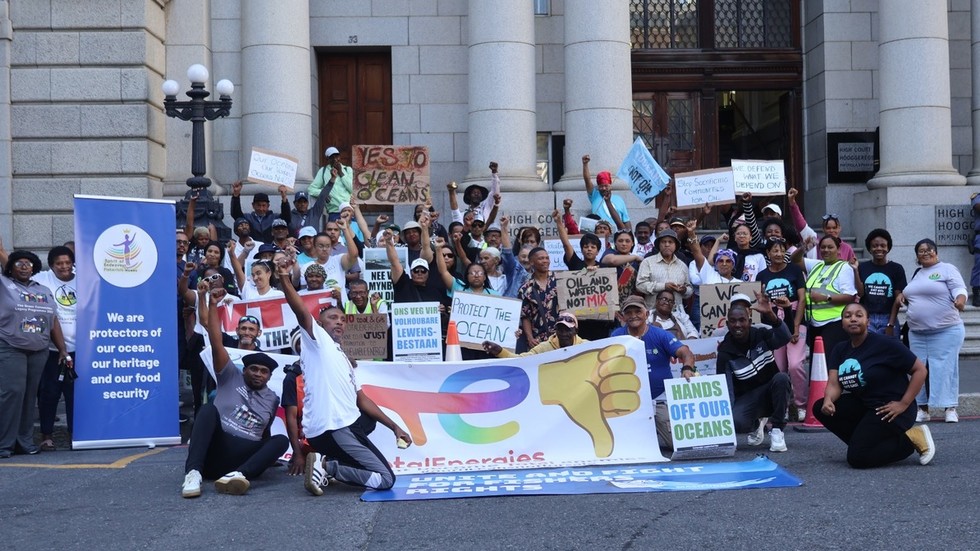
Johannesburg Court Reserves Judgment in Challenge to TotalEnergies' Offshore Drilling Plans Off South Africa's Coast
A South African court has reserved judgment in a high-stakes legal battle over French energy giant TotalEnergies' proposed deep-water oil and gas exploration project, as environmental activists and fishing communities argue that the approval process was flawed and poses severe risks to marine ecosystems and local livelihoods.
The case, heard in the Western Cape High Court in Cape Town, pits a coalition of plaintiffs—including the Aukotowa Fisheries Primary Co-operative Limited, The Green Connection, and Natural Justice—against the Director-General of the Department of Mineral Resources and Energy, the Minister of Forestry, Fisheries and the Environment, and TotalEnergies Exploration and Production South Africa (TEEPSA). The dispute centers on environmental authorization granted for drilling in the ultra-deep waters of the Deep Western Orange Basin, located approximately 200 kilometers off South Africa's west coast in the Atlantic Ocean.
According to court documents and arguments presented during the proceedings, the plaintiffs contend that the approval process violated South Africa's Constitution, the National Environmental Management Act (NEMA), and the country's international climate commitments. They argue that the assessments failed to adequately address the project's "need and desirability" as well as the catastrophic risks of oil spills, which could devastate marine life and fishing industries reliant on the region's waters.
"There are predictable, long-term ecological impacts that go along with petroleum projects," the plaintiffs stated in their submissions, emphasizing how the interests of multinational corporations appear to supersede the rights of coastal communities. The Aukotowa Fisheries co-operative, representing small-scale fishers from the Northern Cape and Western Cape provinces, highlighted the potential disruption to their livelihoods, noting that an oil spill could render fishing grounds unusable for years.
The legal challenge seeks not only to review and set aside the Director-General's decision to grant the environmental authorization but also the Minister's dismissal of prior appeals against it. In a bold request, the applicants have urged the court to issue a rare substitution order, directly refusing the authorization rather than remanding the matter back to the department for reconsideration.
"Because the flaws in the need and desirability and oil spill risk assessments are so fundamental to the project’s viability, we are asking the Court to take the rare step of a substitution order," the plaintiffs argued in their heads of argument. "This means that instead of sending the matter back to the Department of Mineral Resources and Energy to try again, the Court should itself issue an order refusing the authorisation. This is necessary to ensure that the environment and the rights of the fishers are protected from further unlawful administrative processes."
Central to the plaintiffs' case is the acknowledged risk of a major oil spill from a "well blow-out," which they describe as the most significant hazard of the exploration activities. Court filings note that such an event could be "catastrophic," leading to the effective destruction of the marine environment for a sustained period.
"Because the consequence of an oil spill would be the effective destruction of the marine environment for a sustained period, this risk has a bearing on multiple aspects of the impact assessment," the applicants submitted. "The impact on marine ecology, commercial and small-scale fisheries, coastal and near-shore users and intangible heritage was in every case estimated as ‘high’ or ‘very high.’”
These concerns are amplified by South Africa's recent history of environmental controversies in the energy sector. The country, heavily reliant on coal for more than 80 percent of its electricity, has been pushing toward renewable energy sources amid global climate pressures and domestic energy crises, including rolling blackouts known as load-shedding that have plagued the economy since 2007. Critics of fossil fuel projects like TotalEnergies' argue that new offshore drilling contradicts South Africa's commitments under the Paris Agreement and its own Nationally Determined Contributions, which aim to peak greenhouse gas emissions by 2025 and reduce them thereafter.
TotalEnergies, a Paris-based multinational with operations in over 130 countries, discovered potentially significant reserves in the Orange Basin in 2022 through its Brulpadda and Luiperd prospects. The company has touted the project as a potential game-changer for South Africa's energy security, estimating recoverable resources could exceed 1 billion barrels of oil equivalent. However, the firm maintains that its environmental impact assessments complied fully with national regulations.
During the court hearing on Tuesday, Advocate Chris Loxton, representing TEEPSA, defended the approval process, drawing a clear distinction between exploration and production phases under NEMA and the National Environmental Management: Integrated Coastal Management Act (ICMA). He argued that adherence to NEMA inherently satisfied ICMA requirements, countering the plaintiffs' claims of procedural lapses.
"The Applicants have not shown that there is any requirement of ICMA which was not in the course of complying with NEMA," Loxton said. "They have not said, for example, that you were supposed have done X and the consequence is Y." Loxton's submissions emphasized that the exploration activities, which involve seismic surveys and initial drilling without full-scale production, were appropriately evaluated for risks, including spill prevention measures aligned with international standards.
The case unfolds against a backdrop of growing activism in South Africa, where communities affected by mining and energy projects have increasingly turned to the courts to enforce environmental protections. Similar challenges have targeted other fossil fuel initiatives, such as the proposed Thacker Pass lithium mine in the United States or gas projects in Mozambique's Rovuma Basin, where TotalEnergies also holds interests. In South Africa, the 2021 High Court ruling against a coal-fired power plant in Mpumalanga province set a precedent for scrutinizing the "just transition" away from carbon-intensive energy.
Environmental groups like The Green Connection, an NGO focused on sustainable development, have linked the TotalEnergies case to broader inequities. "Fishing communities and the impact of exploration on their livelihoods" have been central to their advocacy, with reports indicating that the Orange Basin supports over 20,000 jobs in the fisheries sector, contributing around R6 billion annually to the economy, according to the Department of Forestry, Fisheries and the Environment.
Natural Justice, a human rights organization specializing in environmental law, has provided legal support to the plaintiffs, arguing that the project's approval process marginalized indigenous knowledge and failed to conduct meaningful public participation, particularly for remote coastal communities. The department and ministry have not issued public statements on the ongoing litigation, but officials previously defended the authorization as rigorous and science-based.
As judgment is reserved—meaning the presiding judge will deliberate before issuing a ruling, potentially in the coming weeks or months—the outcome could have ripple effects. A victory for the plaintiffs might halt the project and embolden similar challenges across Africa, where offshore drilling is expanding amid the global energy transition. For TotalEnergies, which reported $219 billion in revenue last year, the decision could delay or derail its African expansion plans, particularly as the company pledges to reach net-zero emissions by 2050.
Supporters of the project, including some industry analysts, argue that responsible exploration could bolster South Africa's economy, which grew by just 0.6 percent in 2023 amid energy shortages. Yet, with climate scientists warning of rising sea temperatures and ocean acidification threatening the Benguela Current ecosystem—home to sardines, hake, and other commercially vital species—the stakes extend far beyond the courtroom.
In the interim, the plaintiffs continue to rally support, with petitions circulating online and community meetings held in fishing villages like Hondeklipbaai and Port Nolloth. Whether the court will substitute its judgment for the government's remains to be seen, but the case underscores the tension between energy ambitions and ecological imperatives in a nation at the forefront of the global fight against climate change.