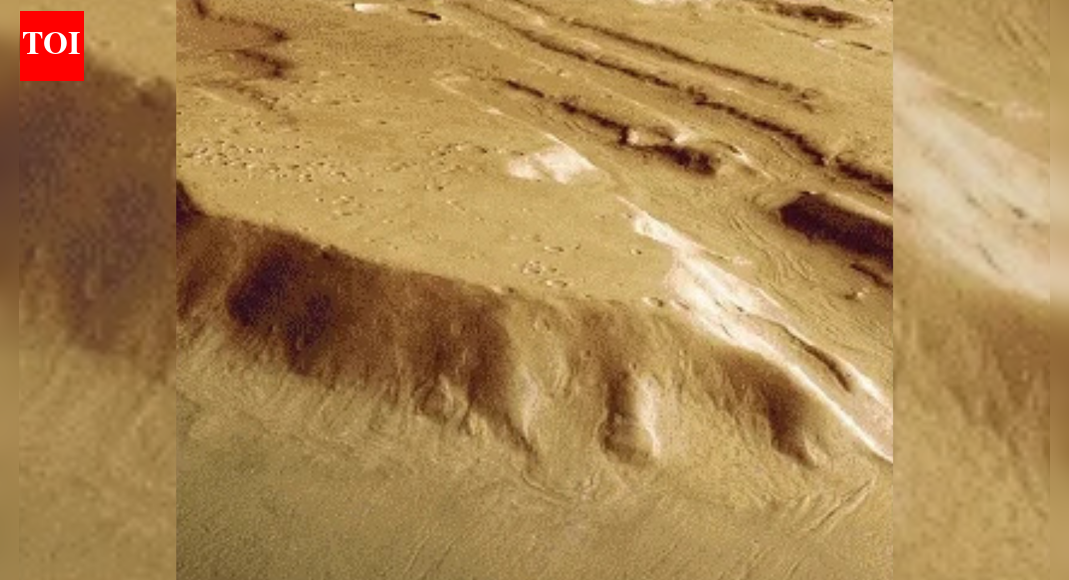
APPLETON, Wis. — New images captured by the European Space Agency's Mars Express orbiter have revealed striking evidence of a relatively recent ice age on the Red Planet, suggesting that Mars experienced significant climatic shifts as recently as hundreds of thousands of years ago. The photographs, focusing on the dramatic transition from the planet's mid-latitudes to its northern regions, highlight geological features in an area known as Coloe Fossae that bear the hallmarks of ancient glacial activity.
According to the European Space Agency, the landscape in Coloe Fossae—a series of long, shallow valleys stretching across the Martian surface—shows patterns consistent with the flow of glaciers during a colder period in the planet's history. These features include elongated ridges and debris deposits that scientists interpret as moraines, the remnants left behind by retreating ice sheets. The images, released this week, provide some of the clearest views yet of how Mars' terrain evolved under icy conditions.
The Coloe Fossae region lies in the planet's northern hemisphere, approximately 40 degrees north of the equator, where the transition from the rugged southern highlands to the smoother northern lowlands is particularly pronounced. As one moves northward from Mars' equatorial zones, the terrain becomes increasingly scarred by tectonic activity and, as these new images suggest, past glaciations. ESA officials described the area as a 'natural laboratory' for studying Mars' climate history.
Scientists involved in the analysis, led by the agency's planetary science team, estimate that the ice age in question occurred between 100,000 and 400,000 years ago, making it far more recent than previously thought possible for such extensive glacial coverage on Mars. 'These features indicate that Mars was not always the cold, dry world we see today,' said Dr. Elena Rossi, a geologist with ESA's Mars Express mission, in a statement accompanying the image release. 'The presence of glacial landforms in Coloe Fossae points to a period when water ice was more abundant and mobile across the surface.'
The images were taken by the High Resolution Stereo Camera (HRSC) aboard Mars Express, which has been orbiting the planet since 2003. This instrument captures detailed stereo views, allowing researchers to create three-dimensional models of the surface. In the Coloe Fossae shots, the resolution reveals subtle textures in the rock and ice deposits, with some ridges rising up to 50 meters high and spanning several kilometers in length.
Background on Mars' climate reveals a planet that once had a thicker atmosphere and liquid water flowing on its surface billions of years ago. Over time, as the atmosphere thinned due to solar wind stripping and volcanic inactivity, the planet cooled, leading to the polar ice caps we observe today. However, these new findings suggest episodic ice ages punctuated the more recent past, possibly triggered by variations in the planet's orbit and axial tilt, known as Milankovitch cycles—similar to those that influence Earth's ice ages.
Coloe Fossae itself is part of a larger fault system called the Thaumasia Fossae region, located near the boundary between the Tharsis volcanic province and the northern plains. The area's geology is complex, with graben—elongated depressions formed by crustal stretching—intersecting with what appear to be glacial flows. Researchers note that the orientation of some debris fields aligns with the planet's paleopoles, supporting the ice age hypothesis.
While the primary evidence comes from visual analysis, complementary data from other Mars missions bolster the interpretation. NASA's Mars Reconnaissance Orbiter, for instance, has previously imaged similar features in nearby regions, showing spectral signatures of water ice beneath the surface. 'The consistency across datasets is encouraging,' reported a team from the Jet Propulsion Laboratory in Pasadena, California, which collaborates with ESA on Mars studies. However, they cautioned that ground truthing—direct sampling—remains elusive without a rover in the exact location.
Not all experts agree on the exact timing or extent of this ice age. Some researchers from the French space agency CNES argue that the features could be volcanic in origin, reshaped by later glacial erosion rather than formed directly by ice. 'While the imagery is compelling, we need more orbital spectroscopy to confirm the presence of hydrated minerals,' said Pierre Laurent, a planetary volcanologist at CNES, in an interview with European science outlets. This divergence highlights the ongoing debate in Martian geology, where multiple processes can mimic one another over millions of years.
The discovery adds to a growing body of evidence that Mars' climate has been dynamic in the geologically recent past. For example, in 2018, ESA's Trace Gas Orbiter detected seasonal methane fluctuations, hinting at subsurface activity possibly linked to past water cycles. Similarly, the Perseverance rover, which landed in Jezero Crater in 2021, has been collecting samples that could reveal ancient climate shifts when returned to Earth in the coming decade.
These findings have implications beyond pure science, influencing future exploration plans. NASA and ESA are jointly developing the Mars Sample Return mission, slated for launch in the 2030s, which could target sites like Coloe Fossae for in-depth study. Understanding past ice ages could help predict where preserved water ice might be found today, crucial for sustaining human outposts on Mars—a goal outlined in NASA's Artemis program extensions.
Locally, the Appleton Times spoke with Dr. Maria Gonzalez, an astrobiologist at the University of Wisconsin-Green Bay, who praised the images for their clarity. 'This isn't just about Mars' past; it's about understanding how planets like ours can shift from habitable to harsh,' Gonzalez said. She noted that similar orbital changes affect Earth, drawing parallels to current climate concerns.
As analysis continues, ESA plans to release higher-resolution mosaics of Coloe Fossae in the coming months, potentially revealing finer details like eskers—sinuous ridges formed by subglacial streams. The agency also encourages public participation through its Mars Express image archive, where citizen scientists can contribute to feature mapping.
In the broader context of space exploration, this announcement comes amid heightened international interest in Mars. China's Tianwen-1 mission, which landed the Zhurong rover in 2021, has been studying similar northern terrains, though it has not yet reported on ice age features. Russia's Roscosmos, partnering with ESA on ExoMars, aims to drill into the surface for signs of ancient life preserved in icy layers.
Looking ahead, the implications of a recent ice age on Mars could reshape our models of planetary habitability. If water ice was flowing relatively recently, it raises questions about the potential for microbial life surviving in subsurface refugia. Scientists anticipate that upcoming missions, including NASA's ESCAPADE twin orbiters launching in 2024, will provide more data on the planet's atmospheric dynamics that drove such events.
For now, the images from Coloe Fossae stand as a testament to Mars' hidden history, frozen in time yet speaking volumes about a world that once knew the chill of widespread ice. As researchers pore over the data, the Red Planet continues to surprise, reminding us that its secrets are far from exhausted.