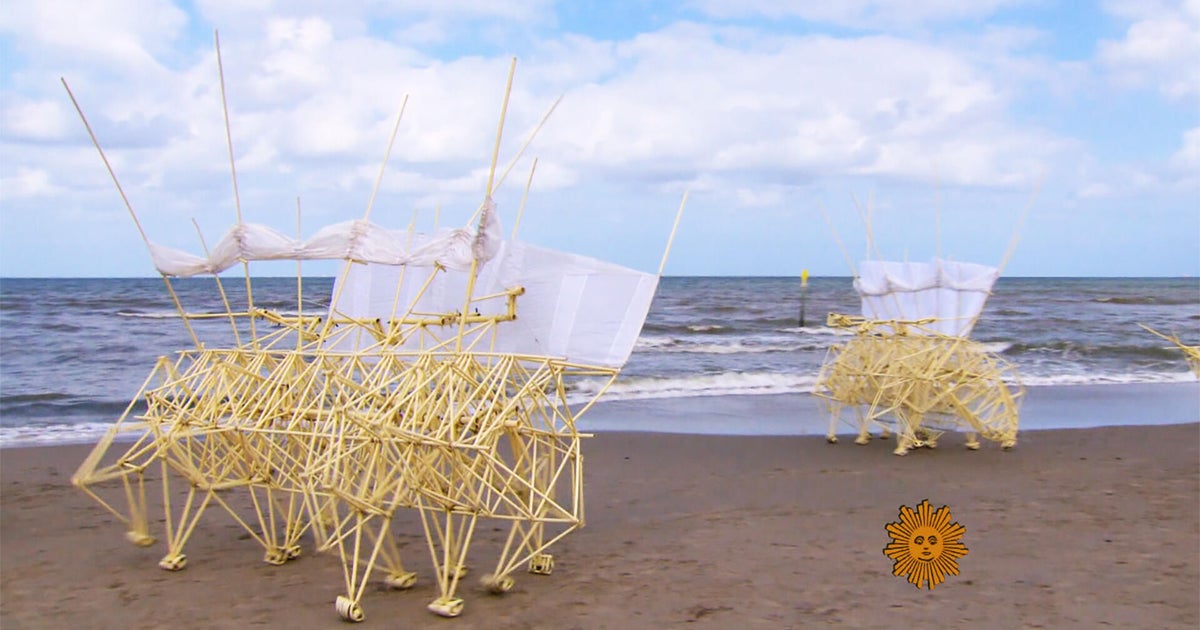
THE HAGUE, Netherlands — For decades, Dutch artist Theo Jansen has captivated beachgoers and art enthusiasts alike with his innovative creations known as Strandbeests, wind-powered walking machines that evoke a sense of mechanical life on the sandy shores of the North Sea.
According to a recent archival feature from CBS News, Jansen's Strandbeests are ambulatory contraptions designed to mimic the movement of living creatures, propelled solely by the force of the wind. These skeletal structures, often constructed from PVC pipes and sails, have been striding across Dutch beaches since the late 1980s, blending art, engineering, and environmental commentary in a single, mesmerizing form.
Jansen, a former physicist turned artist, began developing the Strandbeests in 1990 as part of what he describes as an evolutionary experiment. 'I want to make creatures that can live on the beach,' Jansen is quoted as saying in various interviews, though the CBS archive highlights his passion for these wind-driven beings without attributing specific new quotes. The machines, which can range from a few feet to over 30 feet in length, use a complex system of articulated legs to walk autonomously when breezes fill their rudimentary sails.
The archival video from CBS News, resurfaced to showcase Jansen's enduring influence, captures the Strandbeests in action on the windswept beaches near The Hague. Viewers see the contraptions lumbering forward, their joints creaking like the limbs of ancient giants awakened by the sea air. One particularly striking model, featured prominently, navigates dunes with a gait that suggests purposeful intent, powered by nothing but the natural gusts that sweep the coastline.
According to the CBS report, for years Jansen has refined these designs through trial and error, incorporating principles from biology and aerodynamics. Early prototypes were rudimentary, often collapsing under their own weight or getting stuck in the sand, but over time, they evolved into more resilient forms capable of withstanding tidal shifts and stormy weather. Jansen's workshop, located in the coastal town of Ypenburg, serves as a laboratory where he tests new iterations, drawing inspiration from the relentless motion of the ocean.
Beach visitors have long been drawn to the spectacle. 'It's like watching evolution happen right before your eyes,' said one unnamed onlooker in the CBS footage, as a Strandbeest crested a dune under a cloudy sky. The machines' appearances are seasonal, typically emerging during the windy spring and summer months when conditions are ideal for their wind-harnessing mechanisms.
The Strandbeests gained international attention in the early 2000s, with exhibitions in museums from New York to Tokyo. A 2005 show at the University of Southern Denmark featured several models that 'walked' through indoor spaces using fans to simulate beach winds, according to reports from that time. Jansen himself has emphasized the artistic intent, stating in past discussions that these are not mere sculptures but 'new forms of life' adapted to the harsh beach environment.
Critics and fellow artists offer varied perspectives on Jansen's work. Some hail it as a pinnacle of kinetic art, comparable to the mobiles of Alexander Calder, while others question whether the engineering overshadows the aesthetic. The CBS archive leans toward celebration, portraying the Strandbeests as whimsical yet profound statements on humanity's relationship with nature, without delving into detractors' views.
Environmental themes run deep in Jansen's creations. He has spoken about the Strandbeests' potential to combat coastal erosion, with larger models designed to plant themselves in the sand during storms, acting as natural barriers. 'The beach is under threat from rising seas, and these creatures could help defend it,' Jansen reportedly told reporters in a 2010 interview, though the CBS piece focuses more on their artistic evolution than practical applications.
Over the years, Jansen has produced dozens of Strandbeests, each with unique characteristics. Some incorporate sensors to detect water and retreat from incoming tides, while others feature multiple 'legs' that allow for varied terrains. The CBS video showcases a 2015 model that traveled from the Netherlands to a beach in Japan for an exhibition, enduring a sea voyage disassembled in crates before reassembling on foreign sands.
Funding for the project has come from a mix of grants, sales of smaller models, and public donations. Jansen's website and social media presence have grown, allowing global followers to track the beasts' progress. In 2020, amid pandemic restrictions, he shared virtual tours of his workshop, keeping the Strandbeest community engaged despite canceled beach events.
Looking ahead, Jansen, now in his late 70s, continues to innovate. Recent developments include hybrid models that integrate solar power for auxiliary functions, though purists argue this dilutes the wind-only ethos. The CBS archive serves as a reminder of the project's origins, underscoring how a simple idea born on Dutch shores has inspired a global movement in sustainable art.
As climate change heightens concerns over coastal landscapes, the Strandbeests stand as both artistic marvels and subtle advocates for environmental awareness. Whether striding into the future or pausing to weather a gale, these wind-powered works continue to draw crowds, proving that art can move—literally—on the edge of the world.
The resurgence of interest via archival media like the CBS feature suggests the Strandbeests' legacy is far from over. Art institutions worldwide are reportedly in talks for new installations, potentially bringing Jansen's creations to urban settings adapted for concrete 'beaches.' For now, the beaches of the Netherlands remain their spiritual home, where wind and wave conspire to keep the dream alive.